


Today we’d like to introduce you to Matt Kennedy.
Matt, let’s start with your story. We’d love to hear how you got started and how the journey has been so far.
I’ve actually been selling art since elementary school. I probably first traded one of my own drawings for a bag of chips or a pack of Kiss trading cards, then got a quarter here and a dollar there for caricatures of teachers (which got me in trouble) and in junior high school I bought a classmate’s rather detailed Thanksgiving illustration of a turkey at the guillotine–which I still own.
By high school, I was buying and selling comic books and original comic book art, which funded my move (and then my survival) when I first came to Los Angeles. I got a job at the comic shop that bought my collection, and soon afterwards I filled out an application at the Soap Plant on Melrose and got hired to work at La Luz de Jesus Gallery upstairs. That was an incredible education. At that time there was really no place else like it.
Someday the city of Los Angeles will build a statue of Billy Shire for his cultural contributions because when you look at the 1990s–at what was on television and in magazines and in movies, a lot of that is the influence of Soap Plant, Wacko, and La Luz de Jesus. And personally, so much of me comes from that time and place. It was so cheap to live in LA back then that I could work a minimum wage job (well, really several entry-level jobs) and still manage to buy art and pay my bills.
Being there for that first explosion of what would become known as pop surrealism gave me a front-row seat at the epicenter of pop culture. Everybody walked into that place, from Axl Rose to Elton John, William Burroughs, and Charles Bukowski and one day Mel Brooks walked in and literally changed my life. I was manning the register and he popped in and asked me to be in a commercial he was shooting down the street.
That led to a half-dozen lucrative years of acting, which evolved into licensing, writing about, and producing films. If you view film as art, which I absolutely do, I’ve had a consistent career in this for more decades than I care to admit.
When I came back to run La Luz de Jesus Gallery in 2009, it was a homecoming of sorts, and by the time I left in 2018 to focus on Gallery 30 South it closed out the longest tenure of any director by far. Just being part of a club with people like Robert Lopez and Alix Sloan in the stewardship of that legacy was an incredible honor.
Has it been a smooth road?
In my experience, very few things worth having come easy, but struggle is relative. I was homeless for a bit and did a lot of couch surfing in the early days. There were nights when I didn’t have a place to stay but was too proud to let anyone know, and I would sleep in hotel lobbies, clutching my guitar case until the desk clerks realized I wasn’t waiting for anyone and chased me out.
I worked a twelve-hour shift at that comic shop, and then four hours bar-backing at a nightclub, and there was a period of almost a year with no days off at all. Like most people in their twenties, I ate a lot of instant ramen and peanut butter and extra value meals. But it didn’t seem all that bad. When I look back on it now, I’m amazed I’m still alive, but when I was young, I had an oblivious fearlessness and a lot of dumb luck.
We’d love to hear more about your business.
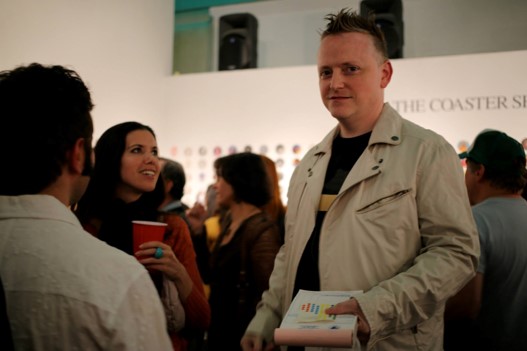
Gallery 30 South is ostensibly a fine art gallery, part cultural hub, and part clubhouse–as it frequently hosts impromptu film screenings (we have a 4K projector), live model paint-and-draw classes, and wine and whisky tastings. It’s also an atelier space for my wife’s award-winning and museum-exhibited jewelry line, Adnohia. Our specialty is that we don’t really specialize.
There is definitely a thread that runs through our exhibitions, but it’s not incredibly obvious and it’s really deeply rooted in our personal taste as artists and collectors. We’ve shown abstract expressionism, figurative, narrative comic art, and interactive, audio-visual and sound installations. We’ve completely transformed the space into prison for Donald Trump with Indecline, and into an all-cardboard 19th-century Belgian art studio with Dosshaus.
I gave Chuck D his first-ever solo exhibition, and I’m the only gallerist that Frances Bean Cobain will work with. I’ve worked with national treasures like Shigeru Idei (Japan), and Torben Ulrich (Denmark), and we’ve got a mother-and-daughter show this summer with Ryuhow & Koko, the latter of whom is making her solo debut at the age of 12.
I’m most proud of giving Lydia Breckenridge her first-ever art exhibition, African American Punk Rock Quilts, and getting her international news coverage for her extraordinary work that she didn’t think belonged in an art gallery.
Pretty soon I’ll also be getting credit for discovering Linda Aronow, whose live concert photos documenting the Los Angeles punk and post-punk scene will be getting published in multiple volumes.
Is our city a good place to do what you do?
When I first moved out here my rent was $168, sharing a one bedroom with my best friend from Kindergarten. That was less than thirty years ago. That provided a lot of time to try and fail. Los Angeles is now the second or third most expensive city to live in the USA, so it’s evolved into the city of the side-hustle. If you are an actor or any kind of performer or comedy writer, I think you have to live here, but you need a lot more infrastructure than you used to.
LA county has some of the best city colleges for art, so you don’t need to spend a fortune at a private art school to learn your craft. If your aim is to teach, you can get your undergrad degree at a cheap, local school with a great program and then work to afford your masters at a prestigious diploma mill. I read a while back that the population of Delaware moves to California every year. It didn’t elaborate about how many of them move back or how soon, but it doesn’t seem like a lot.
I can’t complain about the traffic because I can literally throw a baseball from my apartment to my gallery–and I’m no Suzuki Ichiro, but traffic does make my mind up for me about not going to other people’s events quite frequently, which means that other people are making similar choices about coming to see me. Culturally, it’s hard to find a city anywhere else on earth that embraces its diversity as much as Los Angeles, and the food is incredibly underrated.
As a kid from Lynn, MA– a place of few options but great character, Los Angeles is my adopted home. I truly love it here, and I embrace the opportunities I’ve been given and those I’ve earned, and I do my best to encourage whoever else I can to live their dream. Los Angeles is definitely a city of dreams.
Pricing:
- Our annual coaster show features 1,000 original artworks priced between $0 – 250.
- Our monthly (2nd Friday) live-model paint & draw is only $20 for three hours ($18 if you buy in advance).
- A one of a kind, Giger-esque bejeweled bone-and-silver, ermine skull ring by Ai Kennedy will run you a little over $200.
- Unique, remixed album covers by Panik Collective are $250 for a digital proof and start at $4k for a 4×4′ painted canvas.
- Riccardo Mayr’s painting of Darth Vader on a damaged 16th century Guido Reni school canvas was priced $40,000.
Contact Info:
- Address: 30 S. Wilson Ave. Pasadena, CA 91106
- Website: www.gallery30south.com
- Phone: (323)547-3227
- Email: info@gallery30south.com
- Instagram: @gallery30south
- Facebook: https://www.facebook.com/gallery30south/
- Twitter: @gallery30south
- Yelp: https://www.yelp.com/biz/gallery-30-south-pasadena
- Other: www.popsequentialism.com

Image Credit:
Eric Minh Swenson, Lee Joseph
Getting in touch: VoyageLA is built on recommendations from the community; it’s how we uncover hidden gems, so if you know someone who deserves recognition please let us know here.
Popular
-

Que Johnson on Building Brands That Last: From Visibility to True Market Authority
-

Christina Wren Steps Into the Director’s Chair to Tell Stories That Feel Like Home
-

Portraits of the Valley
-

LA’s Most Inspiring Stories
-

JordanL on ‘Breathe,’ Belief, and Building a Movement Beyond the Music
-

Megan Birney Rudert on How Access to Light Is Powering a More Sustainable and Equitable Future