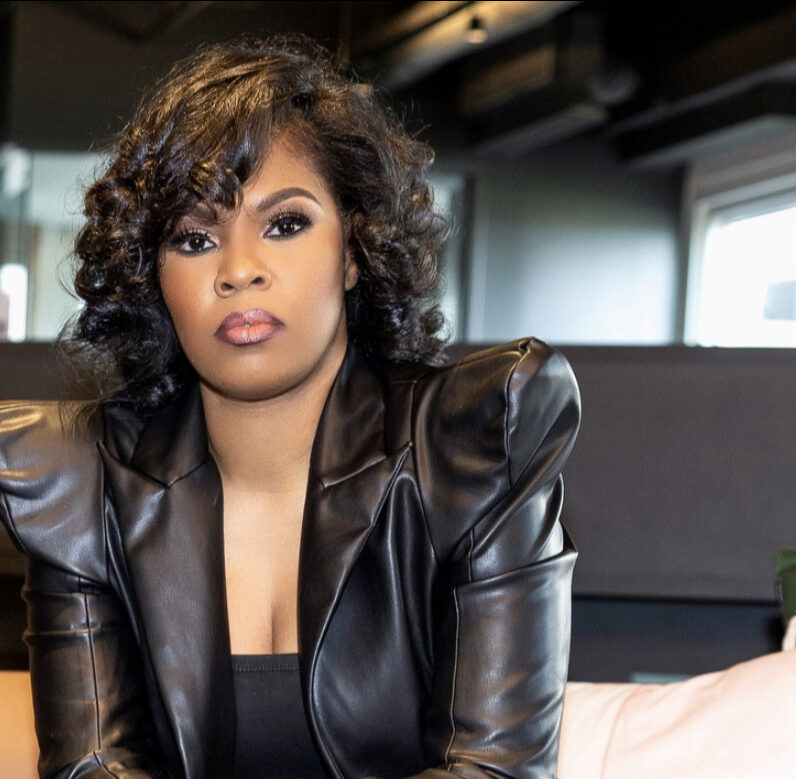
Que Johnson has built her career on a powerful distinction many businesses overlook: the difference between being seen and being known. From launching The Purple Girl Show in her bedroom to leading a national agency, her journey has been shaped not by perfect timing, but by proven results and the demand for her insight. As a self-described “Brand Surgeon,” Johnson goes beyond surface-level strategy — helping clients align their internal clarity with external messaging to create brands that truly connect and convert. Her work extends beyond business success into community impact, where she focuses on creating access, ownership, and long-term opportunity in underserved spaces. Now, through her expansion into tech with F.T.N Generations, she’s positioning brands for a future where visibility alone isn’t enough — clarity, adaptability, and intelligent integration across platforms will define lasting success.
Que, you’ve built your career around the idea of brand longevity. What do you think most businesses get wrong when they focus on short-term visibility over long-term impact?
One of the biggest mistakes I see businesses make is they focus on being seen, but not being known.
There’s a difference. Anyone can go viral. Anyone can get views. But if your audience cannot clearly say what problem you solve or why you’re the go-to solution, then visibility becomes noise not value. And the truth is, brand awareness alone doesn’t guarantee trust, preference, or purchase.
What most businesses don’t realize is that visibility without clarity creates confusion. And confused audiences don’t convert they scroll.
The brands that win in the long term are not the loudest; they are the ones most remembered and most trusted. They are known for a specific solution, a specific result, and a specific experience.
So instead of asking, “How do I get more views?”
The real question should be:
“What do I want to be known for when people see me?”
Because when you shift from being seen to being known, you stop chasing attention and you start building a brand that actually lasts.
From launching The Purple Girl Show in your bedroom to leading a national agency, what were the key turning points that shaped your confidence as a media and branding authority?
Honestly, it was simple.
The turning point for me wasn’t some big, perfectly planned moment—it was the questions. People kept asking me, “How did you do it?” And at the time, I didn’t even have a website. I was building The Purple Girl Show from my bedroom using the BlogTalk platform, and the only social media platform I was really active on was what was formerly known as Twitter now X.
But the results were speaking. The reach was growing. The interviews were happening. The visibility was there.
So when people started asking questions, I paid attention.
For me, I have a rule two questions is a conversation three questions is a consultation.
And when I realized people weren’t just curious they were trying to understand how to apply what I was doing to their own brands that’s when it clicked. That’s when I recognized the value in what I had built, even without all the “traditional” pieces in place.
That moment shifted my confidence. It showed me that authority isn’t about having everything perfect—it’s about having proof, results, and clarity.
And that’s exactly when I started my agency.
Because I wasn’t just building for myself anymore, I had something that could help other people build, too.
You describe yourself as a “Brand Surgeon”. What does that process actually look like when you step in to transform or reposition a brand?
When I say I’m a “Brand Surgeon,” I mean that very intentionally because I don’t just look at the brand, I look at the person in front of me.
Most people think branding is logos, colors, or marketing strategy. But what I’ve learned is this: your brand is often a direct reflection of what you’re going through internally. If there’s confusion, inconsistency, or lack of clarity within you, it’s going to show up in your brand—every single time.
So my process starts deeper than most.
Before we touch the visuals or the messaging, we address the internal work. We get clear on identity, confidence, decision-making, and direction—because without that, anything we build externally won’t last.
And the reality is, 90% of the time, 90% of businesses come to us because something is off. Something has been:
- Damaged
- Untreated
- Or just plain stuck
That’s where the “surgery” comes in.
We diagnose what’s not working whether it’s messaging, positioning, visibility, or alignment—and then we rebuild with intention. Sometimes that means refining. Sometimes that means removing what no longer serves the brand. And sometimes, it means starting over the right way.
Because real transformation isn’t surface-level.
It’s about aligning who you are with how you show up so your brand doesn’t just look good… it works, connects, and converts at the level you’re called to operate in.
Your work extends into community impact and workforce development. How do you bridge the gap between business success and creating real opportunities for underserved communities?
I bridge that gap by doing something very simple I show up.
A lot of people talk about underserved communities from the outside looking in. But what they don’t see are the hidden talents, the overlooked 4.0 GPAs, the artists, the tech analysts, the chefs, the future doctors… the everyday, highly capable people who just haven’t been given the same access or exposure.
To me, the underserved community isn’t a problem, it’s an opportunity.
So my approach isn’t just about creating opportunities on the surface. My success is rooted in something deeper: creating leverage, legacy, and wealth in communities that people have historically overlooked.
That means:
- Connecting talent to real access
- Building pathways to ownership and income
- Positioning individuals to be seen, valued, and paid for their skills
- And making sure the resources don’t just come in but actually circulate within the community
Because real impact isn’t about temporary programs, it’s about changing the trajectory.
When you show up consistently, invest intentionally, and build with the community not just for it you don’t just create opportunities… you shift outcomes for generations.
As you expand into tech with F.T.N Generations, how do you see the future of branding evolving at the intersection of technology, media, and business growth?
The future can be bright if brands understand what’s happening right now and move with intention.
What we’re seeing is a real-time shift where branding, technology, and business growth are no longer separate conversations they’re one ecosystem.
So what does that mean for the future?
It means brands won’t just be built for people, they’ll be built for people and machines.
You’re not just trying to get attention anymore. You’re trying to:
- Be understood by AI
- Be recommended by platforms
- And still feel human enough to connect emotionally
That’s the balance.
The possibilities are endless:
- Brands powered by AI but led by human identity
- Real-time marketing that adapts instantly to behavior
- Tech-driven storytelling that feels personal, not automated
- And ecosystems where your brand works for you 24/7 even when you’re not in the room
But here’s the part people can’t miss…
Technology will amplify whatever is already there.
So if your brand lacks clarity, tech will expose it faster.
But if your brand is solid, strategic, and aligned technology will scale it faster than we’ve ever seen before.
That’s why with F.T.N Generations, we’re not just entering tech, we’re helping brands position themselves for where the world is going, not where it’s been.
Because the future of branding isn’t just digital…
It’s intelligent, intentional, and integrated.
Link: