


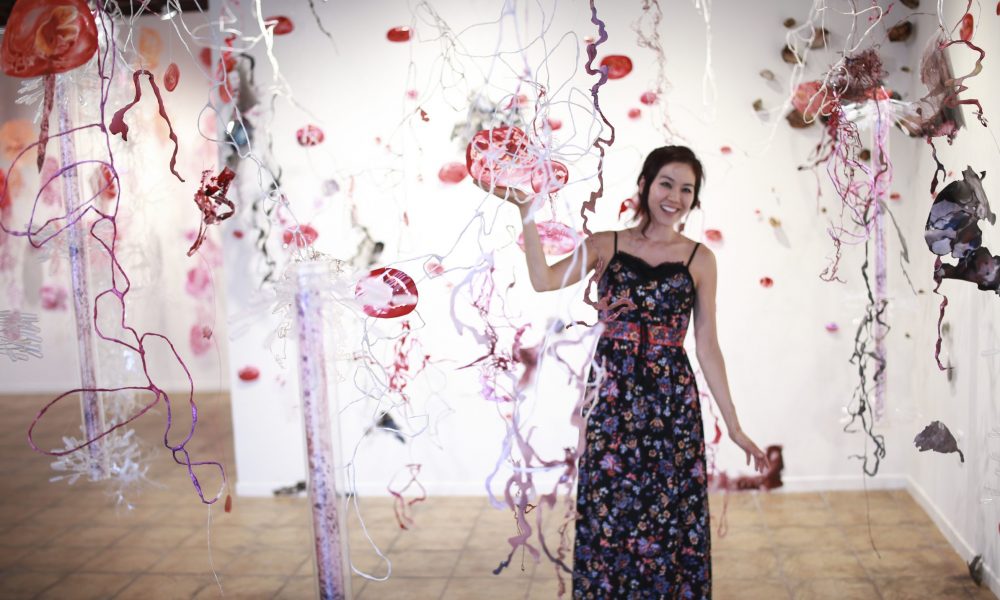
Today we’d like to introduce you to Meeson Pae Yang.
Meeson Pae, we’d love to hear your story and how you got to where you are today both personally and as an artist.
I came to art as a necessity. Prior to that moment, I had no exposure to art. In 1998, my younger brother was diagnosed with Non-Hodgkins Lymphoma and passed away shortly afterward at the age of 15.
After completing high-school, I started studying at UCLA. I was struggling with the idea of loss and trying to process it all. I was having a terribly difficult time making sense of it all. I started studying English literature in college and then moved on to sociology. I was in limbo and didn’t exactly know what field I wanted to major in and at the same time in transition trying to process loss and pain. I discovered that I was barely able to communicate merely with words – pen to paper was not working. I could not convey the deep internal struggle and what all of this meant and so I started physically making things.
I bought paint and clay and simply started making things. It was a primal and innate urge to visually communicate my thoughts. This was my first attempt at making art. I wasn’t sure what I was doing. I didn’t even know how to use these materials. I wanted to see if I could figure out what was happening internally by expressing it through an external object so that I could step back and look at it. In my second year of college, I decided to apply to the art department. A portfolio of twelve images needed to be submitted for admission to the art department. I was overwhelmed because I had no artistic background and it seemed pretty much impossible… so I abandoned the idea.
But one week before the application was due, something struck a chord in me and I felt that I just needed to do it. I managed to make twelve artworks with no sleep and pure determination. I submitted my portfolio, and amazingly I was accepted. That was my first introduction to art. It was a steep learning curve and I was introduced to art history, materials, and conceptual processes for the first time. Initially, I explored concepts pertaining to the body, cellular forms, and the decay. This was of course directly related to my brother’s illness. I was looking at artists like Kiki Smith and Eva Hesse, who I am still very much influenced by.
The piece titled, Index, marks a turning point in my work. With Index, death, and decay transformed into the potential for life and the way that nature uses systems to ensure reproduction and growth. After UCLA, I took a class at a local community college because I felt I need more technical skills. I took a beginning sculpture at El Camino College and the professor gave me the opportunity to show in an outdoor display case on campus. When the case was empty, it was just a rectangular box of glass and stainless steel with fluorescent lighting. It looked terribly clinical.
This became my first site-responsive installation. The work was conceptually about connections and individual elements coming together to form a larger unit.
We’d love to hear more about your art. What do you do you do and why and what do you hope others will take away from your work?
WHY:
I create because I cannot live without creating. It is a constant source of challenge, discovery, and inspiration.
PROCESS:
I begin work in different ways and it is always a very organic flowing process and development. I don’t make detailed sketches, but I will have a very rough post-it or napkin sketch and that will be the beginning. From the rough sketch, I will begin compiling materials. These materials are then combined and rearranged in various fashion – it becomes a very physical process where I have to see the work in three-dimensional form and then see if the materials and the form make sense. This making “sense” is a mixture of slight intuition, metaphor, and also taking information, systems, and structures from nature and transposing them onto the materials.
Often times a word will trigger something in my mind and that will lead me towards associations that will guide me to look for certain materials. I keep a log of words that spark strong visuals and I look to these words to also build visual associations. Part of the process is also finding interesting materials. I occasionally stumble upon interesting materials when walking through Asian markets – all kinds of different dried mushrooms, seeds, and root. My materials come from a wide gamut of places from tide pools, forests, industrial warehouses, medical supply stores, cosmetic stores, to craft and hobby shops – pretty much everywhere.
I start with small experiments or prototypes when beginning a work. I have this box of what I call Do-Dads which are small sculptures that I make and test out various materials, similar to Eva Hesse’s studio pieces. Once I feel that an idea has jelled, I move forward. The next steps become mechanized like an assembly line, and I make multiples and variations of multiples to ultimately create an immersive field or environment. I see all the works interconnected and that I am creating an ecology or cosmology where all the works interact and function together.
EXAMPLE OF STUDIO PROCESS + LIFE:
I was on a walk and discovered this beautiful pine seed pod on the ground. It looked like an armored sphere with thick layers of bark in petal-like shapes. I took this single seed pod into the studio and watched it as it opened slowly day after day. I documented the opening of the armored pod. The seeds slowly emerged out until all that was left was an empty shell.
I was interested in making a work that would capture the moment when the seeds disperse through the air. In the work, Dispersion, the moss balls are like enlarged seed capsules that are frozen in time and are about to germinate. I am interested in capturing a freeze frame or sliver of time. In the case of Dispersion, I wanted to capture that moment when life is released.
ARTIST STATEMENT:
The work explores the convergence of science, technology, and mythology into a thickly layered stratum of images and objects reflecting systems within nature. Intersections and parallels in systems become unfolding metaphors and imagery to dissect and explore. Much of the work begins by extracting simple elements and then expanding, repeating, and extending these components into transmuted conglomerations and abstractions.
The process of the work involves a methodical collecting of artifacts, images, and sounds to synthesize and compress into expansive visual fields. Working in a variety of media from painting, video, sculpture and installation, each medium is a tool to process natural phenomena from the microscopic to the macroscopic.
OVERALL:
I love to explore universal concepts like change, order, patterns, structures, power, systems, and relationships. I am interested in forms, patterns, systems, and beauty from the natural world. The process of my work involves exploring elements from micro to macro and recombining and compressing them into new forms with materials ranging from traditional such as clay and wood to industrial materials, medical supplies, cosmetics and found organic materials.
These hybrid forms explore polarities: abstract/representational, eastern/western, hard/soft, micro/macro, liquid/solid, light/dark, transparent/opaque, material/immaterial, past/future, concrete/ephemeral. Ultimately, I hope to submerge viewers into a mesmerizing fantastical environment through my multi-sensory large-scale installations that evoke ethereal abstractions relating to the natural world.
What do you think it takes to be successful as an artist?
I define success by asking myself – Am I doing work that is challenging, interesting, and allows for discovery and curiosity? If it consumes me and permeates my soul – then I know it is the right direction and will lead to success.
I believe perseverance is key to being a successful artist. There are many times artists face rejection and they need to endure and keep pushing forward. I’ve had many many rejections and I have kept all those letters as a reminder that “no’s” are a temporary stumbling block and if you keep pushing forward, great opportunities will open up.
Do you have any events or exhibitions coming up? Where would one go to see more of your work? How can people support you and your artwork?
I often have exhibitions throughout the US, Asia, and Europe, as well as permanent public artworks in the city of Pasadena, Culver City, Royal Caribbean Ovation, and Le Meridien Hotel (Zhengzhou, China). Upcoming exhibitions and news can be found on my website under Exhibitions.
Contact Info:
- Website: www.meesonpaeyang.com
- Email: meesonpaeyang@gmail.com
- Instagram: https://www.instagram.com/studiomeeson/
- Facebook: https://www.facebook.com/meeson.yang
- Twitter: https://twitter.com/meesonpaeyang


Getting in touch: VoyageLA is built on recommendations from the community; it’s how we uncover hidden gems, so if you know someone who deserves recognition please let us know here.
Popular
-

Que Johnson on Building Brands That Last: From Visibility to True Market Authority
-

Christina Wren Steps Into the Director’s Chair to Tell Stories That Feel Like Home
-

Portraits of the Valley
-

LA’s Most Inspiring Stories
-
JordanL on ‘Breathe,’ Belief, and Building a Movement Beyond the Music
-
Megan Birney Rudert on How Access to Light Is Powering a More Sustainable and Equitable Future