
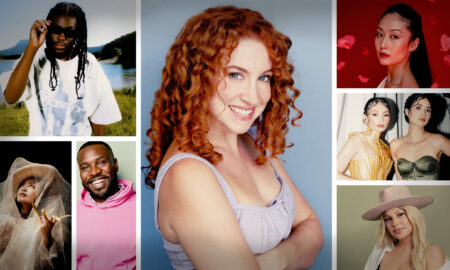




Today we’d like to introduce you to Sam Ripley.
Alright, so thank you so much for sharing your story and insight with our readers. To kick things off, can you tell us a bit about how you got started?
I grew up in LA, spending weekdays with my mom in Los Feliz and weekends with my dad in Pasadena, where we’d hole up in the Arclight Paseo (R.I.P.) and watch every new release. My parents have very different tastes, so I was exposed to an incredibly wide spectrum of content—from King Arthur to Alien, and everything in between. I credit my mom for teaching me story, my dad for helping me fall in love with movies, and my step dad for showing me the craft of filmmaking.
I was also lucky to grow up surrounded by a lot of artists, actors, and musicians, and was constantly fascinated by different modes of storytelling. One of the gifts of that upbringing was that I never saw art as something elite or inaccessible. I found it choreographing backyard fight scenes, playing Dungeons & Dragons, and drawing alone in my room. Artmaking felt accessible, playful, and essential.
As a kid navigating a lot of change in my family and world, I related deeply to characters on screen and in books, tracing my own quiet dramas over their epic journeys. Media—especially movies—helped shape my inner world and left me with a deep desire to express myself through storytelling.
That desire carried me to Vassar College, where I studied film with a focus on screenwriting. I became fascinated with genre storytelling and structure, and found myself falling in love with the process of writing—particularly the conceptual stage: outlining and breaking a story. I couldn’t get over the realization that almost every story, regardless of medium, genre, or time period, shares the same basic skeleton. This discovery deepened my belief that narrative is a fundamental human tool for understanding ourselves and the world.
Vassar also pushed me to explore beyond film—I practiced video art, printmaking, drawing, and film photography. I loved these practices because they were deeply process-oriented, requiring patience, repetition, and experimentation. The more I created, the more it felt like part of one continuous thread: expressing something internal in a way that felt real, meaningful, and accessible.
After college, I was lucky enough to intern at several production companies in LA and New York, where I got a closer look at the business side of the industry. It was amazing to see people get paid to talk about (and produce) film and TV, but I also felt distanced from the actual making. The industry, as I experienced it, didn’t always feel like it was built for everyone. That disconnect pushed me to stop waiting for permission and start creating.
I moved back to LA and took a job at a nonprofit dedicated to preserving the testimonies of Holocaust and genocide survivors through documentary film. I started as a video editor, but my role quickly evolved into creative producer, giving me the chance to use my voice and skills in service of a meaningful mission. Being part of a large, multifaceted organization also helped me discover my love for collaboration and leadership. I found deep satisfaction in building workflows, defining goals, and guiding a team toward a shared vision. I had incredible opportunities to learn from experienced creatives with varying management styles—and to mentor and support younger editors and interns.
During that period, I also wrote and directed my first short film, The Burden of Care, which tells the story of an aging father struggling to follow through with an unconventional end-of-life plan. Making it reaffirmed everything I love about filmmaking—the community, the problem-solving, the chance to play with genre, the balance of creative and practical thinking, and the sense of controlled chaos. It was also an opportunity to collaborate with friends and family—my parents served as executive producers, and my godfather, Bernie White, played the lead opposite Clay Wilcox, another dear family friend. Working with them reinforced my belief that the best work happens when the process is playful, loving, and collaborative.
The film premiered at Dances With Films and screened at the LA Lift-Off Film Festival, LA Independent Film Festival, and Ignite Film Festival. It was surreal and gratifying to see a story go from something in my head to the big screen. Getting to watch it in a real theater was a lifelong dream come true—a memory I’ll cherish forever.
More recently, I’ve transitioned out of the nonprofit world and now work as a freelance editor and creative producer in film and TV. I’m also in the midst of developing my next short—a pulpy, surreal horror film—which I’m hoping to shoot in the fall!
I’m still at the beginning of my story, but I’ve learned that if you stay curious and keep creating, the next chapter always finds you.
Alright, so let’s dig a little deeper into the story – has it been an easy path overall and if not, what were the challenges you’ve had to overcome?
I’ve had a really lucky life, but I think everyone—especially anyone trying to make art—faces a steady stream of challenges.
A big one I struggled with growing up was perfectionism, which I think is pretty common among people who love art. Ira Glass, one of my heroes, has this great lecture called The Gap where he talks about how your taste usually develops long before your technical skills, which means you spend a long time making work that falls short of your own standards.
I relate to that deeply— as a kid, I’d tear up drawings and abandon films halfway through because they didn’t match the version I saw in my head, but I think it’s something you just have to learn to accept. I still see flaws in my work, but I’ve learned that nothing real is perfect and nothing perfect is real. I think the key to making interesting work is experimenting, failing, and learning. I never want to be a filmmaker or an artist who settles into a routine and stops taking risks, which means I’ve had to get comfortable living in “the gap.”
Another challenge I’ve been struggling with is the weight of cynicism about the future. It’s hard not to wonder about the future of “the industry,” let alone the world, with so much scary change on the horizon. I definitely have moments where I wonder if this career path is a valid or worthy goal when there are so many HUGE issues that need immediate attention beyond filmmaking, and, on a more practical level, so many seemingly insurmountable hurdles on the road to getting paid as an artist
I’ve found that a mix of naive optimism and gratitude is the only thing that keeps me moving forward. It’s easy to get stuck in self-doubt and existential dread, but you have to keep moving, keep making things with people you love, and celebrate every win, no matter how small. The more I chase improvement, play, and the joy of making something human and real, the more satisfying filmmaking becomes.
Appreciate you sharing that. What else should we know about what you do?
I’m a filmmaker and creative director based in Los Angeles, working across narrative, branded, and experimental projects. I come from a writing and editing background, which shaped how I approach storytelling—how to build rhythm, shape emotional tone, and ground a story in authenticity. That foundation still guides my work today, whether I’m writing and directing a short film or defining the voice of a larger campaign.
My work often explores themes of emotional isolation, memory, and identity—usually through stories that feel both intimate and slightly heightened. I’m interested in how the surreal can reveal something real, and how stylized or genre-inflected storytelling can be deeply personal.
I’m most proud of the projects where I’ve been able to bring people I love into the process. I really value collaboration and the feeling of a project going from “mine” to “ours” is alway deeply gratifying. Being in a position to set the tone on set and build teams based on trust and honesty means everything to me. I want the people I collaborate with to feel empowered to take risks and bring their full selves to the work.
I think what sets me apart is my focus on the human element, even in stylized or conceptual work. I’m drawn to visual storytelling and bold ideas, but always as a way to explore something personal and emotionally grounded. I’m less interested in spectacle for its own sake and more interested in how form can serve feeling. Whether I’m working on a narrative piece or a brand project, I try to create from a place of curiosity, empathy, and emotional truth.
Is there any advice you’d like to share with our readers who might just be starting out?
I think it’s really hard to give good advice that doesn’t quickly devolve into clichés, but some of the best advice I’ve been given is:
Organization = freedom. The more structure you give yourself, the easier it becomes to be creative.
Make a lot of work. Quantity kind of beats quality when you’re starting out—because you have to get through a lot of mistakes.
Be a good person—or at least the kind of person people want to be around. Life (and art) requires friends and collaborators. Try to be helpful and pleasant whenever possible.
Slow is smooth, smooth is fast. It’s easy to rush toward a goal, but the more you can take time to appreciate the process, the better your work becomes.
Collect heroes and references. You’re only as good as your taste. Pay attention to what you respond to in other people’s work.
Believe in yourself. Nurture your creativity. Remind yourself you have things to say—and that you deserve to be heard.
Contact Info:
- Instagram: https://www.instagram.com/samripleyy/
- Youtube: https://www.youtube.com/watch?v=4TXpJ6zhVNA


Popular
-

Que Johnson on Building Brands That Last: From Visibility to True Market Authority
-

Christina Wren Steps Into the Director’s Chair to Tell Stories That Feel Like Home
-

Portraits of the Valley
-

LA’s Most Inspiring Stories
-
JordanL on ‘Breathe,’ Belief, and Building a Movement Beyond the Music
-
Megan Birney Rudert on How Access to Light Is Powering a More Sustainable and Equitable Future


