


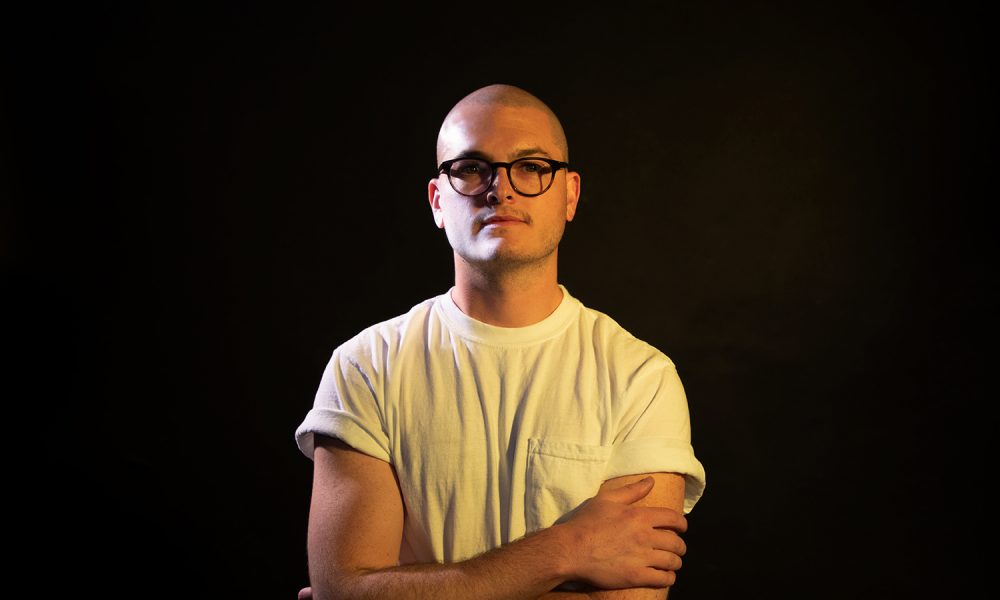
Today we’d like to introduce you to Ryan Gould.
Ryan, can you briefly walk us through your story – how you started and how you got to where you are today.
I was born in Miami, Florida in the 80’s right after the Miami Drug Wars ended. All my parents’ friends either had thick mustaches like Tom Selleck and wore Hawaiian shirts unbuttoned just a little too far or had fluffy permed curls like Jennifer Beal in Flashdance with pastel padded blazers. At the time, my dad was a photo hobbyist. He was very naturally gifted but never took it seriously. He eventually gave it up and has since mailed all his old negatives and prints to me.
One of my favorite photographs my dad took was of my mother standing by the pool at my childhood home wearing this amazing royal blue pantsuit with the sleeves scrunched up to her elbows staring intensely into the camera. She looks stunning but also slightly frustrated. It reminds me of something Larry Sultan would have taken. My mother was a model and a flight attendant for the now-defunct PanAm. Her general route was from Miami to Paris where she would stay for a few days and then fly back to Miami.
She was always interested in art, and one day she walked into a bookstore to buy a Jean-Michel Folon monograph, and she asked the clerk where she could buy an original print. He told her to find The Blue Shadow which was this massive boat docked on the Seine River and owned by Folon’s manager and future wife, Paola Ghiringhelli. That day, my mother walked along the Seine, found The Blue Shadow, knocked on the door, and met Paola. They became friends and business partners, and my mother became an importer and dealer of European artwork for Folon, Valerio Adami, and Joan Miró.
Growing up surrounded by the work of esteemed artists is what started my art education, but like my father, I didn’t take artmaking seriously until I was in my late 20’s. I spent the majority of my 20’s working odd jobs. I taught English in South Korea for a couple of years and then worked as a tax educator for the Colorado Department of Revenue, and would spend my evenings drawing, making small sculptures, playing music, and making photographs.
Artmaking became a ritual. I needed it, and after the better part of a decade of making work after-hours, I decided it was time to commit to my practice. So, I moved to Santa Barbara for graduate school. After graduating in 2015, I moved to Los Angeles and built a live/work studio complete with a darkroom where I make work and tutor young artists in film development, darkroom printing, and studio lighting.
Overall, has it been relatively smooth? If not, what were some of the struggles along the way?
Making the decision to be an artist isn’t easy. You’re willingly subscribing to vast criticism, unstable income streams, and near-constant self-doubt. I once had a professor tell me, “If you can do anything else, do it,” and then proceeded to recite the Charles Bukowski poem “Roll the Dice.” You know, the one that goes, “if you’re going to try, go all the way. This could mean losing girlfriends, wives, relatives, jobs and maybe your mind. It could mean not eating for three or four days. It could mean freezing on a park bench. It could mean jail, it could mean derision, mockery, [and] isolation.” Some of my classmates dropped out that day, but for those that remained, it reinforced our dedication to artmaking. Because, for us, there isn’t anything we can do but make art.
We’d love to hear more about what you do.
When I started grad school, I was constructing small sets and fabricating scenes like Gregory Crewdson, but without a budget. It was all introspection and self-aggrandizing. Nothing was really landing, and the whole process made my skin crawl.
It wasn’t until I discovered the work of Robert Heinecken, the collaborations between Larry Sultan & Mike Mandel, and the artists of the Pictures Generation that I hit my stride. These artists helped me realize that artmaking is bigger than the self. Of course, all work is personal, but to couch it in a larger socio-cultural ideology makes it accessible and allows for viewers to more easily empathize, to question their belief systems and the institutions of power that have created those belief systems, and to understand the space they occupy.
The institution of power I’m most interested in is the porn industry. I grew up with dialup internet. I remember coming home from school, booting up the computer, listening to the chirps and clicks of our modem kicking in, and the excitement of seeing nude images load inch-by-inch on the screen. It was the first-time kids didn’t have to steal their dad’s Playboys and had access to an infinite amount of pornographic imagery.
This was also the age of Adam Carolla and Jimmy Kimmel’s Man Show on Comedy Central which ended each episode with buxom women jumping on trampolines and had ads for Girls Gone Wild in each commercial break. At the time, it was thrilling. In hindsight, what we were experiencing was the absorption of pornographic tropes into popular culture, and it has profoundly shaped the way men of my generation objectify women and judge their worth.
The work I make positions pornography as today’s defacto sexual education in order to allow viewers to question how pornography has impacted them either directly or indirectly through pop culture and addressed the impact art and technology has played in democratizing erotic images. Most recently, I’ve been photographing a 3×3 inch quadrant of user-generated online porn videos, scaling the image to nearly 15 times its original size, and displaying the final prints in lightboxes.
Beginning with video titles, I use in-camera cropping to call attention to specific words and watch the video through the viewfinder making exposures when something in the video agrees with or challenges the text. Vast contradictions in contemporary sexual ideologies are placed into full view, including the disparate sexual expectations of men and women in pornography and the rapid and seemingly arbitrary normalization of porn in the popular lexicon.
By enlarging the images to such an enormous degree, we no longer are able to see pixels but each individual RGB light at the subpixel level, drawing attention to digital screens: the most recent technological advancement allowing pornography to live neatly in our homes and on our phones.
What is “success” or “successful” for you?
If the work raises questions rather than providing answers, it is a success. I try to make work that is not obvious on the surface. The images I create typically have a dual meaning. Predominantly, there is a punch line: some lingual connection between image and text. This is what I am willing to provide on the surface.
The viewer can then either take the connection at face value or try to read more deeply into it. The work should be ambiguous so the viewer can shape the image and message to be good or bad or indifferent because I’m not interested in telling people what to think. I just want to put people in situations where they have to think. If I can do that, then the work is successful.
Contact Info:
- Address: 857 S San Pedro St Suite 305 Los Angeles, CA 90014
- Website: http://ryanharrisongould.com
- Phone: 5614797170
- Email: ryan.harrison.gould@gmail.com
- Instagram: https://www.instagram.com/ryanharrisongould/


Getting in touch: VoyageLA is built on recommendations from the community; it’s how we uncover hidden gems, so if you know someone who deserves recognition please let us know here.
Popular
-

Portraits of the Valley
-

LA’s Most Inspiring Stories
-

JordanL on ‘Breathe,’ Belief, and Building a Movement Beyond the Music
-
Megan Birney Rudert on How Access to Light Is Powering a More Sustainable and Equitable Future
-

Linda Kneidinger on Building Lasting Change Through Small Steps and Self-Compassion
-

Jolana Nika on Redefining Modern Connection Through Intentional, Real-Life Experiences