


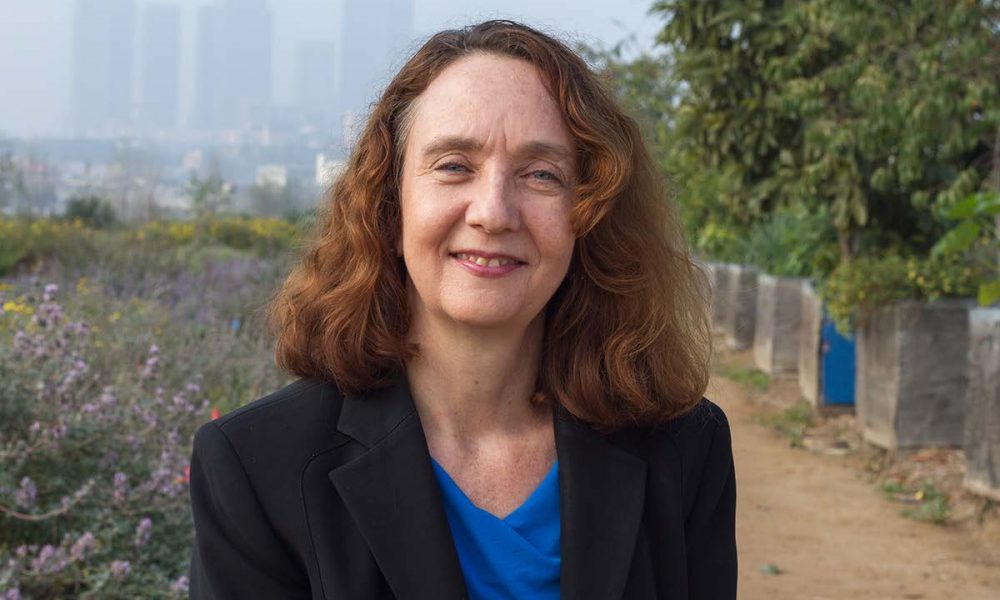
Today we’d like to introduce you to Rachel Surls.
Thanks for sharing your story with us Rachel. So, let’s start at the beginning and we can move on from there.
I came to Los Angeles in 1988 after a two years stint in the Peace Corps, in Honduras. There, I had worked with small coffee farmers and their families to start vegetable gardens. I really enjoyed the work and wanted to find something similar in the US–some way to help people through gardening. Once living in Los Angeles, I found a job with the University of California Cooperative Extension as the youth and community gardens coordinator. It was the perfect job for me. I drove around Los Angeles with my Thomas Guide (if you’re young you might not know what that is, but it’s what we used to navigate LA before Google maps, etc.) and I went to schools and communities to help start gardens. Today, community and school gardens are popular but then they were not. I would basically cold-call schools and say “hey, would you like to have a garden?” and if they did, I would go with tools, plants, and soil in the back of my truck. I loved to see kids pull a radish or a carrot out of the ground for the first time and the pleased and surprised look on their faces. Most children (and adults, too) do not necessarily know or think much about where food comes from until they interact with a garden.
Over the years, my job has evolved and changed. Today, there are quite a number of local nonprofit groups that help start school and community gardens. I train UC Master Gardener volunteers who support all of these groups and the many school and community gardens around town. I also work with my colleagues around the state to develop resources and training for urban farmers. Along with the interest in gardening has come the phenomenon of tiny farms in the city–on vacant lots or in backyards. My coworkers and I have visited many urban farms and trained urban farmers on legal issues, food safety, and a variety of other topics. It’s been fun to see urban gardens and urban farms, once novelties, become popular in Los Angeles. In a way, we’re getting back to our roots. Los Angeles was once the top farm county in the nation, believe it or not. Los Angeles was full of farms, dairies, poultry ranches, apiaries, and small backyard farms. One accomplishment that I’m proud of was to co-author a book that documented this history. It’s called “From Cows to Concrete: The Rise and Fall of Farming in Los Angeles” and was published by Angel City Press in 2016.
We’re always bombarded by how great it is to pursue your passion, etc – but we’ve spoken with enough people to know that it’s not always easy. Overall, would you say things have been easy for you?
After working on urban gardening from 1988 to 1997, it began to feel like I was swimming upstream and I got kind of burnt out on this work. It seemed that school administrators, other officials, and the philanthropic community were not very interested in school and community gardens. So my career shifted and I was an administrator at my organization for about 15 years, managing all of our various programs. I enjoyed that and imagined that I would continue my career as an administrator with the University of California. However, around 2008 and 2009, our office started getting more and more calls about gardening, many of them from beginners. It seemed that suddenly people were very interested in becoming more self-sufficient through gardening. Our experience locally aligned with a national survey that showed a very significant rise in the numbers of home gardeners after 2008. While the reasons aren’t entirely clear, I think it had something to do with the economic crisis. Gardening and home food production help people feel a sense of control as the world shifts uncertainly.
With this interest surging, I felt strongly that I wanted to get back involved in the day-to-day world of gardening, and in 2012, I was able to do that. I am grateful to my organization for allowing me this opportunity to change and grow with my interests. It is an amazing time to be doing this work because there is now so much recognition that food–how we grow it, how we serve it, how we eat it, and what we do with food waste–has implications for every aspect of our society–locally and globally. Now people do care about gardens–as part of the larger food system–and as a way to take direction action in addressing issues like food insecurity, unequal access to healthy food, and climate change.
Please tell us about University of California Cooperative Extension.
University of California Cooperative Extension (UCCE) is part of UC’s Division of Agriculture and Natural Resources (UC ANR). It’s a part of the University of California that I think should be more widely recognized. We’re an off campus, non-credit part of UC that’s based in local communities. We offer free and low cost classes, workshops, seminars and other programs for local residents. For example, UCCE oversees the 4-H Youth Development Program, that offers hands-on learning and life skills for youth ages 5-19. Many people think of 4-H as a rural program but we also have it in the city! We also offer free nutrition education class. We work with farmers. And we have the UC Master Gardener Program, which trains local residents to teach sustainable gardening in their communities. Cooperative Extension is over 100 years old! It exists throughout the United States as part of each state’s land grant university system.
What were you like growing up?
I was a somewhat shy kid who was always interested in food and gardens. Some of my best childhood memories are of experimenting in the kitchen. I also gained an early love of plants from my mother and grandmother. I loved animals. I was in 4-H. In retrospect, it seems that all my childhood interests culminated in my career.
Contact Info:
- Address: UC Cooperative Extension
700 West Main Street
Alhambra, CA 91801 - Website: http://celosangeles.ucdavis.edu/
- Phone: 6265861982
- Email: ramabie@ucanr.edu
- Instagram: @rachelsurls
- Facebook: https://www.facebook.com/University-of-California-Cooperative-Extension-Los-Angeles-County-60035129491/
- Twitter: @RachelSurls
- Other: https://ucanr.edu/sites/UrbanAg/

Image Credit:
Mary Redlin
Suggest a story: VoyageLA is built on recommendations from the community; it’s how we uncover hidden gems, so if you or someone you know deserves recognition please let us know here.
Popular
-

Christina Wren Steps Into the Director’s Chair to Tell Stories That Feel Like Home
-

Portraits of the Valley
-

LA’s Most Inspiring Stories
-

JordanL on ‘Breathe,’ Belief, and Building a Movement Beyond the Music
-

Megan Birney Rudert on How Access to Light Is Powering a More Sustainable and Equitable Future
-

Linda Kneidinger on Building Lasting Change Through Small Steps and Self-Compassion