


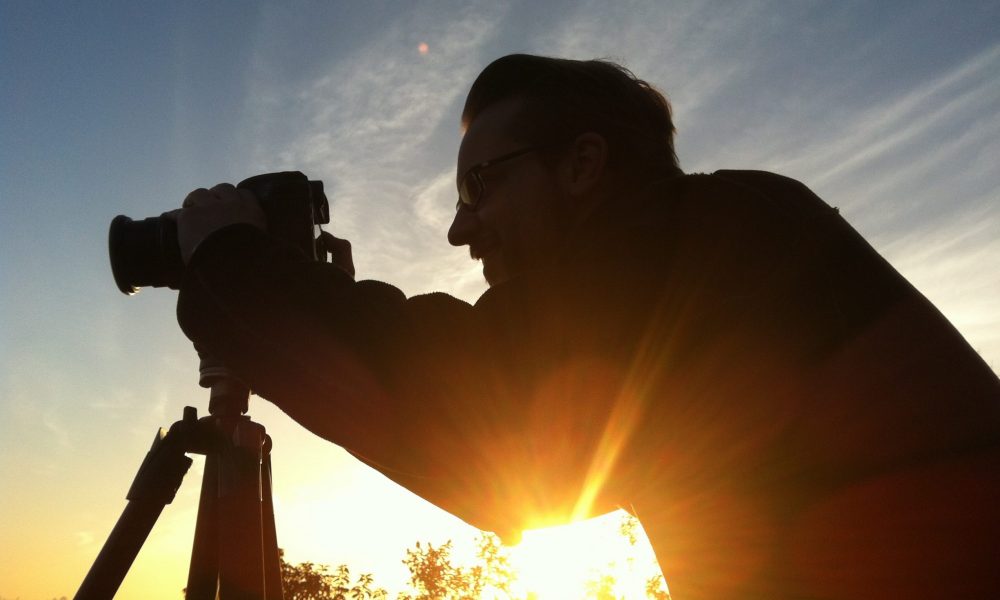
Today we’d like to introduce you to Dominik Rausch.
Dominik, let’s start with your story. We’d love to hear how you got started and how the journey has been so far.
My journey of becoming a director began in a small town in Germany, where I was born and raised. When I was about eight years old, I remember seeing a video my dad filmed on his camcorder. It showed various shots of landscapes accompanied by classical music he edited into the film. The shot I remember the most was of a river — the motion of the water was perfectly in sync with a piano concerto by Mozart that played in the background.
It was then and there that I discovered the power of “motion pictures.” While I appreciated other art as well, there was (and is) just something so powerful about movies that gets under your skin and has the potential to change your entire view of the world.
The second significant moment I remember that influenced my decision to follow my dream of becoming a director came as a result of my training as a classical pianist. I’ve played the piano since I was six years old… and even won a few competitions. But playing other people’s music wasn’t enough; so, when I was 13, I started writing my own music. That led to me discovering legendary film composer John Barry and shortly after that the one and only John Williams. Even though “binge viewing” wasn’t a thing yet, it’s the only way to describe what happened next when I went on to watch (and listen to) all of Steven Spielberg and John William’s collaborations.
That’s what settled it. Even though a lot of my friends suggested I should study film in Germany, I knew there was one place — and one place only — I wanted to go. And that place was Hollywood.
So only a few weeks after graduating from high school in 2006, I started applying to film schools in LA, got accepted to Columbia College, and then made the move across the big pond a few months later.
It was the strangest feeling, but the second I arrived in LA I felt like I was home. The people, the culture, the creative spirit, and craziness that is Hollywood was exactly what I’ve been longing for my entire life.
I made a promise to myself that I wouldn’t be a student, who just stays within the safe and cozy walls of college for four years and then tries to find a job; but that I would go out and look for opportunities to work on film sets immediately, while still in college.
During my second quarter there, I got my first job, which was as a boom operator on an indie feature that shot in 29 Palms in the middle of July. Not only were numerous sun burns part of the gig (to the point that the director felt bad and offered me his hat!), but since I was still in school, I would work on set from 6:00 AM until around 6:00PM, drive back to LA for night class until around 11:00 PM, and then would head right back to the desert, go to bed around 1:30 AM and do the same the next day… for about two weeks. I forgot to mention — it was an unpaid position. But I couldn’t have been happier.
And the insanity paid off. The producer pulled me aside at the end of the shoot to thank me for all my hard work and gave me a surprise check for $100. That was my first official pay check on a film set and I couldn’t have been more proud.
That same producer then brought me on to other productions — I did everything from helping out as production assistant to unloading trucks and setting up lights as a grip/electric. During that time, I also worked day and night to apply for and receive a scholarship from the Academy of Motion Pictures Arts and Sciences.
One thing led to another, and I ended up working as part of the producing team for a critically acclaimed feature film called “April Showers.” On that set, I met actress Illeana Douglas, who was writing a script for IKEA at the time. “IKEA?” you ask. That’s right. It was a first-of-its-kind branded entertainment series for digital distribution when YouTube was still in its infancy — this was in 2008.
She asked me to work on the project (called “Easy To Assemble”) and this turned into my first gig as a producer. Little did I know that the project would blow up, get millions of views around the world, receive numerous awards, and be listed as one of the Top 5 Branded Entertainment projects of 2009 by the famous advertising magazine Ad Age. Other projects on that list were Michael Bay’s “Transformers” and NBC’s “Chuck,” which was crazy because we were just a small web series.
This was when I learned my first lesson as a producer: it doesn’t matter how big or small the screen. You put your best foot forward and create the best damn thing you can possibly create. No matter the budget or time constraints. And with the tight schedule and involvement of celebrities like Jeff Goldblum, Jane Lynch, Cheri Oteri, Tim Meadows, Ed Begley Jr, Justine Bateman, and Tom Arnold, a 60-page script, and only five days of production at the IKEA in Burbank (which we were NOT shut down for production) it certainly wasn’t easy. But our philosophy throughout production remained the same: even though this was “just” a web series, we were giving it the same love and attention to detail we would give a film or TV show.
The success of “Easy To Assemble” (which was renewed for three more seasons, something that was unheard of in the digital space at the time, since usually branded content only runs for one campaign cycle) opened many doors for me in the world of branded entertainment first as a producer with projects for brands like Trident Gum, Pary City, Ace Hardware, and Wal Mart as well a director for Bridgestone Tire’s 2017 NFL Rookie Premiere campaign.
It also allowed me to invest into my own camera equipment, which I would use to shoot smaller short films to establish my voice as a director. I have been called a ‘Cynical Dreamer,’ because while I often process daily life with a dose of sarcasm, I approach life on screen with a sense of wonder and conviction in the belief that, ultimately, we can all find beauty and love.
Then in 2009, I was invited to join the Producers Guild of America and I went on to work on or develop projects for companies like Sony Crackle, 20th Century Fox Digital, Netflix, Amazon Prime Video, Comedy Central, YouTube and Funny Or Die.
My path here combined with the current political environment has finally led me to the project I am currently working on called “Story Reel,” which is a series of short films telling extraordinary stories of minorities, immigrants, and other diverse American voices that deserve to be heard on a larger scale in the media to recapture the American Dream. My goal is to create something that is somewhere between HBO’s “The Night Of” and Spielberg’s “The Post.” This is where all my passion as a producer and director as well as my fascination for the power of motion pictures come together.
I truly believe that videos, film and TV have the power to make a difference in people’s lives and I fully intend to use all of the storytelling tools available to me to help create a better tomorrow. Like so many other dreamers in this town, I, too, want to change the world.
Great, so let’s dig a little deeper into the story – has it been an easy path overall and if not, what were the challenges you’ve had to overcome?
Being an immigrant comes with its unique challenges. I remember how difficult it was just to get a social security number and doing simple things like signing a contract with phone service providers or getting a driver’s license.
You quickly figure out that this country runs on credit — in other words, your credit score kind of defines you. That’s a huge hurdle to overcome when you first move here, because to the credit bureaus you are basically an infant with no financial history. And it takes quite some time to establish one.
The other thing that was a challenge was the language barrier. Even though, in Germany, we learn some English in high school, it’s really more theoretical than practical.
This is where I have to credit all of my friends for helping me in college. They were very patient with me and went out of their way to help me get a better understanding of American English. It was interesting that at first everyone felt bad correcting me and most of my friends tried to do it as little as possible because they didn’t want me to feel like an outsider. As soon as I found out about them being hesitant, though, I announced to everyone that I would like to be corrected as often as humanly possible. Some nights, one of my best friends and I would spend hours in our dorm room reading books out loud. Sentence after sentence, I would repeat what she had just read and try to sound American.
I’m incredibly grateful to all of my friends for making it so easy for me to start a new life in a new country. And there is a certain bond among filmmakers in particular that instantly turns you into a family. I remember like it was yesterday when my car got towed outside the dorms, because I had parked in a red zone… it was the second week of living in LA. I hadn’t yet been introduced to the insanity of all the parking rules.
So here I was without a car, thinking it was stolen (because I didn’t know “towing” was a thing), and with broken English trying to figure out what to do next. Before I knew it, three of my classmates jumped in a car with me and together we went on a ride to find my car. After a few hours of getting lost (this was 2007 and we didn’t have GPS on our phones yet) and calling about a dozen different towing companies, we finally found my car. The problem was I had just bought it a few days before, and somehow the registration didn’t transfer over to my name yet, so the towing company wouldn’t release it to me. A few phone calls and one day later, I was able to get it back. The bill from the towing company was $600. Welcome to LA! But the three supportive classmates and I have been friends ever since.
In terms of struggles on the way to becoming a director, I would say the most important thing I have learned about this town and industry in particular is that you are defined by your biggest success. After producing and winning awards for IKEA’s “Easy To Assemble” I was the “branded entertainment producer guy,” which I will always be grateful for because it opened so many doors and really launched my career as a working professional in Hollywood. But to simultaneously establish myself also as a director in the more traditional narrative world of film and TV became a slightly longer road as a result of it.
That being said, I wouldn’t change a thing if I had to do it all over again. In fact, I believe my experience as a producer helped me become a better director because being in the position of a producer really teaches you a lot about filmmaking. You see everything that goes on in front of and behind the camera. So now, when I step on set as a director, I feel confident and calm because I know everyone’s struggles and how I can help them.
I think a lot of directors focus just on the cast and what they see on camera; and because of that, tend to neglect the crew. Having worked in various crew positions and as a producer, however, helped me understand that every single element on set ends up on screen. If you don’t respect the crew, for example, and as a result create tension on set, the cast might pick up on that energy and it could end up affecting their performances. So appreciating, respecting, and embracing everyone’s perspective and needs on set allows me to create an environment that keeps both cast and crew happy, and ultimately lets me capture what I envisioned capturing on camera in the first place.
Ultimately, the lesson I learned on the road to becoming a director is what Steve Jobs meant when he said, “You can’t connect the dots looking forward; you can only connect them looking backwards.”
We’d love to hear more about your business.
Story Reel is an advocacy film company that tells authentic human stories around social issues that deserve more attention in the mainstream media with four simple goals: open eyes, touch people’s hearts, stimulate discussion, and inspire.
We aim to capture our stories in a way that is uniting as opposed to polarizing (considering both sides of the political spectrum), which is something we believe society needs in the current political environment. Our films will be mainstream to make the featured stories universally accessible to a wide audience, reaching far beyond the communities whose visibility we aim to elevate.
By showing real human stories whose circumstances have been shaped by the political climate, we make dialogue about real life possible. We hope to move people on all sides of a conversation away from dogma formed by the hypothetical.
We are most proud of the wide range of subjects we aim to cover, which include immigration, civil rights, gender equity, diversity, criminal justice, education, environment, healthcare, housing security, drugs, and food security.
I believe our approach to bringing stories to life on screen is unique and different from many other films and videos out there that deal with political themes, because we aim to go about it in a mainstream way that combines difficult issues with entertaining filmmaking. We never want our audience to walk away feeling depressed, but instead spark a sense of hope to get them fired up and excited about making a difference.
What moment in your career do you look back most fondly on?
One of my proudest and most memorable moment’s so far during my time here in Los Angeles occurred after a concert in Santa Barbara featuring John Williams, the film composer.
I had been obsessed with his music for years; and only a few months after I moved to LA, someone pointed out to me that there would be a concert at the Santa Barbara Bowl. I couldn’t believe it. Back then I had no idea that John Williams even did live performances, since it was never advertised in Germany. So one of my best friends and I immediately bought two tickets.
Needless to say, the concert was incredible; but what came next blew my mind.
I had brought some sheet music with me in the hopes that I might get it signed by the composer himself. But John Williams concerts are not exactly like the ones of rock bands, where the fans wait outside to see the musicians get on a tour bus. The Santa Barbara Bowl cleared out pretty quickly and after about 20 minutes, my friend and I were about the only people left from the audience. The rest of the people were just staff and security guards, who kept informing us that we needed to clear the area, too, as they were about to shut everything down.
One of the security guards, however, was a wonderful woman who could tell how passionate I was about John Williams’ music and she was very patient. We had a kind exchange, but she told us that there is very little hope of meeting John Williams. At this point, even the entire orchestra had already left.
But we didn’t give up and kept talking to her, while being mindful of her job and making sure she didn’t get in trouble either.
Then, she told us, “Wait here,” turned around and walked backstage. After a few moments, she emerged again and told us to follow her. She took us backstage to John Williams’ green room. And there he was, standing and talking to colleagues before they called him over to meet us. At this point I was basically about to pass out because I couldn’t believe that I was about to meet John Williams. Not only did I get my sheet music signed, but we also got to talk to him for a bit and took pictures together. He was incredibly kind and wished me the best of luck.
All of a sudden it was all sinking in. I had arrived. I was in Hollywood, with one of the idols I had looked up to my entire life standing here right next to me, as I was about to go on my own journey to becoming a filmmaker.
It was surreal and one of the most important moments of my life because I learned two lessons that have defined my personal philosophy ever since:
Don’t ever give up and treat people with kindness and respect. Amazing things will happen.
Contact Info:
- Website: www.DominikRausch.com


Getting in touch: VoyageLA is built on recommendations from the community; it’s how we uncover hidden gems, so if you know someone who deserves recognition please let us know here.
Popular
-
Robin Olive on Building an Inclusive Performing Arts Movement and Expanding Opportunities for Every Student
-

Portraits of the Valley
-

LA’s Most Inspiring Stories
-

Que Johnson on Building Brands That Last: From Visibility to True Market Authority
-

Christina Wren Steps Into the Director’s Chair to Tell Stories That Feel Like Home
-
JordanL on ‘Breathe,’ Belief, and Building a Movement Beyond the Music