




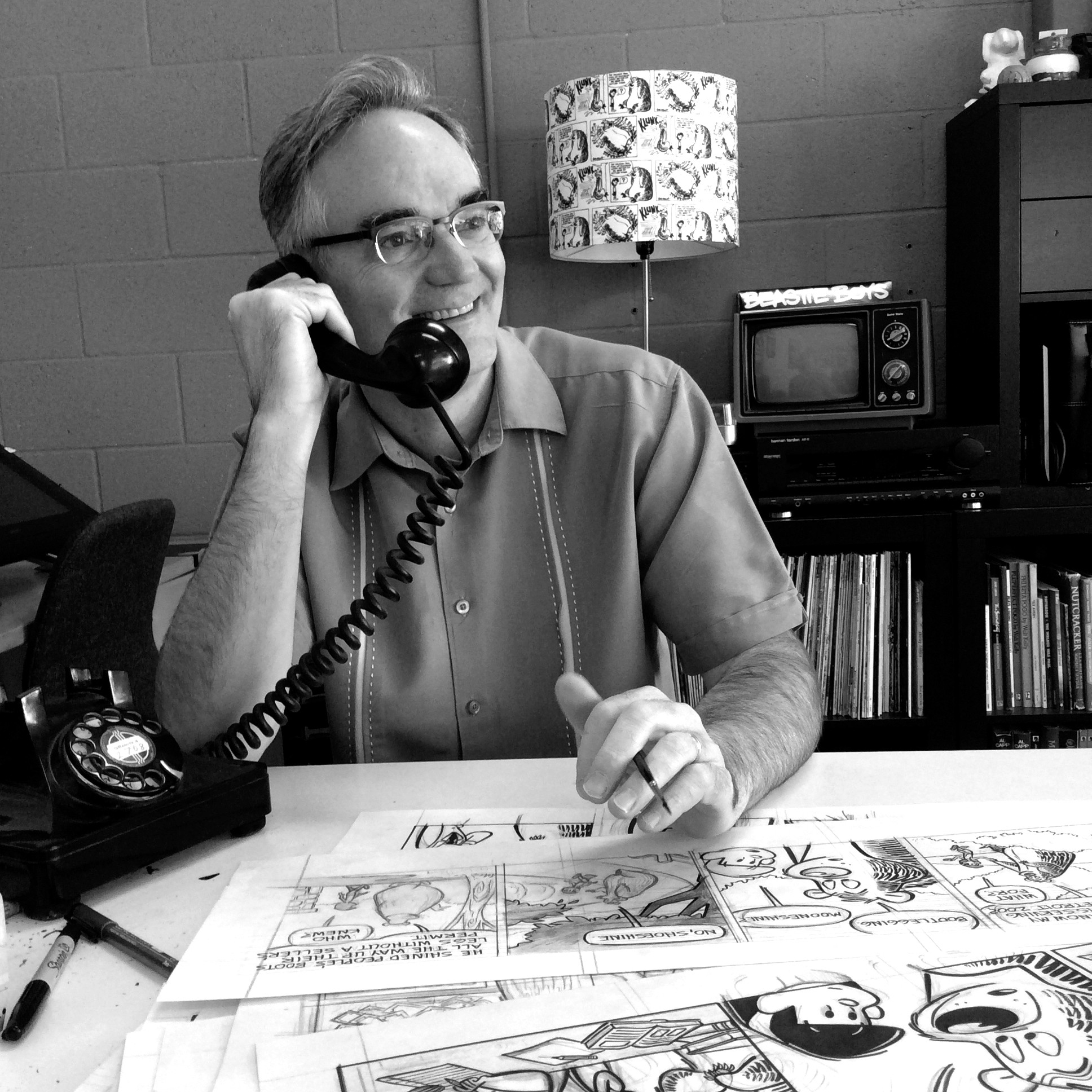
Today we’d like to introduce you to Bob Scott.
Hi Bob, so excited to have you on the platform. So before we get into questions about your work-life, maybe you can bring our readers up to speed on your story and how you got to where you are today?
Hi! I’m Bob Scott, and I have been fortunate to have made my living as an artist in both the animation and cartooning worlds. I mean, finding a spot in either field is a giant stroke of luck, but to have been successful in both is a true dream come true.
Can you briefly walk us through your story?
Briefly? Hm, well, when I was a toddler, my mom set me in front of the cartoons on tv so she could tend my little brothers. My love of animation and cartoons started before I could even walk, and by the time I was ten, I was already trying to animate. I drew constantly. I loved the attention I got from my drawings, but I also craved the peace and quiet I found when I was immersed in drawing. Hours would pass before I knew it.
I read every book I could find on comic strips and animation and collected as many Super 8 prints of animation as I could afford. Back in the 1970’s it was hard to learn about these fields. Oh, I would have loved today’s luxury of being able to watch any piece of animation you want at any time! But I persevered, reaching for more and more information. I wrote letters to my animation heroes at Disney and the amazing artists who drew comic strips. Amazingly, many of them wrote back! I still have letters of encouragement from Warner Brothers cartoon director Chuck Jones and Looney Tunes and Merrie Melodies voice actor Mel Blanc.
I created my own comic strips when I was a kid, and yes, they were wildly derivative. Okay, maybe my cartoons were straight-up copies. But I stand by them as they were valuable learning steps. I mimicked Doonesbury and Jeff MacNelly’s Shoe much like students mimic teachers when learning a new language. I loved a strip called Eek and Meek. It actually inspired me to create my own strip when I was a teen. I stirred together Eek and Meek and Jeff MacNelly’s Shoe and came up with Twip, a cat who hung out in bars. Ha ha. This sounds like I was on the fast road to AA meetings, doesn’t it?
In high school, I became serious about cartooning. I drew for the school newspaper and started thinking about syndication. Larry Wright (Wright Angles, Kit ’N’ Carlyle) was an editorial cartoonist for The Detroit News. I liked his work and gave him a call. Fortunately, Larry invited me to come to his office to visit and watch him work. I brought an armful of my comic strips for him to look over. He kindly critiqued my work, giving me pointers about inking, humor and writing. Larry’s biggest piece of advice was to draw from my own experiences and what I know. That advice has stuck with me all these years.
He also let me choose one of his comic strips to take home. I still have it framed in my house. He was a huge influence on me.
Community is important for any artist, and a few budding animators and I found each other and geeked out together. One slightly older friend gave me helpful hints about my portfolio so I was able to apply to Cal Arts with more confidence.
My community grew exponentially when I arrived at CalArts, and met the other students in the Character Animation department. Finally! My people!
But finding people who loved animation meant that I also found people who were “better” than me.
Fearing that I didn’t have what it takes to land my dream job at Disney, I started submitting comic strips to the reigning syndicates. Maybe that was a more viable path for me? I got tons of positive feedback, but no contracts at that time. I did get my strip Myron published in The Newhall Signal for a couple of years.
While at CalArts, my sophomore film Late Night with Myron toured in Spike and Mike’s Animation Festival, and I did a little freelance work for Disney and Marvel Animation. Upon graduation, I landed a job at Marvel Animation doing character design on Muppet Babies. The job was “okay” but I got to see Stan Lee occasionally. Also, my desk was in a storage room, so my friend and I spent our breaks rummaging through original Spider-Man comic book pages.
Was I on my way to being part of animation? Yes and no.
Well, while it was true that I was working in animation, I really wanted to be in feature animation. In the mid-1980’s, there was very little animation happening outside of Saturday morning t TV shows and Disney, who was only making an animated film every 3 – 4 years. So, no, my prospects looked dim.
Good thing for comic strips! When I heard that Jim Davis was looking for an assistant on his new comic strip U.S. Acres, I jumped at the chance! In one month, I graduated CalArts, moved to Muncie, IN and married my college sweetheart. Jim hired Brett Koth and I to pencil the new strip, and my wife Vicki joined the staff to ink the strip.
The work was relentless. Brett and I were each penciling almost 2 weeks of strips per week. It was non-stop. And I loved it. I found my groove at Jim’s studio. Jim was a great guy, and I learned so much about gag writing from him. Plus, with a lot of ribbing, Jim taught me the correct way to draw a bale of hay. I’m from Detroit; what do I know about hay? Brett is a true master of the funny drawing. I can’t count all the times he and I laughed ourselves to tears over one of his drawings. Take a look at his strip Diamond Lil and you will see what I mean.
Eventually, Vicki started drawing Garfield for licensing, and as it was Garfield’s heyday, she was very, very busy. When Jim launched a branch office of Film Roman Studios in Muncie, I found myself back in animation. As director and animator on the Court Musician segment of Garfield’s Nine Lives, I earned an Emmy nomination.
Then Who Framed Roger Rabbit happened, and the animation industry exploded, and the Second Golden Age of Animation began. Vicki and I immediately moved back to Los Angeles so I could join the small crew of animators on the short Roger Rabbit in Tummy Trouble.
Studios were ramping up productions all over town, so I worked everywhere, including Warner Brother’s cartoon shorts unit (a dream come true to animate Bugs Bunny shorts just like Chuck Jones!) and the brand new Dreamworks Animation!
But a second massive change rocked the industry. Where Roger Rabbit proved to studios that audiences still loved animation, Pixar’s Toy Story reinvented the medium itself. Within 4 years, I took my family of four to the Bay Area so I could animate and storyboard at Pixar. I was at Pixar from Monsters, Inc to Cars 2. I am most proud of my animation contributions on Pixar’s 2D projects: Your Friend the Rat, Day and Night and the end credits to Ratatouille. I love that I got to do hand-drawn animation at the world’s leading CGI studio.
Can you talk to us a bit about the challenges and lessons you’ve learned along the way. Looking back would you say it’s been easy or smooth in retrospect?
When I graduated college, animation was coasting along in a very low gear. There were serious rumblings that animation might die out…But when I returned to LA in 1989, there were far more jobs than animators. My classmates from CalArts became directors and art directors in their 20’s! There were actual bidding wars to sign talented artists! We were lucky!
Today is a different story. The industry in LA is shrinking. My wife says it is hibernating. So many incredibly talented people are struggling to find work. With the major studios looking at AI as talent replacement, things are scary industry wide. But for LA specifically, a lot of factors are wiping out the jobs in animation. Mergers, funding, remote workers from outside the area… I don’t know.
I hope a third Golden Age is right around the corner.
Thanks – so what else should our readers know about your work and what you’re currently focused on?
I’ve been a working artist for over forty years now, and I think the key to my longevity is my ability to shift gears. When work in animation went from traditional hand-drawn to CGI, I learned CGI. When animation started to dry up, I shifted to storyboard work.
And now, as jobs get shorter and shorter, I am shifting to publishing. It’s all storytelling, right? Whether it is telling a joke in three panels or an adventure in a two-hour movie, or a tale of unlikely friends in a graphic novel, it’s all storytelling.
And so I am most proud of the graphic novel series based on my syndicated webcomic Molly and the Bear (AKA Bear with Me.)
Yeah, that’s right: I have never left comic strips. Even as I was working full time in animation, my strip Molly and the Bear was picked up by GoComics webcomics and have been “cooking up hilarity” there ever since (Vicki’s words).
The shift from comic strips to graphic novels happened when Vicki suggested expanding the strip into a longer format to reach a bigger audience. I disliked the idea. Long form writing is slow and painful for me. I can do 3 or 4 panel joke writing all day long, but writing a 200+ page story is a different skill set. So, naturally, I resisted. I resisted hard. But Vicki offered to help me form some Molly and the Bear strips into a full graphic novel like she did for the Peanuts graphic novels for Boom Comics. Suddenly a collaboration was born!
Vicki and I have worked together before, so we understand each other’s processes. She does the script adaptation, and we share the layout of the books. I do all the pencils and inking, and I’ve made my lettering into a font so we can spell-check and edit as needed. Vicki sweeps in with the color and the pep talks. A full graphic novel is a real grind to get through.
I love that Vicki adds so much to the stories and characters, especially Molly. In the strip Molly is a bit one dimensional but in the books, Molly is a more real 11-year-old girl. She has opinions, likes and dislikes. Some female readers have told us that they like that we allow Molly to get angry.
What matters most to you?
It matters to me to have time to work on my own projects. I need that personal control of my work. I love working at studios because my inner artist feeds on the energy and creativity of others. The downside of working at a studio is that someone else always has input. Someone else is the boss. But with my strip, I am the boss. I decide what storylines to write, when a joke is good enough, when the art is done. I fill my reserve of self-confidence this way, so the changes and notes I get at a studio don’t chip away at me.
I also crave the peace and quiet. Like when I was a child, when I immerse in drawing, my mind finds the creative zone where critics and chaos can’t reach me.
It matters to me that animation survives so the next generations can find the peace and joy I have found in the industry. And so maybe I can keep working in my beloved field a few more decades.
Contact Info:
- Website: https://www.gocomics.com/molly-and-the-bear
- Instagram: https://www.instagram.com/bobscott_mollyandthebear


Image Credits
Photograph of me on the phone taken by Vicki Scott.
Popular
-

Greg Hex Is Turning the Everyday Kitchen Knife Into a Modern Design Object
-

Portraits of the Valley
-

LA’s Most Inspiring Stories
-

Rick Norris Learned That Building a Successful Business Means Building a Life You Actually Want to Live
-
How Olivia Rush Turned Survival Into a Mission to Help Others Keep Going
-

How Bibi Goldstein Is Helping Entrepreneurs Reclaim Their Time by Embracing the Power of Delegation


