




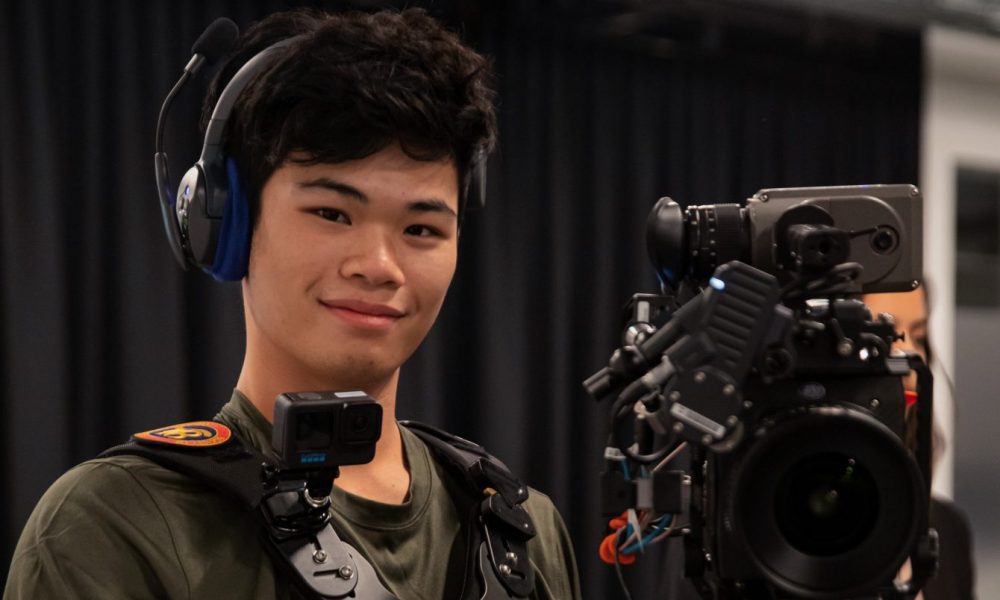
Today we’d like to introduce you to Bo-Yu Chen.
Hi Bo-Yu, thanks for joining us today. We’d love for you to start by introducing yourself.
Initially, I wanted to be an actor; my first time on a film set, I saw the camera work, and I knew that was where my heart actually was. I learned my craft on set by working in grip and electric; then, I started shooting everything that I could get my hands on for more experience. In that shooting process, I found camera movement to be a constant struggle, but I loved moving cameras. So, I found Steadicam, and everything clicked.
I did a cold reach out to my now mentor Greg Smith. He inspired and taught me how to be a camera operator with a specialization in Steadicam. I have been working and growing as a DP and camera/ steadicam operator ever since. I’ve been blessed and lucky for the wonderful mentors and peers who have guided me and helped me get here. Now, I want to keep refining my skills, learning new ones, and creating wonderful movies.
Would you say it’s been a smooth road, and if not what are some of the biggest challenges you’ve faced along the way?
Anyone can tell you it’s hard breaking into “the industry,” especially here in L.A. Getting on a film set is hard; once you’re there, it can feel overwhelming – with everyone so busy and you wanting not to get in the way. Luckily, I’ve had kind peers who helped me get a hang of set life. Finding projects to shoot is also challenging. After honing my craft, I still struggled to get work as a DP. I recall many reach-outs and rejections before some directors agreed to give me a shot. After those first projects succeeded, my reputation and opportunities as a DP grew exponentially. With Steadicam, I also grew fast after refining my technical skills and cutting my teeth on lower-budget projects.
Now, I am pursuing more professional projects. This also comes with challenges, as “moving up” becomes more difficult at each stage. Expectations grow along with competition for good projects. I am so grateful to the directors who trusted me with their projects and the crew who stuck with me to make things happen. My success is due in no small part to their help and guidance. It takes time to establish a reputation, and I am building one that I am very proud of.
Appreciate you sharing that. What else should we know about what you do?
I am a Director of Photography (DP) & Camera/Steadicam Operator. As the former, I set the look and tone of the storyline in a film by reading through the screenplay and consulting with the director to create the desired emotions within the story through lighting, framing, and different camera movements. While operating a camera or Steadicam, I work with the DP to execute their vision and create that same feeling they’re trying to convey. I love this work. It’s a good feeling – almost magical – when I create moods for scenes that end up perfect for the story. And, while I know roughly how things will look before I execute them because that’s my job, the unexpected, perfect little things brighten my day. This might be the sun catching a shade of tinted glass at just the right angle or an actor doing something that’s truly touching and beautiful. It could also be a superb camera angle we found to add so much power to the story. These fancy little surprises make my day!
I think that my can-do attitude and problem-solving skills set me apart in an industry that’s teeming with talent. I’ve been recognized by peers for my skill level, quick thinking, and resourcefulness. Especially as a Steadicam operator, I’ve mastered my workflow for ultimate efficiency. Continually refining this process down to the most minute details, I’ve reworked how I organize my gear and workstation. For example, I make sure all common components are within arm’s reach. With pre-prepped posts and accessories, I can go from a very high angle to very low within seconds. Combine that with a well-documented & memorized workflow; all common camera placements can be done before people even realize I’ve started adjusting.
Because I’ve worked as both a DP and a Steadicam operator, I am able to put myself in the shoes of the other. This allows me to make split-second decisions/suggestions that might include alternative ways to achieve a certain look/feel/purpose when the original way takes up too much time or too many resources.
Overall, no matter what challenge I’m presented with in pre-production, I will find a way to offer solutions and tools that are effective at telling the story while remaining suitable to the budget level and scope of the project. Additionally, I often think through different shots or movements within a scene on my own time to have multiple viewpoints and suggestions ready for whatever gets thrown at me. Because I have built and collected a large toolbox of solutions & a solid network of support, I enable the director and DP to be even more daring with their cinematography choices, knowing I am able to execute these.
Efficiency and quality are key for me as a DP as well. It is important for me, and for many directors and actors I work with, that the energy of the scene be maintained after we start filming. That means we avoid making changes between takes and minimize the setup time between shots. As the DP, I, therefore, have to devise a lighting plan before we start shooting that keeps all these moving pieces in mind and communicate with my team about the plan and workflow. The goal is for us to be as unobtrusive to the scene as possible while still maintaining quality visuals.
That said, there is also a fine balance between quality and efficiency that we must respect. Many people can get pretty shots, but I value the ability to get them fast. This is helpful for the budget but also in storytelling because we can get more shots filmed to forward the scene and/or directors and actors have more time to work the scene. My ability to produce great work fast helps other departments who are also essential for the project’s success have more of the limited allocated resources. That makes a better movie.
I am most proud of my continual improvement and skill-building. I’ve learned how to plan ahead, facilitate communication, be adaptive, and remain flexible to incorporate and embrace inspiration as it comes up.
My work as a DP has been predominantly in the narrative field, with one feature-length project and numerous short films. I also have Steadicam credits for narrative work, music videos, and in commercial shooting. Three films I’ve worked as DP for and six that I’ve been the Steadicam operator for are screening at the LA Shorts International Film Festival – an Academy & BAFTA qualifying festival.
These three DP projects are:
Upstream, Directed by Yintao Gong & Produced by Jessica Qinyue Luo & Alexa Feeney;
Flatulence: The Origin, Directed by Xingyu Harry Chen & Produced by Jessica Qinyue Luo & Xinchen Zhang;
Mom is Visiting, Directed by Meixuan Li & Produced by Bridget Gales amongst others, and co-DP by Vahan Bedelian.
My most notable steadicam credits include:
– “K Town Killer”, a short that premiered at the Tribeca film festival & directed by Vahan Bedelian & Healin Kweon, DP Donald Nam;
– “Little Saigon”, a feature that casts Vietnamese actor Hong Dao (from Netflix’s Beef) currently in post-production, directed by McFloyd Nguyen, DP Jacky Cheung) ;
– “Shaolin Avengers”, a short directed by Andy and Brian Le (Credits: Everything Everywhere All At Once, Shang Chi, Chinese Born American, etc.), and DP Khoi Nguyen, currently in post-production;
– Rooftop, a short with well know Korean actor Won Jong Lee (Money Heist: Korea & many others), directed by Byung Chan Jang, DP Patrick Krum, currently in post-production.
How can people work with you, collaborate with you or support you?
Please reach out to me via Instagram @boyufilm or email boyufilm@outlook.com
Contact Info:
- Website: boyufilm.com
- Instagram: https://www.instagram.com/boyufilm/


 Image Credits
Jessica Qinyue Luo Xingyu Harry Chen Vinh Pham Yukun Chan Healin Kweon
Popular
-
JordanL on ‘Breathe,’ Belief, and Building a Movement Beyond the Music
-
Megan Birney Rudert on How Access to Light Is Powering a More Sustainable and Equitable Future
-

Linda Kneidinger on Building Lasting Change Through Small Steps and Self-Compassion
-

Jolana Nika on Redefining Modern Connection Through Intentional, Real-Life Experiences
-
What did suffering teach you that success never could?
-
Who saw you clearly before you could see yourself?


