


Today we’d like to introduce you to Allison Honeycutt.
Every artist has a unique story. Can you briefly walk us through yours?
I grew up in a spiritual community in a small town in Iowa. As a child, I was always drawing and making art and with my father being a jewelry artist and silversmith it made the idea of growing up to be an artist seem quite natural. My parents always supported me in making art and doing what made me happy. I studied art in my home town at Maharishi University and at Nova Scotia College of Art and Design where I met some of my closest friends and learned to expand the scope of my art. After college, I traveled but always had Iowa to come back to as a home base, through this time I continued to make and show art and delve into my spiritual practice. Then,
someone very close to me died and I yearned to be in a place with more anonymity as well as more artistic opportunities so I could throw myself more into my art, so I moved to Los Angeles. LA has provided me with so many great chances to show my work, collaborate, and meet other amazing artists. I still visit my Iowa home a couple of times a year to recharge and get inspiration from the simple beauty and close community it holds.
Please tell us about your art.
I make a variety of different types of art, and always have my hand in a few series at a time, many that have stretched over many years.
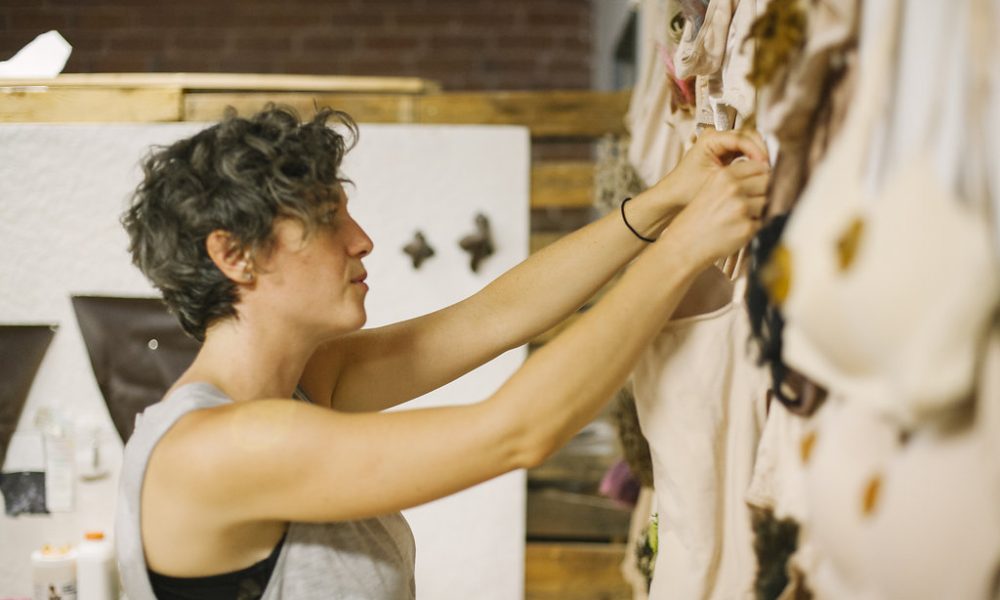
The two series that I am most involved in currently are my Fleshsuits and my Grief Bonnets, both fiber-based work. Working with fabric is a wonderful way to play with form and emptiness simultaneously when creating wearable art you have the opportunity to fill your piece and let it move or let it live as only an object like a discarded shell, beautiful and empty but telling the story of a life lived inside of it.
The Fleshsuits are wearable sculptures that I created to explore questions about nudity and body standards and societies imposed rules and aspirations for our bodies. Most of these pieces are made from flesh-toned underwear and other garments with nipples and pubic hair attached to them giving the appearance of false nudity. Most of the nipples I create by making molds, filling them with liquid latex and then painting them, but sometimes, as with the pubic hair, I use found objects. Some favorite materials I use for pubic hair include: wig fragments, fur scraps, honeycombs, wasp nests, dried seaweed, moss, grass fibers, birds nests, wool, and rope. The strangeness and exaggeration of the materials I use can give a lighthearted nature to the pieces and allow people permission to contemplate nudity and the human body in a new context. More recently I have started using the Fleshsuits in performance art pieces and have plans to do more collaborations with dancers and choreographers.
The Grief Bonnets are my newest work exploring all types of grief and its many nooks and crannies. They are modeled after a pattern of an antique sun bonnet, and the material I use to construct them comes (mostly) from second-hand stores; fabric scraps, discarded sheets, or used clothing give an extra presence to the pieces. The Grief Bonnets are inspired by my own experience navigating grief while moving through the world. They represent a portable place of privacy, comfort, safety, and maybe something secret.
I am currently developing work that combines the Fleshsuits and the Grief Bonnets.
Do you have any advice for other artists? Any lessons you wished you learned earlier?
There is no one way to be an artist.
It’s okay to take breaks from making art if you need to, for some people it’s important to have that type incubation time, you will not get stripped of the right to call yourself an artist.
Experiment with as many materials and techniques as you can.
Don’t get chained to perfection, there is a lot of beauty and skill to be found in the wild and the sloppy.
Seek out collaboration, it’s a great way to expand the boundaries of your art and to see closely how other artists work.
Don’t get caught up in comparing your art to that of other artists, embrace your own unique style and work to bring that to its fullest,
How or where can people see your work? How can people support your work?
People can see my current and past work on my website and on my Instagram. The best way people can support me is by attending my exhibitions, visiting my website, following me on Instagram, and by inquiring about any art that you might want to purchase.
Contact Info:
- Website: allisonhoneycutt.com
- Email: [email protected]
- Instagram: @allisonhoneycutthunt @honeycuttart


 Image Credit:
Rainbeau Tharp, Allison Honeycutt, Hilary Nelson
Suggest a story: VoyageLA is built on recommendations from the community; it’s how we uncover hidden gems, so if you or someone you know deserves recognition please let us know here.
Popular
-
Cedar Boschan on Elevating Black Music Rights and Driving Urgent Conversations Around Credit, Equity, and Artist Protection
-

Portraits of the Valley
-

LA’s Most Inspiring Stories
-

Robin Olive on Building an Inclusive Performing Arts Movement and Expanding Opportunities for Every Student
-

Que Johnson on Building Brands That Last: From Visibility to True Market Authority
-

Christina Wren Steps Into the Director’s Chair to Tell Stories That Feel Like Home