




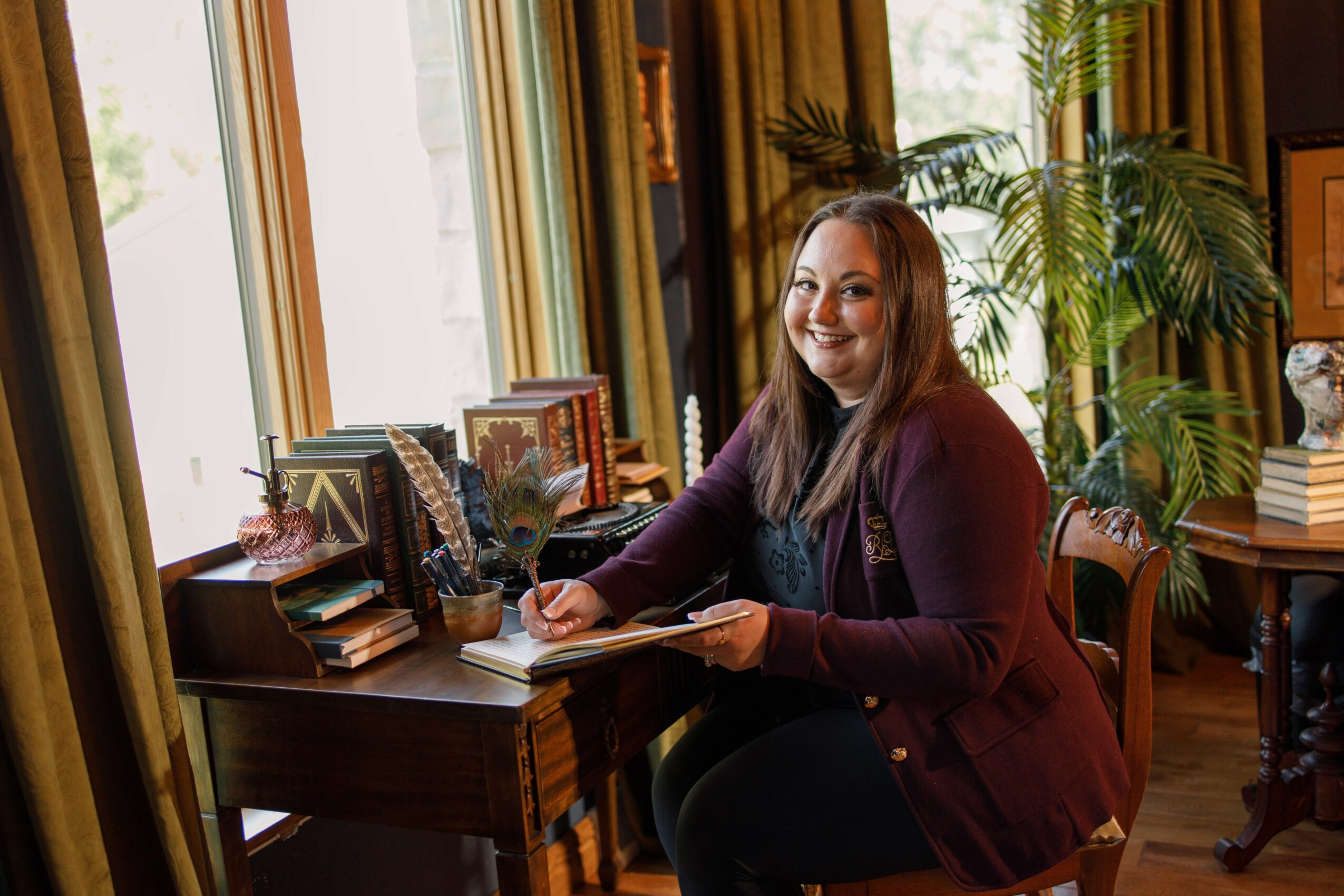
Today we’d like to introduce you to Alina Wells.
Hi Alina, thanks for joining us today. We’d love for you to start by introducing yourself.
I think my story really starts with the fact that I’ve always been a writer.
Growing up, I was the kid who hid that she was reading books on her lap under her desk during class or was often caught scribbling something into a notebook that had nothing to do with algebra. I wrote poetry, created characters, drew maps of imaginary worlds, and spent a frankly unreasonable amount of time daydreaming. Writing was the thing that came most naturally to me, so eventually I pursued a degree in journalism with a minor in creative writing.
Then I graduated, entered the “real world,” and discovered that knowing what you love doesn’t necessarily mean knowing what you’re supposed to do with it. Like so many post-graduate creatives, I fell into the trap of doing the “sensible” thing instead of pursuing my writing.
By 2019, I was working a sales job I hated, newly engaged, and going through what I can only describe as my quarter-life existential crisis. Eventually, a toxic work environment pushed me to leave my job, and I found myself trying to answer a much bigger question: if I wasn’t going to follow the path I thought I was supposed to, what did I actually want to build instead?
The answer became Writing It Wells, which I launched in December 2019.
It originally began as a literary blog where I could combine my background in writing with my love of helping other writers. I didn’t start it with some grand business plan or a big-picture understanding of exactly what it would become. I simply started writing.
A few months later, of course, 2020 arrived and the world changed dramatically because of Covid. In a strange way, that period gave me even more reason to keep pouring myself into this little thing I had created. The rest of the world might have hated quarantine, but to a writer like me, being unexpectedly given endless alone time to spend on the page was a blessing in disguise.
Over the next six-plus years, Writing It Wells grew alongside me. The blog expanded into professional developmental editing, author education, an online community of thousands of writers, my newsletter The Wellspring, creative projects and resources, brand collaborations, and a platform where I get to talk about storytelling every day.
I’m also still an author myself. That has always mattered to the way I approach Writing It Wells because I understand what it feels like to be on the other side of the editorial relationship. I know how much courage, time, vulnerability, and sheer stubbornness can go into writing a book. I never want an author to walk away from working with me feeling as though I’ve taken ownership of their story. My job is to help them see what their story can become while protecting the voice and vision that made it theirs in the first place.
Today, Writing It Wells sits at the intersection of so many things I love: storytelling, editing, education, creativity, books, and community. What began as a literary blog has grown into a business and creative platform that I never could have fully imagined when I launched it in 2019, and I’m still discovering what it’s meant to become.
Looking back, it’s funny to think that leaving a job I hated helped push me toward creating a career I never would have known to apply for.
Sometimes the path that doesn’t go according to plan ends up becoming the story.
Would you say it’s been a smooth road, and if not what are some of the biggest challenges you’ve faced along the way?
Definitely not. I think one of the hardest things about building a creative business is that there isn’t necessarily a map for where you’re going, especially when what you’re building keeps evolving.
Writing It Wells has grown slowly and organically over the past six-plus years. There was never a moment when I woke up and suddenly had thousands of followers, a full client calendar, or a perfectly defined business model. There have been a lot of small wins stacked on top of one another, and plenty of periods where I was putting an enormous amount of work into something without knowing when, or if, any of it would work.
Learning to trust that process has probably been one of my biggest challenges.
There’s also a strange identity shift that happens when something you started because you love it becomes a business. Suddenly, being good at writing or editing isn’t enough. You have to learn marketing, sales, strategy, branding, contracts, finances, client management, content creation, and a dozen other skills nobody mentioned when you decided you wanted a creative career. I’ve had to learn most of those things by doing them, getting some of them wrong, and trying again.
And then there’s the internal side of it. I’ve had to learn how to take myself and my ambitions seriously. There have absolutely been moments of imposter syndrome, comparison, creative burnout, and wondering whether all of the work I was putting in would eventually become the thing I could already see so clearly in my head.
I think one of the biggest lessons I’ve learned is that growth doesn’t always look impressive while you’re inside of it. Sometimes it looks like changing direction. Sometimes it looks like an idea that doesn’t work. Sometimes it’s spending months building something only to realize you’ve outgrown it. And sometimes it’s continuing to show up when nothing particularly exciting is happening.
But when I look back at Writing It Wells in 2019 compared to what exists today, all of those seemingly small decisions compound. The business I have now wasn’t built by one lucky break. It was built by years of learning, experimenting, adapting, and refusing to stop imagining what else it could become.
I’m still figuring things out. I hope I always am. I think that’s part of what keeps the work interesting.
Alright, so let’s switch gears a bit and talk business. What should we know about your work?
At its heart, Writing It Wells is an educational resource for fiction writers. Everything I create comes back to one central idea: helping writers understand the story they want to tell, strengthen their knowledge of craft, and build a sustainable creative life that allows them to keep doing the work they love long-term. Essentially, it’s the kind of roadmap I wish I’d had myself, built from what I’ve learned navigating the creative life from both sides of the page. Currently, I offer two paths to achieve this: developmental editing and education.
As a developmental editor, I specialize primarily in fantasy and romantasy, working with authors on the big-picture elements of their manuscripts: story structure, character development, pacing, emotional arcs, worldbuilding, relationships, tension, and all of those interconnected pieces that make a story memorable. The goal is to understand what they’re trying to create and help them make that version of the story as strong as possible, while clarifying anything the author might not fully see for themselves. It’s an intricate dance of clarity and collaboration.
Education has always been woven into Writing It Wells, but it has become an increasingly important part of where I’m guiding the company. I create writing and editing resources, teach craft through my online platforms, write The Wellspring newsletter, and develop educational products and creative experiences designed to make professional-level storytelling knowledge more accessible to writers at different stages of their careers.
I also talk about something I think gets overlooked when we teach writing: the emotional side of being a writer. Burnout, rejection, comparison, perfectionism, creative confidence, and sustaining a relationship with your creativity all affect what eventually makes it onto the page. Teaching writers how to navigate these challenges and an industry that can take an emotional toll is one of my greatest goals as an educator.
I think that combination is a big part of what sets my work apart. I care deeply about the technical side of storytelling, but I’m equally interested in the human being creating it. You can understand story structure perfectly and still be terrified that your book isn’t good enough. You can know exactly what needs to change in a manuscript and still feel completely overwhelmed by revision. Writers don’t stop being people when they sit down at their desks, and I don’t think we should teach or edit as though they do.
Being an author myself shapes that philosophy enormously. I know what it feels like to spend years with a manuscript, to rewrite something again and again, to question whether an idea is working, and to care deeply about a fictional world that exists primarily inside your own head. That experience helps me better serve the authors who come to me for help. Whether I’m editing or teaching, I want writers to leave with a better understanding of their own storytelling journeys and greater confidence in their ability to make decisions about their work.
As for what I’m most proud of, it’s probably the trust I’ve built with writers.
I’m proud of the manuscripts I’ve helped shape and the authors who have trusted me with stories that mean an enormous amount to them. I’m humbled that thousands of writers have chosen to be part of the community I’ve built online. And I’m honored when someone tells me that something I taught changed the way they looked at their story, helped them start writing again, or simply made them feel understood during a difficult part of the creative process.
Writing It Wells began as a literary blog, grew into an editing business, and is now growing again into something much larger: a place where writers can find education, resources, professional support, and community throughout different stages of their creative lives.
I think that’s ultimately what I want Writing It Wells to be known for: helping writers create better stories while building a writing life they can actually stand behind.
What were you like growing up?
I was imaginative to an almost ridiculous degree.
I was constantly inventing something. Stories, characters, imaginary worlds, elaborate games, performances, little projects I had decided were suddenly very important. I could entertain myself for hours if you gave me books, paper, art supplies, or enough space to disappear into my own head. My mother was instrumental in shaping these pursuits. I think she recognized fairly early that I was meant to be an artist, and she actively encouraged me.
I was also incredibly curious. I loved learning, but usually on my own terms. If something interested me, I wanted to know everything about it. If it didn’t…well, there was probably a novel hidden somewhere nearby. I think that combination of curiosity and stubborn independence has followed me pretty faithfully into adulthood.
Books were obviously a huge part of my childhood. I loved fantasy in particular because I was fascinated by the idea that someone could create an entire world out of nothing and somehow make another person believe in it.
I was particularly inspired by Tamora Pierce’s novels. I still remember the day I first discovered *Alanna: The First Adventure*. I was in a children’s thrift store and I begged my mom to get me the first and second book from where I was standing in the ball pit. I took them home, read them, and thought, “I’m going to be an author and write stories about lady knights someday.”
Fast forward to today and I am, indeed, writing a story about a lady knight.
I was also naturally observant. My mother used to tell me that even when I was small I would hold back and study what everyone was doing before I would decide to join in. I paid attention to people, relationships, conversations, and all the tiny details that made someone interesting. I think that’s probably where some of my fascination with character comes from now. Even today, character psychology and the question of why people make the choices they do are some of my favorite parts of storytelling (and who doesn’t love eavesdropping on café conversations? I mean, that’s just fun!).
At the same time, I’ve always had a fairly ambitious streak. When I became interested in something, I didn’t really know how to engage with it halfway. I wanted to make things, improve them, understand them, and see how far I could take an idea. I think some of that entrepreneurial streak came from my father, who embarked on his own business journey while I was growing up and taught me how to balance risk with bravery. If something didn’t turn out the way you hoped, you got up and kept trying.
Looking back, there are definitely pieces of the person I am now that were already there—I just didn’t have names for them yet.
Mostly, though, I remember being someone with a very large internal world. I think adulthood teaches us to become a little more practical, and one of the things I’ve consciously tried to do as I’ve gotten older is protect that part of myself.
It turns out the kid who spent far too much time living in imaginary worlds actually had the right idea.
Pricing:
- Developmental Editing: $0.03/word
- Manuscript Critique: $0.025/word
- A 15% booking fee reserves your project on the Writing It Wells editing calendar.
- Free sample edits are available for authors who would like to experience my editorial approach before booking.
- Additional services and add-ons are available depending on the needs of the manuscript. Current services, availability, and pricing can be found at writingitwells.com.
Contact Info:
- Website: https://writingitwells.com
- Instagram: @writingitwells
- Facebook: @writingitwells
- Other: Tiktok: @writingitwells and Pinterest: @writingitwells


Image Credits
Amy Lawson
Popular
-
Greg Hex Is Turning the Everyday Kitchen Knife Into a Modern Design Object
-

Portraits of the Valley
-

LA’s Most Inspiring Stories
-

Rick Norris Learned That Building a Successful Business Means Building a Life You Actually Want to Live
-

How Olivia Rush Turned Survival Into a Mission to Help Others Keep Going
-

How Bibi Goldstein Is Helping Entrepreneurs Reclaim Their Time by Embracing the Power of Delegation


