




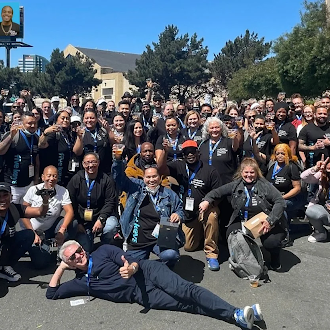
Today we’d like to introduce you to Steve GOOD.
Hi steve, please kick things off for us with an introduction to yourself and your story.
It started, improbably, with a Craigslist job posting.
In 2007, I wasn’t looking to transform Five Keys into one the nation’s largest second-chance organizations—I was simply looking for my next role. I had just finished a chapter as a middle school principal in San Francisco and had previously worked as an executive in a national education organization. Like many people at that stage in their career, I was ready for something new.
What I found was unexpected: a posting for a principal position at a school operating inside the San Francisco County Jail.
I had no experience working with incarcerated individuals or in adult education. My background was in traditional K–12 education. But something about the opportunity intrigued me—the idea of running a school inside a jail, in partnership with the Sheriff’s Department. It felt different. It felt meaningful.
So I took the job.
Then came the reality check.
Once I got a look at the organization’s finances, I remember turning to my wife and wondering if I had made a mistake. At the time, Five Keys was small—just 12 employees, one school site, and a budget of roughly $2 million. At home, I had young twins. Stability mattered.
But I had already committed. So I stayed.
What followed wasn’t a straight line. It was a steady expansion of both the work and the vision. When I first arrived, Five Keys wasn’t a second-chance employer. That became part of the work—intentionally building it into what is now one of the largest second-chance employers in the nation.
Today, Five Keys looks dramatically different. We operate with a $136 million budget and employ more than 1,200 people across California—about half of whom are formerly incarcerated. Our work spans 14 county jails, prison-based programs, more than 2,000 beds of supportive housing and shelter, and a broad range of workforce development and reentry services. We even operate a farm in Norco.
And yet, despite all that growth, I still think of us in very simple terms.
At our core, we are a workforce development organization. We take people coming out of jail and prison and provide real opportunities—training, living-wage jobs, and benefits like health insurance. We’re not just helping people get by—we’re helping them rebuild their lives.
In many cases, that transformation begins before release. Individuals enroll in our programs while still incarcerated, earn their high school diploma, transition through reentry support, and ultimately come to work for us. Some of our strongest staff started exactly that way.
It’s one of the things I’m most proud of.
Of course, none of this was built by one person. It reflects the work of an extraordinary leadership team, a deeply committed board, and the enduring vision of our founder, Sunny Schwartz.
That said, the work hasn’t always been easy.
In the early years especially, I heard a lot of skepticism. People would ask why we were investing in computers, education, and resources for individuals who were incarcerated when many families in the community were struggling to access the same.
My answer has always been straightforward.
Everyone who is incarcerated is going to return to our communities. The question is: who do we want coming back?
Do we want individuals who have had the opportunity to grow, become employable, and rebuild their lives? Or individuals who have had no support and may return worse off?
For me, the answer is clear.
This work makes communities safer. It reduces crime. It saves millions of dollars in reincarceration costs. And it helps reunite families. Children of incarcerated parents are far more likely to end up in the system themselves—but when we interrupt that cycle, we change entire futures.
Today, we see that impact in the data. While recidivism rates can reach as high as 60 percent, outcomes for those connected to Five Keys are significantly lower—saving the state millions, if not billions, of dollars.
But beyond the numbers, it’s about something more fundamental.
It’s about transformation—of individuals, of families, and of communities.
What began as a simple job search has become a lifelong commitment to that idea. And I feel incredibly fortunate that I didn’t scroll past that posting.
Would you say it’s been a smooth road, and if not what are some of the biggest challenges you’ve faced along the way?
Not even close. There has been no shortage of obstacles.
Early on, one of the biggest challenges was simply the idea of operating a school inside a county jail. Even in San Francisco, where we had strong support from the Sheriff and command staff, there was resistance from some deputies who questioned why we were treating incarcerated individuals with dignity and investing in their education.
When we expanded to Los Angeles, we faced many of the same challenges. What made a difference there was a deputy named Dave Bates. He became a strong internal advocate, helping build trust within the Sheriff’s Department and demonstrating that well-run educational programs actually make jails safer—for staff and for those incarcerated. In fact, he believed in the work so much that he eventually left the department to join Five Keys.
But those were just some of the early hurdles.
There has also been ongoing skepticism from parts of the broader community—particularly from those who take a more punitive view of justice and don’t always see or understand the public safety value of this work. We’ve had to consistently make the case that investing in people returning from incarceration isn’t just the right thing to do—it’s the smart thing to do.
Funding has been another constant challenge. Like many organizations in this space, we operate in an environment where revenue can be uncertain and often declining. At the same time, being a second-chance employer requires a significant level of investment—training, support, supervision, and a deep commitment to meeting people where they are. It’s incredibly meaningful work, but it can also be exhausting.
There’s also the personal toll. The long hours, the travel across the state, the responsibility of sustaining programs that so many people rely on—it adds up. And the work itself is not easy. We serve individuals who are incarcerated, formerly incarcerated, or experiencing homelessness. We operate programs in some of the most challenging environments, including shelters and sites in places like Skid Row, where even providing basic dignity—like access to showers and restrooms—can be a daily challenge.
This is hard work. There’s no way around that.
But for all the obstacles, the rewards far outweigh them.
When you see someone earn their diploma, secure a job, reunite with their family, and begin to rebuild their life—it reinforces why this work matters. It reminds you that the people many others have written off are, in fact, an incredible and often untapped resource—full of potential, resilience, and capacity for change.
That belief is what has carried us through the challenges. And it’s what continues to drive the work forward.
Thanks for sharing that. So, maybe next you can tell us a bit more about your work?
It’s funny—this isn’t the career I ever imagined for myself.
In fact, I spent nearly 10 years in college doing everything I could to avoid getting a job. I figured the more classes I took, the longer I could delay the inevitable of a 9-to-5. When I finally did choose a path, I went into teaching for what I thought were the practical perks—summers off and being done by 3 p.m.
What I didn’t expect was that I’d fall in love with the work.
Being a teacher turned out to be one of the most rewarding jobs I could imagine—working with young people, watching them grow, and seeing the impact you could have on their lives. Then I became a school principal, and I thought, this must be the best job. As a principal, you get to step into every classroom, connect with students across all ages, work closely with families, and see the broader impact of a school community.
It was meaningful work. And for a long time, I thought that was where my career would stay.
Then Five Keys happened.
I didn’t expect to find a calling in social services, and I certainly didn’t expect to build a career working with adults who are incarcerated, formerly incarcerated, or experiencing homelessness. But somewhere along the way, I discovered a deep sense of purpose in working with people who are often overlooked and underestimated.
It turned out to be the most rewarding work I could possibly imagine.
What makes it so meaningful isn’t just the mission—it’s the people. The colleagues I get to work alongside every day, from teachers to shelter staff to our leadership team and board, are deeply committed to making a real difference in people’s lives. This is work where you can see the impact every single day.
It’s in the big moments—watching someone walk across the stage at a high school graduation, or handing someone the keys to their first apartment after years of instability.
And it’s in the small, urgent moments too—our staff acting as first responders in shelters, administering Narcan and saving lives during overdoses. These aren’t abstract outcomes. These are real people, real lives, real second chances.
There’s also been the opportunity to work beyond direct service—engaging with city and state leaders, helping shape policy, and advocating for systems that are more just and more effective. Being part of that broader effort to create change has been incredibly fulfilling.
On a personal level, this career has given me a meaningful life—not just professionally, but for my family as well. It’s something I hope my kids can look at and feel proud of.
This work isn’t easy. There are real challenges, real obstacles, and tough days. But despite all of that, I can say without hesitation—it’s been a dream job.
I honestly can’t think of anything more rewarding than being part of work that changes—and sometimes saves—lives every day.
Let’s talk about our city – what do you love? What do you not love?
As a native San Franciscan—and a lifelong Giants fan—I’ll admit I was highly skeptical about coming to Los Angeles.
At first, the idea didn’t sit well with me. Like a lot of people from San Francisco, I carried a certain bias about L.A. But it turned out to be one of the best decisions we’ve made—not just professionally, but personally as well.
What changed my perspective was the people.
Working with the Los Angeles County Sheriff’s Department opened up an entirely new level of impact for us. It gave us the opportunity to bring education and training programs inside the county jails at a much larger scale. Along the way, we met individuals who challenged my assumptions—people whose commitment to this work runs deep.
One of those individuals is Dave Bates. He was a deputy with the Sheriff’s Department who helped build support for our programs from within. He saw firsthand how education and structured programming could make facilities safer and more effective. Eventually, he made the decision to leave the department and join Five Keys, believing he could do even more on this side of the work.
That kind of commitment says a lot.
Our work in Los Angeles has also allowed us to expand beyond the jails. At Rio Seco, we operate the largest tiny home village in Los Angeles for individuals who were previously unsheltered. It’s a remarkable site—a place where people have access to safety, cleanliness, meals, and medical care. Every day, we’re helping people stabilize and begin to rebuild their lives.
And then there’s the work in Skid Row—some of the most challenging conditions you’ll see anywhere. Even something as basic as providing access to showers becomes an opportunity to restore dignity. It’s simple, but it matters.
What I’ve come to appreciate about Los Angeles is its scale and its diversity. It’s a true melting pot, with communities facing immense challenges—but also filled with people who are deeply committed to being part of the solution. Across the county, our schools and programs are reaching individuals who need support the most, and we’re able to make a real difference in their lives.
I’ll be honest—I was wrong about L.A.
In fact, two of my sons now live here full-time. They made the move themselves, and they’ve embraced the city in their own way. They’re still Giants fans, of course—but even I have to admit, it’s hard not to appreciate players like Freddie Freeman or Shohei Ohtani.
At the end of the day, Los Angeles has created incredible opportunities for our team at Five Keys and for the people we serve.
And yes—the weather doesn’t hurt.
The traffic? That’s still a problem.
Contact Info:
- Website: https://www.fivekeys.org
- Instagram: fivekeysschoolsandprograms
- Facebook: https://www.facebook.com/FiveKeysSchoolsAndPrograms/
- LinkedIn: https://www.linkedin.com/company/five-keys-schools-and-programs/posts/?feedView=all
Popular
-

Linda Villines on Releasing Stored Struggle and Reclaiming Ease Through the Body
-

Candice Swanson on Honoring the Sacred Early Days of Motherhood Through Intentional Photography
-

Michael Johnson on Telling Untold Stories of Identity and Leadership Through SQUAD
-

Owning the Narrative: Drew Dusterhoff Steps Into Power with Lincoln Must Die
-

Portraits of the Valley
-

LA’s Most Inspiring Stories


