




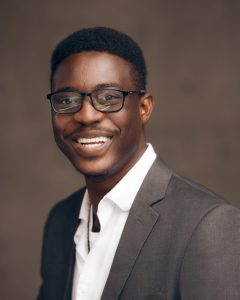
Today we’d like to introduce you to Prince Adu Mensah (Obrempong).
Hi Prince Adu, so excited to have you on the platform. So before we get into questions about your work-life, maybe you can bring our readers up to speed on your story and how you got to where you are today?
I grew up in a home where everyone wanted me to become a medical doctor to save lives. I was forced to read medical books at a very young age. Even though I enjoyed those medical books, I knew deep down that this isn’t what I want to do.
At the age of 15 years, I chanced on a film script in a taxi. That was my first time of seeing a screenplay. After reading the script I fell in love with writing. When I got home that night, I wrote 19 pages of a comedy script following the same script format that I had found in the taxi earlier on. I showed my script to my dad and he really laughed and enjoyed the story. The comedy story was about the killing of Osama Ben Ladin. My dad then took me to a Tv station in Ghana called TV3. We met with the producers of a very popular TV series called “Chorkor Trotro”, they loved the story and bought my script. That was my first income as a creative. The money was used to fund my education at St. Augustines College, Cape-Coast. At high school, I would put away my biology book and be writing scripts for the acting club. These stories made a strong positive impact in my school. I then realized that I could change a larger society if I focus on storytelling. I could also use storytelling to save lives just like a doctor.
I started getting recognized as a writer and I won the best writer for my school in 2014. My effort and recognition as a creative person changed my family’s ideology of me becoming a medical doctor. I had their maximum support when I decided to major in Filmmaking at the National Film and Television Institute (NAFTI) for my bachelor’s degree. As a survivor of child abuse, I wanted to use filmmaking as a medium to create awareness on the long-term negative impact of abuse on people especially children. So I started making films about abuse for my student project. My first short film was about child abuse titled “Adyiah”, this film opened the door of acceptance into the creative space. Later on, I moved into the US to pursue my master’s in Filmmaking at the New York Film Academy. I am currently in Los Angeles living the dream as a filmmaker with other great industry players.
Can you talk to us a bit about the challenges and lessons you’ve learned along the way. Looking back would you say it’s been easy or smooth in retrospect?
Obviously, it wasn’t smooth at the beginning. I had to convince my family to support my talent which wasn’t an easy thing to do especially coming from a country where “art is not really appreciated “. I wouldn’t blame them much, most parents in Ghana are scared to let their children pursue art simply because there are no proper systems that has been layed to favor the art industry. There is nothing painful than being in a society that does not see or appreciate the relevance of your talent. It renders you useless and that was my fear growing up as a filmmaker in Ghana. There are so many creatives who are scared to pursue art simply because there is no assurance of success for them. However, I am glad I got the opportunity to be in the US where I have studied and dunderstand the Hollywood system which someday I will go back to implement it in my country Ghana.
Can you tell our readers more about what you do and what you think sets you apart from others?
I am a filmmaker who is specialized in writing and directing. Sometimes I edit my own project depending on the workload. I am known for directing social expose’ films, documentaries and TV commercials. I have a signature or style that runs through all my films which makes it easier for my audience to identify my films. My film always begins with a monologue or dialogue on a black screen before actual pictures show on screen. The reason I do this is because I always want to set a silent atmosphere inorder to get my audience’s attention to the pictures. Mind you; the images in my films are very strong and sometimes sensitive that’s why I need their full attention. My films are open-ended films. I deliberately do that to get my audience to discuss the film even when they are out of the theater. It’s a “social issue” so they need to discuss about it which makes the subject or the theme in the film very important. One thing I’m proud of is that I never gave up on filmmaking despite all the challenges that come with it. I’m also proud of being able to move to the heart of filmmaking of the world (Hollywood) to get more filmmaking experience. This is enough evidence of how much I love film
Is there anything else you’d like to share with our readers?
Recently I have been on several platforms where I share stories to motivate the youth and children. I have found public speaking as one of my skills and I’m using it as medium to impact lives. I am open to any platform that invites me to share my knowledge and my experience.
Contact Info:
- Instagram: https://www.instagram.com/prince_obrempong_mensah/
- Facebook: https://www.facebook.com/princemensa11/
- Linkedin: https://www.linkedin.com/in/pmehnz


 Image Credits
Jidekol pictures
Popular
-

JordanL on ‘Breathe,’ Belief, and Building a Movement Beyond the Music
-

Megan Birney Rudert on How Access to Light Is Powering a More Sustainable and Equitable Future
-

Linda Kneidinger on Building Lasting Change Through Small Steps and Self-Compassion
-

Jolana Nika on Redefining Modern Connection Through Intentional, Real-Life Experiences
-
What did suffering teach you that success never could?
-
Who saw you clearly before you could see yourself?


