





Today we’d like to introduce you to Barbara Moroncini.
Hi Barbara, so excited to have you on the platform. So before we get into questions about your work-life, maybe you can bring our readers up to speed on your story and how you got to where you are today?
I am originally from Italy. I come from punk rock and metal, but permanent nerve damage ended any hope I had of continuing to play, so I went to City College to study music, and moved on to get a PhD in musicology and composition. I taught university for a few years, in California and in New Zealand, all the while trying to forget that institutions and I never were a good fit, until everything in me screamed to get out of that environment. I came back to Los Angeles and tried to find work outside of academia. This was right after the 2008 economic collapse and nobody was hiring. Everyone I knew in LA had moved away, and I ended up homeless for 15 months. Through that period I showered at the Hollywood YMCA, where I met a woman who had a dog walking business. She was moving to Oregon, and offered me to take on a couple of her clients. That’s when I discovered the magnificence of dogs. It was supposed to be a temporary gig to get me back on my feet, but these brilliant creatures kept on teaching me and changing me for the better, there were zero reasons to go suffer in some office. Going into dog training was a natural transition. Dogs are the best students I’ve ever had 🙂
Can you talk to us a bit about the challenges and lessons you’ve learned along the way. Looking back would you say it’s been easy or smooth in retrospect?
There are no smooth roads–at least not on my path.
At the beginning I got a lot of hits–I have scars on my arms and legs from dog bites, I’ve had stitches, black eyes, a broken lip, and innumerable bruises.
Dog training is an evolving practice, too. There are more and more studies conducted on dogs’ brains, and major universities now have dog psychology programs, so you must continue to educate yourself, stay current on new findings–which is not a struggle, but it’s work for which you are not directly remunerated.
Finally, when you are self-employed you end up working all the time. You can hardly refuse a gig, because you don’t know when the next one is coming, so you have periods of super intense activity, and, especially at the beginning, gaps that make you feel financially quite fragile. And you have to continuously put yourself out there. I am the worst hustler you’ll ever meet–self-promotion actually causes me physical pain–but there’s a lot of competition out there. You must self-promote. It’s a part of the job I truly dislike, so I mostly rely on word of mouth, which is not always ideal.
And of course, driving in Los Angeles. That is a major downer for everyone who lives here, and as a dog trainer you are in your car half of the day, going from location to location.
Thanks for sharing that. So, maybe next you can tell us a bit more about your work?
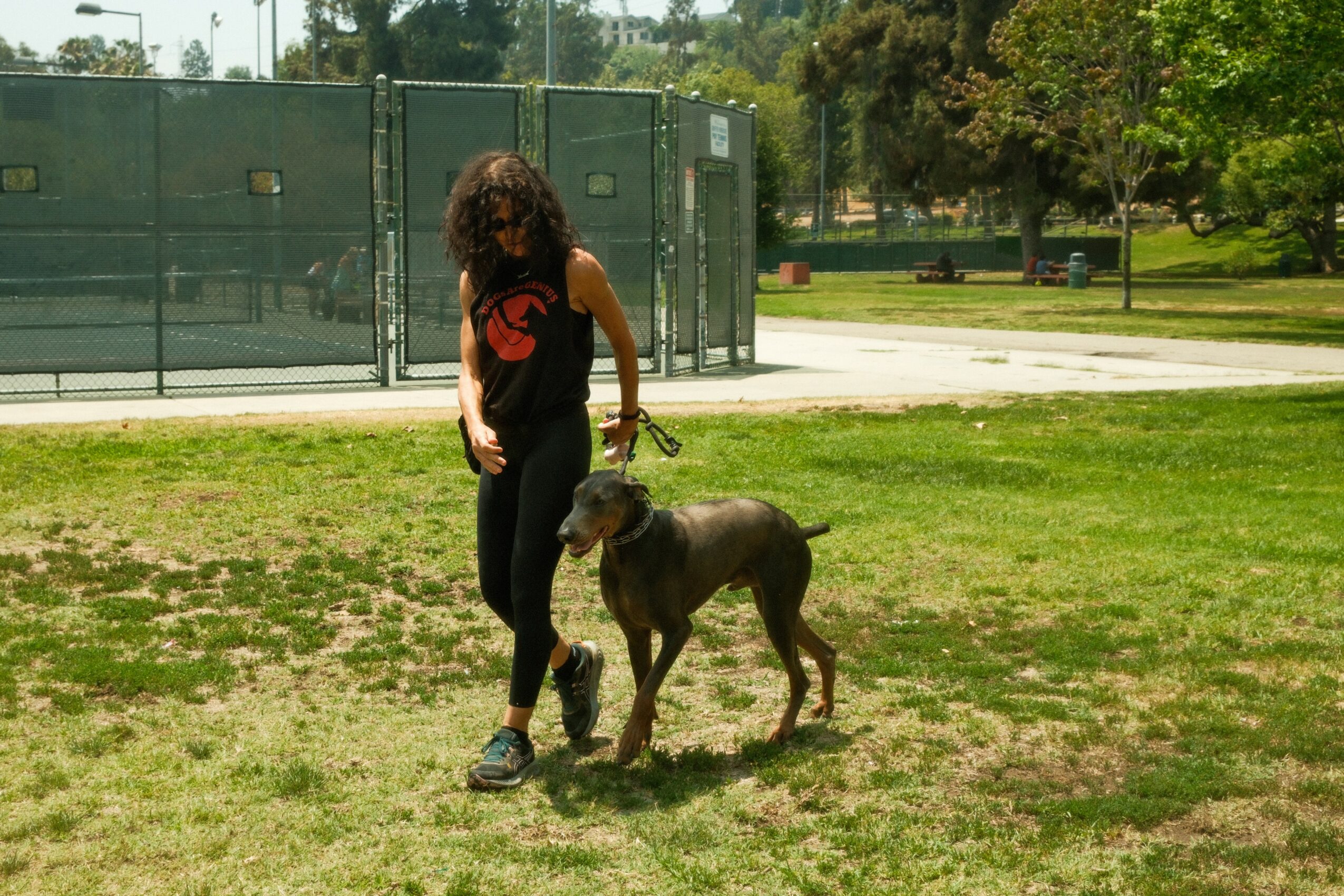
Working with dogs brings you in contact with all kinds of situations, and except for rare instances where there’s a physiological disorder in the animal’s nervous system, most of the behaviors owners want to correct are created by the owners themselves. We bring these predators into our homes and expect them to behave like children, we anthropomorphize them, assign them our own meanings, give them inconsistent and unclear messages that cause all kinds of confusions and little neurosis in our pets. That’s when I step in. Dog training is equal parts understanding what motivates the behavior, drilling to reshape neuropathways, and educating the owner. I try to come in with compassion for both dog and owner. I understand how frustrating it is to have a destructive, or an aggressive dog, and I also know for a fact that those are performances the dog feels like they need to enact in order to take care of needs that are not met by their guardian. Unfortunately there are a lot of mismatches in the owner-dog relationship. People get a specific breed, or even mutts, because they like their look, often not realizing they have a hunter, or a working breed, in their apartment. So a lot of it comes down to educating the owner and advocating for the dog, so that the animal’s natural inclinations and needs are met, and the relationship with their human is restored.
Networking and finding a mentor can have such a positive impact on one’s life and career. Any advice?
Look for the best in the field in your area, go meet them, let them see you are in it for real, and they will help you. If they can’t or won’t, don’t get discouraged. Move on and look for someone else. Stay curious, read all the books, watch all the videos, and most importantly, practice on all of your friends’ dogs. Even better, volunteer at your local shelter! Get to know all the dogs you can meet, watch them, see what drives them, what calms them down, what they respond to. Play with your tone of voice, practice your food handling skills, bring in a calm and assertive energy. In short, do your homework. The work will come!
Pricing:
- $100/h
Contact Info:
- Website: https://dogsaregenius.com
- Instagram: @dogsaregenius
Popular
-

Que Johnson on Building Brands That Last: From Visibility to True Market Authority
-

Christina Wren Steps Into the Director’s Chair to Tell Stories That Feel Like Home
-

Portraits of the Valley
-

LA’s Most Inspiring Stories
-

JordanL on ‘Breathe,’ Belief, and Building a Movement Beyond the Music
-

Megan Birney Rudert on How Access to Light Is Powering a More Sustainable and Equitable Future


