




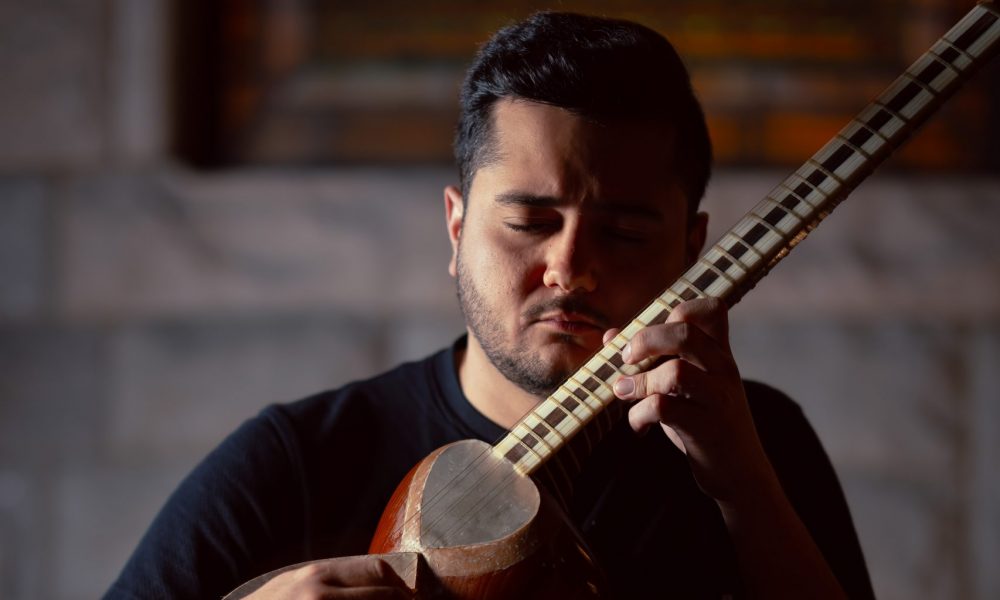
Today we’d like to introduce you to Ali Arshi.
Hi Ali, so excited to have you with us today. What can you tell us about your story?
When I was a child, my parents noticed my keen interest in watching music videos and attempting to mimic the singers’ voices. Despite no one in my family being musicians, they were excellent listeners of music. This interest led them to enroll me in a children’s music class at the age of five. After completing the Orff course, I chose the piano, which I think can be quite appealing at first glance for any child, and began learning. A year later, due to my strong interest in singing, my parents decided to send me to vocal classes as well, where I started learning traditional Iranian music under Master Mahmoud Golpayegani and Master Akbar Golpayegani. After some time, upon my vocal teacher’s suggestion, I began learning the Tar with Master Ferydoon Ehteshami, as learning an Iranian instrument alongside traditional Iranian singing aids in developing an ear for and singing microtonal intervals. My growing passion for music and participation in music festivals from a young age made music a significant part of my life, to the point that I preferred it over any other activity. Typically, in my country at that time, families were hesitant to have their children pursue music or arts academically, favoring engineering and medical fields instead because they believed the arts had no future career prospects. Nonetheless, my parents fully supported us at that time and, following my music teachers’ advice sent me to the Tehran Music School.
During my six years of study at the music school, where I learned both Western classical music and traditional Iranian music, my interest in composing grew day by day. I remember recording several pieces I had composed with the help of my classmates who were instrumentalists outside the school studio. At the same time, I was also organizing various concerts outside of school and dedicating myself to my own compositions. After completing my pre-university education, I decided to take the national entrance exam for art and music to try my luck at getting accepted into the University of Tehran. After a year focused on the entrance examination, I successfully received a full scholarship from the University of Tehran for music. It was during this period that I began to establish myself as an independent artist. It wasn’t long before I performed a project of my own composition, “Far Away but Close,” at numerous concerts. Meanwhile, I participated in various recording sessions, many of which were significant for film and television music. Getting to know Christophe Rezai and receiving guidance from him, as well as playing in his film projects, significantly heightened my interest in composing for film and media. This ultimately led me to act in a scene of “La Minor,” the latest film by Dariush Mehrjui. At the same time, I became disillusioned with the university due to the oppressive environment and the increasing pressure on protesting students, the disregard for the demands of freedom-seeking students, and the violent actions of security forces and police, including arrests and issuance of long-term prison sentences. One of those days, I decided to migrate, a decision that meant leaving behind my country, family, friends, and everything else one is attached to.
The ideal choice for me to study abroad was Berklee College of Music because it is a contemporary music school, and as an Iranian musician, I needed a place with a global perspective to showcase what I knew about traditional music from my country. Berklee was also one of the best options for studying film music composition, prompting me to apply. To attend Berklee’s entrance exam, I traveled to Bangkok since there was no closer venue to Iran at the time. After an 8-hour flight, I met with a team from Berklee the following day and auditioned. As soon as I returned to Iran, COVID-19 started, causing everything to shut down, but one of those days, I received an email from Berklee indicating that I had been awarded a full-tuition scholarship to participate in their bachelor’s program, which was a significant event for me. Meanwhile, I decided to release a single named “where are you,” which resonated with my feelings during those days, and it received considerable attention. After COVID-19 subsided somewhat, it was time to apply for a visa. Due to the absence of a U.S. embassy in Iran, I had to go to another country to apply, eventually obtaining my visa during COVID times from the U.S. Consulate in Karachi. Finally, I arrived in Boston in December 2020.
Adapting to life as an independent person in a new country was initially challenging, but gradually, life found its flow, and I began playing with talented musicians from around the world, which was very enjoyable. Since 2020, I have had numerous performances across the United States. I currently have a band with my friend RazAvaz, with whom we perform independently. I must also mention that during this time, I was honored with the Division Achievement Awards from Berklee. Parallel to performing, all my focus is on composing for film and media, seeing my future in this field. Nowadays, writing music for the screen occupies a significant part of my life, and my goal is to reach Hollywood and compose music for it.
We all face challenges, but looking back, would you describe it as a relatively smooth road?
My journey to where I am today has been anything but smooth, marked by numerous challenges inherent in pursuing music within and beyond Iran. The cultural and societal backdrop of Iran posed the first set of challenges, where the path of a musician is often viewed with skepticism due to restricted freedoms and limited career prospects. Despite my family’s support, moving beyond these confines meant facing the daunting process of obtaining a U.S. visa as an Iranian student, a journey complicated by geopolitical tensions and logistical hurdles, including traveling to another country just to apply. Financial pressures as an independent musician and adjusting to a new culture after leaving everything familiar behind—my country, family, and friends—added layers of difficulty. Adapting to life in the U.S., building a new network, and navigating the music industry’s complexities were formidable tasks.
However, these challenges have been instrumental in shaping my resilience and determination. Attending Berklee College of Music on a full-tuition scholarship was a turning point, offering new opportunities for growth and creativity. Despite the hardships, the journey has been rewarding, allowing me to collaborate with talented musicians globally and focus on my passion for composing for film and media, with aspirations to make music for Hollywood. The road has been rocky, but each challenge has brought me closer to realizing my dreams.
Alright, so let’s switch gears a bit and talk business. What should we know about your work?
In my work, I traverse a diverse musical landscape, bringing together a rich tapestry of sounds that blend traditional Iranian music with contemporary, classical, and fusion genres. Known for my versatility, I specialize in composing across various domains—ranging from classical Persian compositions and film scores to contemporary writing and fusion music. My compositions often carry the distinct colors of Iranian music, a testament to my roots and a unique aspect that sets me apart in the music industry.
What I’m most proud of is my ability to wear multiple hats simultaneously—as a performer, singer, and composer—each role enriching my musical journey with varied perspectives and insights. This multifaceted approach has not only allowed me to grow and evolve as an artist but also to stay current with music technology, keeping me attuned to the latest trends and innovations in the music industry.
My journey from Iran to the global stage has been fraught with challenges, from navigating societal expectations in Iran, where pursuing music professionally is often discouraged, to overcoming the logistical and emotional hurdles of migrating to the U.S. for further studies at Berklee College of Music. The process of adapting to a new culture, along with the financial pressures of being an independent musician, has tested my resilience at every turn. Yet, these experiences have been invaluable, shaping me into a determined artist committed to my craft.
What sets me apart is not just the breadth of my musical abilities but the depth of my experiences. From the early support of my family, through the rigors of music education in Tehran and Berklee, to establishing myself as an independent artist in a new country, each step has contributed to a rich, nuanced understanding of music’s power to transcend boundaries. My ultimate aspiration is to compose music for Hollywood, a dream that represents not just a personal achievement but the culmination of a journey filled with perseverance, passion, and the unyielding belief in the universal language of music.
Can you talk to us a bit about happiness and what makes you happy?
One of the things that brings me the most joy is being productive and creative. I’m not referring only to creativity in music but in everything, for example, cooking. I also really enjoy literature and sometimes write poems. In general, being with people and friends is a major source of happiness for me. I really like walking around busy cities and traveling to different places in the world. And I hope that I can visit my family soon after 4 years, which is going to make me even happier.
Contact Info:
- Website: https://open.spotify.com/artist/35chhoPVXNywXqgP2ul3n1?si=o2HguSncQDy-XuPIeco_gg
- Instagram: https://www.instagram.com/aliarshi?igsh=MTk3b2ZiaHByb2Z6bg%3D%3D&utm_source=qr
- Facebook: https://www.facebook.com/ali.arshi.9
- Youtube: https://youtube.com/@aliarshi1645?si=1dUc6YK7py5jbEqn
- SoundCloud: https://on.soundcloud.com/sgXi68Uw6kCmLo367
Image Credits
Nima Nazemi
Popular
-

Que Johnson on Building Brands That Last: From Visibility to True Market Authority
-

Christina Wren Steps Into the Director’s Chair to Tell Stories That Feel Like Home
-

Portraits of the Valley
-

LA’s Most Inspiring Stories
-

JordanL on ‘Breathe,’ Belief, and Building a Movement Beyond the Music
-
Megan Birney Rudert on How Access to Light Is Powering a More Sustainable and Equitable Future


