




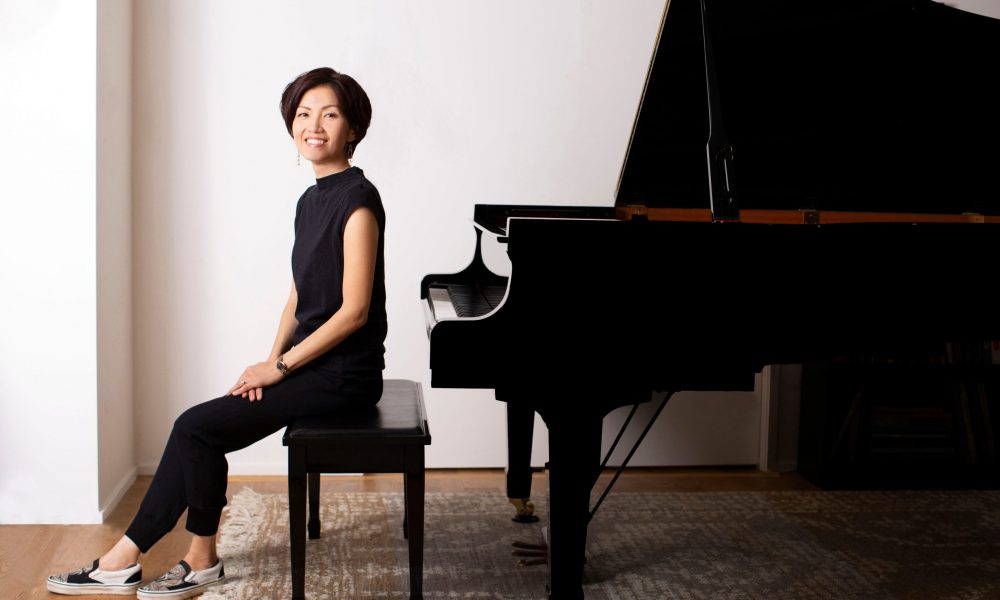
Today we’d like to introduce you to Aiko Fukushima.
What’s your story behind working on the Netflix Animated Series, “Samurai Rabbit: The Usage Chronicles”? How did that come to you?
I took a career seminar about five years ago in Hollywood with some entertainment creatives and met a writer/producer, Shari Ellis. After the workshop ended, she suggested having monthly “check-in” meetings with four other women writers/producers who were in the same group and we are still meeting every month after five years. Shari happened to be working on the “Samurai” project as an associate producer, and she introduced me to Gaumont Films, who created the animation series along with Netflix. I had the opportunity to pitch for the project. They asked me to incorporate Japanese traditional instruments but avoid the typical bombastic Hollywood action music. I recorded three different Taikos, shakuhachi, shinobue, and koto for initial pitch. For the whole series, I recorded many other Japanese instruments including conch, hichiriki, ryuteki, biwa, shamisen, hochiku, den den daiko, binsasara, mukkuri, kokyu, uchiwa daiko, taishogoto, also western instruments like violin, cello, trumpet, french horn, tuba, guitar, musical saw, bones, theremin, also hip-hop 808 synths and beatbox.
This animation series was based on Stan Sakai’s beloved comic book “Usagi Yojimbo” that he has been writing for 38 years. As soon as I started the project, I quickly realized it was my dream job. I was so excited to be able to explore many Traditional Japanese instruments and create so many themes (More than 40 of them!) for characters and situations using my sensibility from growing up in Japan.
Alright, so let’s dig a little deeper into the story – has it been an easy path overall and if not, what were the challenges you’ve had to overcome?
When people get into learning traditional Japanese instruments, they are often carried through generations in families, and even the same instrument has different ways of playing based on the original family or person who invented the style. I wanted to be respectful of the tradition, but producers wanted me to combine that with hip-hop elements for the team of young warriors. So I needed to find some players who were okay with mixing the genre up. Another challenge was to find musicians who could record remotely with professional quality. After many tryouts, I found a group of super-talented musicians in LA, NY, Switzerland, Spain, and Japan who brought life to my writing. I even found some of them by researching on YouTube and contacted them out of blue! It was a challenging but rewarding experience.
In terms of your work and the industry, what are some of the changes you are expecting to see over the next five to ten years?
I am not going to lie – it is still hard to get a film/TV composer job because everybody wants to do what we do. It is so much fun to write music, as you can imagine! It used to be hard to gain the trust that women could deliver the job, but the industry has opened up so much that many diverse & talented people are working on good projects. I need to keep myself up! I used to think that I had to become somebody, but after many attempts, I finally found that I have to be myself and do what I believe. I am not for everybody, but if my music can make somebody’s heart tickle, I am doing something right.
Besides working as a composer, I founded a Children’s Japanese Chorus three years ago. That has been a major source of happiness. Working with children is the most challenging and rewarding experience, and I feel honored to be part of their lives. I have high respect for all the teachers who are helping those children to build their futures!
Contact Info:
- Website: https://www.aikofukushima.com/
- Youtube: https://www.youtube.com/playlist?list=PLLR0hkgKoWKGaStMN4YPbRCEnrc4TwzBb
- Other: https://play.reelcrafter.com/AikoMusic/sample

 Image Credits
©KaoriSuzuki (first photo)
Popular
-

Christina Wren Steps Into the Director’s Chair to Tell Stories That Feel Like Home
-

Portraits of the Valley
-

LA’s Most Inspiring Stories
-

JordanL on ‘Breathe,’ Belief, and Building a Movement Beyond the Music
-

Megan Birney Rudert on How Access to Light Is Powering a More Sustainable and Equitable Future
-

Linda Kneidinger on Building Lasting Change Through Small Steps and Self-Compassion


