




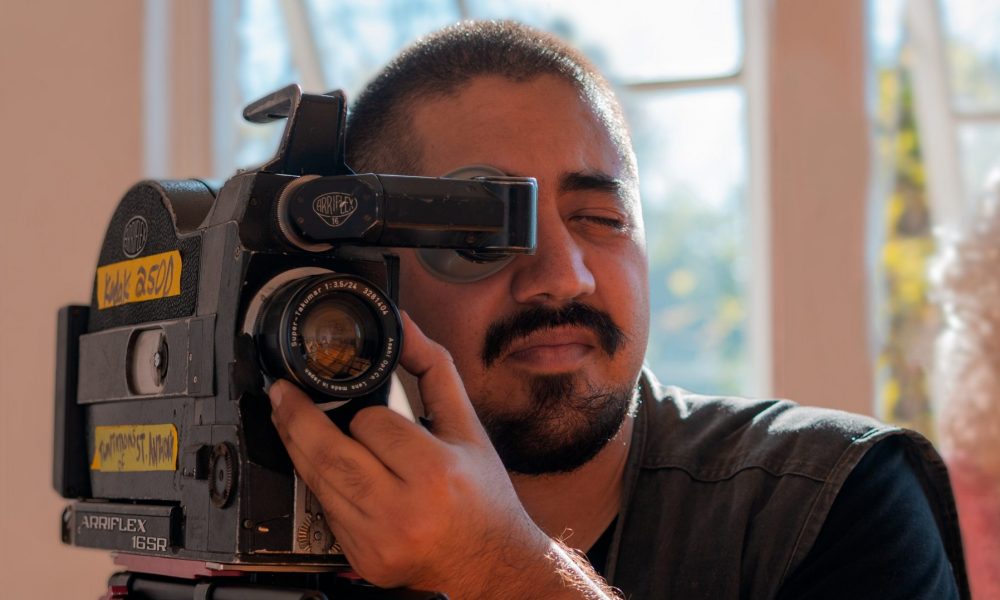
Today we’d like to introduce you to Adrian Hernandez.
Hi Adrian, thanks for joining us today. We’d love for you to start by introducing yourself.
It started with Japanese kaiju movies I saw on VHS as a kid. Seeing the monsters in my nightmares ballooned to the size of skyscrapers was both captivating and terrifying to me as a nine-year-old, and I couldn’t get enough. I remember my copy of the original black and white Godzilla movie had a documentary on it about “suitmation,” or the art of making people in rubber suits appear large and menacing on screen.
Seeing the ingenuity and artistry behind bringing a monster to life was riveting and inspiring. Simple decisions like the choice of angle, frame rate, and lighting had such a profound impact on my experience as a viewer and in a way that books or plays never had for me. This revelation of the power of film as an artistic medium made me overnight, want to be a filmmaker.
After directing films and plays throughout primary school, I was eventually admitted into the USC School of Cinematic Arts for Film and TV Production. While there, I had the opportunity to meet and work with a number of collaborators I still work with today, honing my craft and skill as a storyteller. I also discovered a deep affinity I had for the technical aspects of filmmaking, eventually landing on the craft of cinematography as an additional area of interest to directing my own films.
Before leaving USC, I had the opportunity to act as a cinematographer on an ultra low-budget feature film called “The Dark Side of the Womb” by fellow USC classmate, writer, and director Sam Salerno. The film was shot over our winter break and stars reality TV star Matt McCarthy (Wee Matt). It’s a Troma-style madcap horror comedy about a little person, his corpulent wife, and the killer clown who comes between them. The film is bonkers and was tons of fun to make. From there, I was off!
Since these humble beginnings, I’ve had the opportunity to work as a cinematographer on five more low-budget features as well as many short narrative films, music videos, and documentaries. I’ve had the privilege of working with clients like PBS Frontline, Fox Sports, LAFC, and many more.
My personal directorial work blurs the line between documentary and fiction to tell the stories of cultural outsiders. I’ve directed documentary work about the Holocaust, child abuse in the foster care system, essential workers during COVID, and more.
Like all artists, I’ve always considered myself, never by intention, a misfit. I gravitate, therefore, to stories about outcasts and those on the fringes of society. I believe they have the most interesting stories to tell.
I’m sure it wasn’t obstacle-free, but would you say the journey has been fairly smooth so far?
I love small-scale and independently-minded filmmakers. There’s something about the passion and narrative risk-taking these storytellers embark on that makes the process of making films with them, resource-starved as we may be, fun and satisfying.
The tricky part about these kinds of wild low-budget films is that enjoyable as they are to make, I often can’t make my living solely on shooting them.
They say one for you, one for them, and it’s very true. To stay afloat between the wild and boundary-pushing projects I enjoy, I shoot commercial work, corporate material, and several other odd gigs. I describe my career as “robbing Peter to pay Paul”, and it’s the trap many filmmakers fall into while needed to pay rent in an area as expensive as Los Angeles.
Marinating passion and motivation while wading through the “bill paying” shoots has always been a challenge. Many artists I know can relate.
Thanks for sharing that. So, maybe next you can tell us a bit more about your work?
My cinematography and directorial work cover a wide range of styles and motivations. I’ve shot everything from goofy comedies to hardcore horror films, all of them guided with a few common visual philosophies.
I’m against the modern idea of “invisible cinematography” for the most part. If a filmmaker or narrative calls for a subtler look to their film, I happily adjust my sensibilities. But, for the most part, my style is loud and expressive, often with heightened colors and harsh shadows recalling older filmmaking eras and looks. I grew up gravitating to the wild images of filmmakers like Terry Gilliam, Spike Lee, Dario Argento, and George Romero. These filmmakers, to me, were attracted to the expressive potential of cinema outside of dialogue or replicating scenes photo-realistically. As someone who started narrative experimentation in theater, the expressive potential of the camera was always attractive to me. The camera is what separates movies from taped theater.
I love high-contrast imagery with rich shadows and highlights. Modern film imagery tends towards over-flattery in my opinion, perhaps a symptom of a more image-conscious era. These visual trends are often not allowing space to explore the ruggedness and imperfections of human faces, which, to me, is the chief interest of photographing human subjects in the first place.
These philosophies coalesce in work which pits harsh light on unseen people and stories. As aforementioned, my work tends to chronicle and photograph the worlds of outcasts. Their imperfections and how those relate to their environment are the point of my work. Lighting them like cover models simply wouldn’t be authentic.
What do you like and dislike about the city?
Los Angeles is a beautiful melting pot of nomads and misfits. You can meet just about every kind of person here: from the obscenely and irresponsibly wealthy to locals so broke they’ve never left their zip code. The bohemian spirit of Los Angeles, for as much as I can bemoan it at times, is infectious. You truly never know what you’re going to find next here.
My film work connects me with the pulse of the city and its lovably odd people. I’ve met stand-up comedians, dancers, morticians, actors, and politicians, amongst many other wonderful and unique people.
This said it’s true what they say about LA is a city of transplants without a common culture. Compared to San Fran or San Diego, which have very distinct local and communal identities, LA is a city where everyone is fiercely individual.
Contact Info:
- Website: hernandezmedia.org
- Instagram: https://www.instagram.com/hernandezmedia/


Popular
-

JordanL on ‘Breathe,’ Belief, and Building a Movement Beyond the Music
-
Megan Birney Rudert on How Access to Light Is Powering a More Sustainable and Equitable Future
-

Linda Kneidinger on Building Lasting Change Through Small Steps and Self-Compassion
-

Jolana Nika on Redefining Modern Connection Through Intentional, Real-Life Experiences
-
What did suffering teach you that success never could?
-
Who saw you clearly before you could see yourself?


