





Today we’d like to introduce you to Dr. Vinitha.
Hi Dr. Vinitha, so excited to have you with us today. What can you tell us about your story?
Coming from a super conservative ecosystem in India, I came to the US with a resolution to prove everyone wrong about me. As a woman who was often told what I couldn’t do and never allowed to chart my own path, I decided to rewrite the rules entirely. I broke glass ceilings at every turn, becoming the first college graduate in my family, and channeled that relentless determination into my education and career.
I earned my Ph.D. in Electrical and Biomedical Engineering and spent over 15 years in corporate research and development, mastering deep technology and bridging the gap between complex engineering innovations and real-world enterprise needs.
Today, as the Founder, Chief Executive Officer, and Chief Scientist of Perceive Now, Inc., an enterprise artificial intelligence platform company based in the San Francisco Bay Area, I lead with that same drive. My journey from limitation to innovation fuels my mission to build robust, explainable AI solutions that empower businesses to transform and scale with absolute confidence.
Alright, so let’s dig a little deeper into the story – has it been an easy path overall and if not, what were the challenges you’ve had to overcome?
### Part 1: The Tower and the Escape
For a long time, my early life felt like living as Rapunzel in a castle built by tradition. Growing up in a super conservative ecosystem in India, the walls were made of rigid expectations, cultural scripts that assigned a narrow role to women, and absolute discouragement of independent ambition. That tower was not a sanctuary; it was a confinement designed to keep my potential locked away. But I refused to wait for someone else to rescue me, and I certainly was not going to let down my hair for someone else to climb. I built my own ladder out of sheer intellectual defiance. Becoming the first college graduate in my family was the first stone I dislodged from those walls, proving that I could carve a path through unyielding determination, eventually earning my Ph.D. in Electrical and Biomedical Engineering and stepping onto a global stage.
—
### Part 2: The Immigrant Crucible and the Tech Frontier
Crossing the ocean to the United States was both an act of liberation and a descent into an entirely new crucible. As an immigrant woman stepping into the Western tech space, I carried the invisible weight of starting from absolute zero. I had no generational network in Silicon Valley, no inherited safety net, and no warm introductions to open doors. I spent over fifteen years in corporate research and development, mastering deep technology and working twice as hard to ensure my technical authority could not be sidelined. Every step up the ladder meant dismantling the persistent bias that deep tech and artificial intelligence belonged exclusively to a homogenous old guard. I founded Perceive Now not just to build an enterprise AI platform, but to shatter the modern glass ceilings that still try to confine female founders to the periphery.
—
### Part 3: Forging Connections and Conquering the Investor Room
The hardest part of building a high growth deep tech company is not the code or the algorithmic architecture; it is gaining access to the room where decisions are made. For a long time, the highest levels of venture capital, enterprise sales, and strategic exposure felt like a gated fortress guarded by legacy gatekeepers. When you do not fit the traditional demographic mold, you quickly learn that polite networking does not move the needle. Investors do not care about pedigree or pleasantries; all they care about is getting the best ROI and seeing absolute execution. I had to forge my own connections from scratch, bypass the traditional boys clubs, and position Perceive Now directly in front of enterprise leaders and private equity partners who recognize raw commercial value. Today, leading Perceive Now as Founder, CEO, and Chief Scientist means I am no longer waiting for someone to let down the drawbridge. I built my own kingdom.
—
### Part 4: The Ongoing Chapter
Building Perceive Now is not a destination; it is an ongoing, high-stakes evolution. Having broken through the initial walls of tradition and built my technical foundation from the ground up, the battle today is about scale, execution, and redefining how enterprises leverage artificial intelligence.
In the enterprise AI space, theory is worthless without immediate, measurable ROI. Investors and private equity operating partners do not care about buzzwords; they care about bottom-line impact, robust system architecture, and flawless execution. Every single day, I operate at the intersection of deep scientific research and commercial reality. Whether we are architecting multi-agent M&A workflows, designing explainable AI solutions for complex industry verticals, or deploying enterprise platforms that streamline multi-million-dollar operations, the mandate is absolute: build systems that are transparent, scalable, and indispensable.
The journey from an ecosystem that sought to limit my horizon to leading an elite deep tech platform company in the San Francisco Bay Area has taught me one defining truth. You do not wait for the industry to open its doors; you build a better engine, force them to look, and rewrite the rules of the room entirely.
Alright, so let’s switch gears a bit and talk business. What should we know?
**What is the name of your business or organization?**
Perceive Now, Inc. — **PerceiveNow.ai**
**Please tell us more about your business or organization. What should we know? What do you do, what do you specialize in / what are you known for? What sets you apart from others? What are you most proud of brand-wise? What do you want our readers to know about your brand, offerings, services, etc.?**
I am the Founder and CEO of **Perceive Now**, an enterprise AI company building **patent-pending technology designed to make artificial intelligence reliable enough for real-world, mission-critical work**.
AI today is extraordinarily powerful, but there is still a fundamental problem: generating an impressive answer is not the same as producing a **correct, repeatable, auditable, and trusted outcome**. That distinction becomes especially important when AI is being used in healthcare, financial services, compliance, infrastructure, government, and other environments where an incorrect decision can have significant financial, operational, or even **life-saving implications**.
That is the problem Perceive Now was built to solve.
We develop **bespoke AI solutions for enterprises**, powered by our proprietary, patent-pending technology, **PN OS**. At its core is an AI outcome-enforcement and orchestration architecture designed to control how AI systems reason, execute tasks, validate results, interact with humans, and recover when something goes wrong.
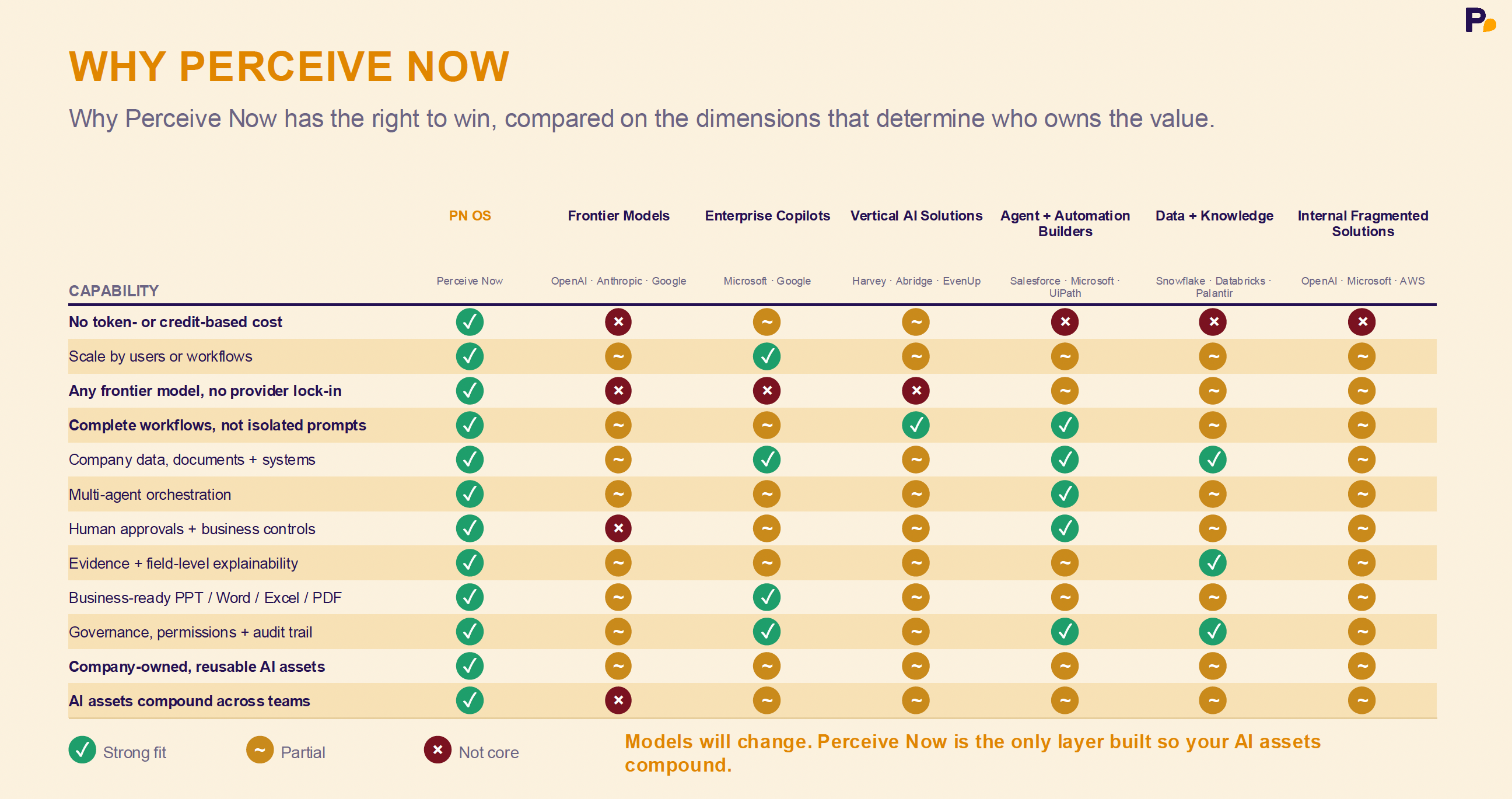
Instead of relying on a single model and hoping it produces the right result, Perceive Now can orchestrate models such as OpenAI, Claude, Gemini, open-source models, enterprise data, business rules, software systems, agents, and human experts into a controlled workflow.
What sets us apart is that we are not simply building another chatbot or adding AI on top of existing software. We are working on the infrastructure required to make AI behave much more like **dependable enterprise software**: with validation, governance, lineage, replayability, model routing, human oversight, and measurable outcomes built into the system.
Our technology can support everything from financial reconciliation and healthcare operations to research, compliance, investment analysis, reporting, and complex enterprise decision-making.
What I am most proud of is that we are building toward a future where organizations can trust AI with progressively more important work — including work where **accuracy is not just a productivity issue, but can affect businesses, livelihoods, and potentially lives**.
We also believe that a company’s workflows, operating knowledge, and AI-enabled processes will become some of its most valuable intellectual property. Our goal is therefore not simply to provide AI as a service. We help organizations create **bespoke AI systems that become assets they can own, operate, improve, and scale**.
Brand-wise, I want **Perceive Now** to become synonymous with one idea:
**AI should not just generate answers. It should reliably deliver outcomes.**
That principle is at the center of our patent-pending technology and everything we are building.
What sort of changes are you expecting over the next 5-10 years?
Over the next 5–10 years, I believe we will see one of the most important shifts in enterprise technology: **AI will move from generating answers to being trusted to perform real work.**
The scale of the transition is already enormous. By mid-2025, **88% of organizations reported using AI in at least one business function**, according to McKinsey. Yet adoption and actual business value are still very different things: McKinsey has also reported that **more than 80% of companies see no material contribution to earnings from their generative AI initiatives**, while only about **1% describe their generative AI strategy as mature**.
That gap—between **AI experimentation and dependable business outcomes**—is where I believe much of the next decade of innovation will happen.
The investment is certainly not slowing down. Gartner projected worldwide generative-AI spending to reach **$644 billion in 2025, up 76.4% in a single year**. IDC projects enterprise spending on AI solutions to rise from roughly **$307 billion in 2025 to $632 billion by 2028**, representing approximately a **29% compound annual growth rate**. Generative-AI spending alone is projected by IDC to exceed **$202 billion by 2028**.
But I think the much more interesting shift is **what companies will be buying**.
Today, much of enterprise AI revolves around copilots, chat interfaces, and assistants. Gartner now predicts that by **2028, more than half of enterprises will move away from paying primarily for assistive AI and favor systems that commit to workflow outcomes**. Gartner also forecasts that **33% of enterprise software applications will incorporate agentic AI by 2028**, compared with less than 1% in 2024, and that at least **15% of day-to-day work decisions could be made autonomously through agentic AI**.
That is a profound change. We are going from:
**“AI, help me do this.”**
to:
**“AI, accomplish this outcome correctly, prove what you did, and tell me when a human needs to intervene.”**
That transition will also change the economics of traditional software. Gartner estimates that as much as **$234 billion of enterprise application spending could be exposed to agentic disruption by 2030—roughly 20% of enterprise application SaaS spending**—as agents increasingly perform work across multiple systems instead of requiring humans to navigate every application individually.
At the same time, the underlying intelligence is becoming dramatically cheaper and more accessible. Stanford’s AI Index found that the cost of running a model with roughly GPT-3.5-level performance fell from approximately **$20 per million tokens in November 2022 to $0.07 by October 2024—a greater than 280-fold reduction in about 18 months**. The smallest model capable of crossing a comparable MMLU performance threshold shrank from **540 billion parameters in 2022 to just 3.8 billion in 2024—a 142-fold reduction**.
That means intelligence itself will increasingly become **commoditized**.
The differentiator will no longer simply be *which model do you have access to?* Almost everyone will have access to extremely capable models. The differentiator will be:
**Can you make those models reliably execute your business processes? Can you validate their outputs? Can you govern them? Can you trace what happened? Can you switch between models? Can you incorporate human judgment? And can you guarantee that the final outcome meets the requirements of the business?**
This is also why I believe the future will be **multi-model**. Enterprises will use different models depending on accuracy, cost, latency, security, privacy, specialization, and deployment requirements. The strategic technology layer will increasingly sit above the models—determining which intelligence to use, orchestrating the workflow, validating the result, and enforcing the required outcome.
The economic consequences will extend far beyond the technology industry. The IMF estimates that AI could affect approximately **40% of employment globally and about 60% of jobs in advanced economies**. The World Economic Forum found that **86% of employers expect AI and information-processing technologies to transform their businesses by 2030**.
And we are already beginning to see measurable productivity effects. PwC’s analysis of nearly **one billion job advertisements** found that industries most exposed to AI experienced approximately **27% growth in revenue per employee versus 9% in less AI-exposed industries—a 3× difference**. Workers with advanced AI skills commanded an average **56% wage premium**, while the skills employers seek are changing **66% faster in occupations most exposed to AI**.
Another major shift will be around **intellectual property and ownership**.
As AI becomes embedded into operations, companies will realize that their proprietary workflows, decision logic, institutional knowledge, evaluation systems, and AI-enabled processes are not merely automations—they are potentially some of the company’s most valuable IP. AI patenting already increased from approximately **3,833 patents in 2010 to more than 122,000 in 2023**, with nearly **30% growth in the most recent year measured by Stanford’s AI Index**.
That is why I expect enterprises to become much more deliberate about what they **own versus rent**.
Ultimately, I think AI itself will become less visible. We will stop being impressed simply because software has an AI button. We will care about whether it **saved six hours, reduced an error rate, recovered revenue, accelerated a decision, prevented a compliance failure, helped a physician, or potentially contributed to a life-saving outcome**.
The next generation of successful AI companies will therefore not be defined only by who has the smartest model. They will be defined by who can make intelligence **reliable, accountable, economically valuable, and safe enough to trust with increasingly consequential work**.
That is also the future we are building toward at **Perceive Now**: a world where AI is not judged by how impressive its answer sounds, but by whether it can **reliably deliver the outcome that was required**.
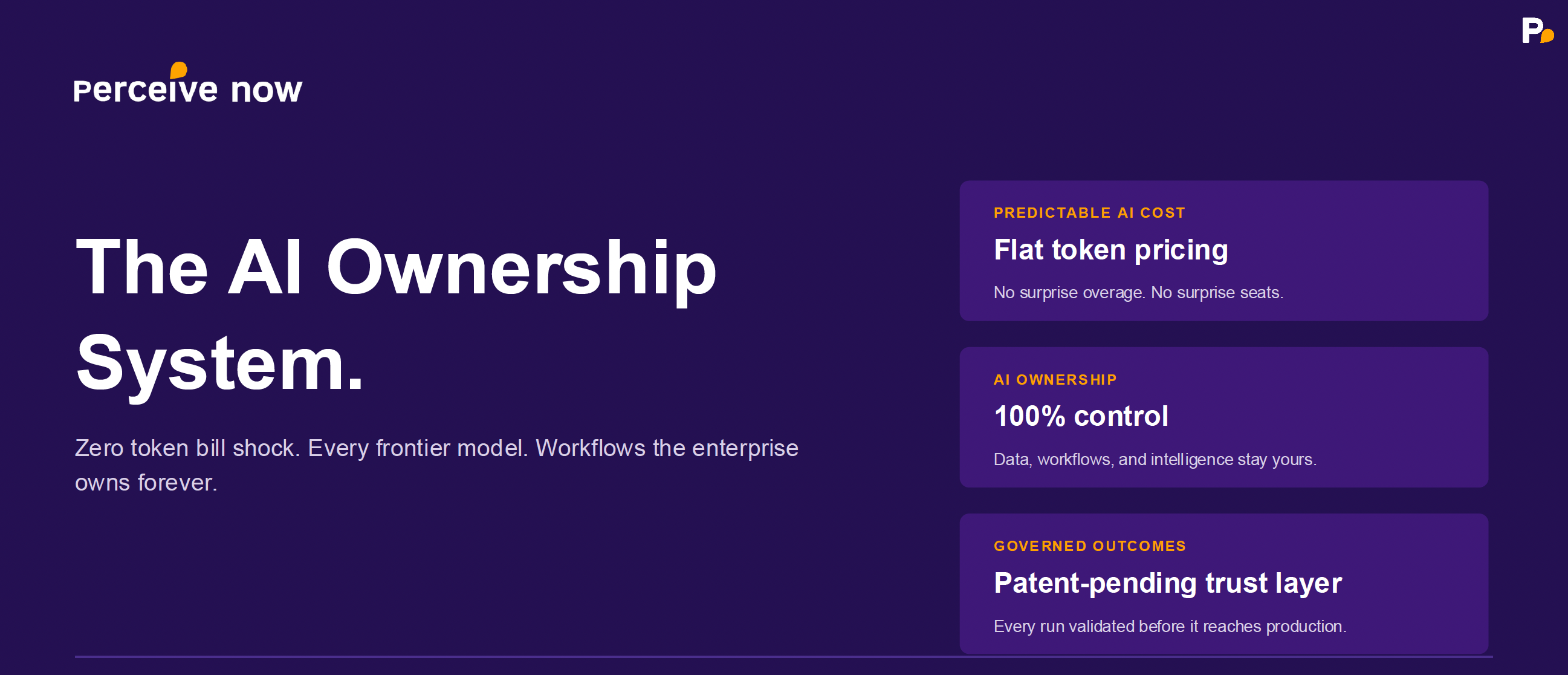
Pricing:
- $540 per user
- $0 token-based billing
- starting at $20k per year FDE
Contact Info:
- Website: https://perceivenow.ai/
- LinkedIn: https://www.linkedin.com/in/vinithatu/
Popular
-

Greg Hex Is Turning the Everyday Kitchen Knife Into a Modern Design Object
-

Portraits of the Valley
-

LA’s Most Inspiring Stories
-

Rick Norris Learned That Building a Successful Business Means Building a Life You Actually Want to Live
-

How Olivia Rush Turned Survival Into a Mission to Help Others Keep Going
-

How Bibi Goldstein Is Helping Entrepreneurs Reclaim Their Time by Embracing the Power of Delegation


