




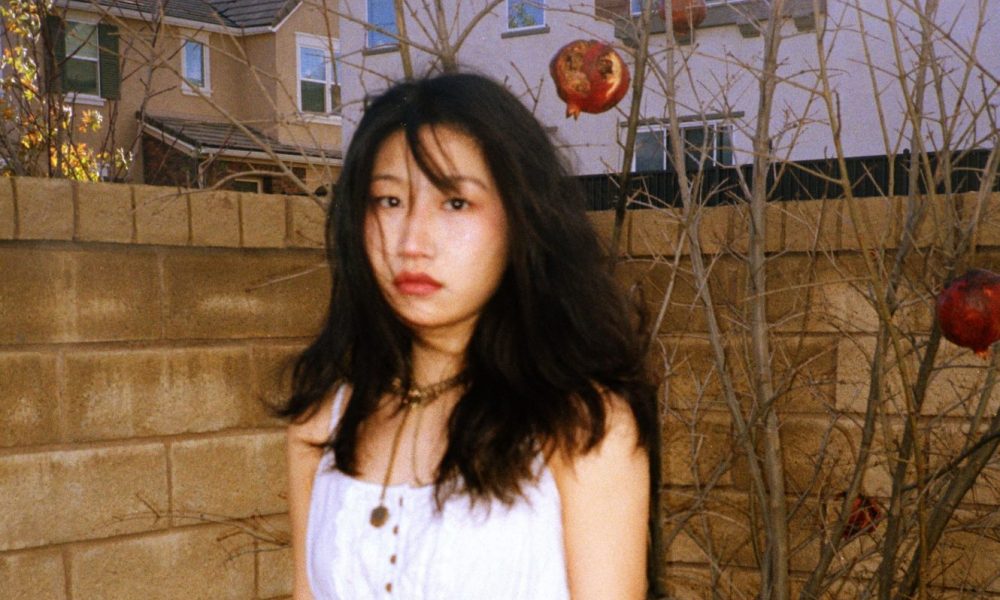
Today we’d like to introduce you to Sining Zhu.
Hi Sining, so excited to have you on the platform. So before we get into questions about your work-life, maybe you can bring our readers up to speed on your story and how you got to where you are today?
I am a multidisciplinary artist from Beijing, China. I spent four years in New York, earning a bachelor’s degree in Fine Arts from the School of Visual Arts. And I’m currently in Los Angeles pursuing a master’s degree in Fine Arts at the California Institute of Arts (CalArts). My practice was mostly based on 2D works such as painting, printing, and silkscreen during my first two years of college studies. The unforeseen epidemic has drastically altered my creative productions and represents a turning point for me to broaden my practices. The epidemic was a unique period. I moved to Santa Barbara for a while because of the online school classes. Everyone was confused and nervous during that time. Trapped at home, I lost motivation to create and turned to the news piling up daily. People are all encouraging each other while facing the unknown and fear.
One day a news story caught my attention: an elderly Chinese empty nester committed suicide and left a suicide letter. When I read the letter, it was gentle and plain. It contained advice for children and care from friends and strangers but no mention of the older man himself. When the soft suicide note was juxtaposed with the extreme suicidal behavior, the strong sense of contradiction and surprise made me want to continue to explore and research the reasons.
I went through Weibo, Zhihu, and other Chinese websites to find out who I could interview. Luckily, a volunteer group replied and helped me contact some empty nesters in the village. Throughout my research, I felt that these events are happening constantly and that the elderly are gradually flattened and blurred in the family and society. This situation is a problem that cannot be avoided not only in rural areas but also in many big cities with good service facilities. In the creation process, I often ask myself: Are we unconsciously prejudiced and misunderstanding this group, and are we listening to them?
The final visual form of this work comes from a lot of experimentation in my creative process. While walking and observing my life’s surroundings, I noticed the stones everywhere on the street. The stones’ mundanity, forgetfulness, and hardness immediately reminded me of the older man’s situation. As I collected the stones, the weight of the bag increased gradually, as did the heaviness in my heart.
In this artwork (To Bid You Farewell), the stones and the flames themselves carry many meanings. The rocks are like little houses, and the older adults are trapped in this small space of protection and holding. In the beginning, the suicide note carved on the stone was visible, and it turned black a little bit during the burning process until it was all covered up. The all-black burn marks felt like they were spreading out from the inside out, and the text’s content no longer mattered. Instead, the notes was transformed into a hidden, repressed emotion connecting the whole social fact and silent sorrow.
After completing this work, I began an interdisciplinary and cross-media artistic endeavor. I wanted to focus into the context of social issues and individual and collective relationships to re-examine and feel the ripple effects.
Would you say it’s been a smooth road, and if not what are some of the biggest challenges you’ve faced along the way?
Young artists face a lot of challenges, and so do I. I have been searching for how to balance the power that my artworks bring me and the self-consumption in the creation process. During the creative process, I would experience constant questioning, hesitation, doubt, and overturning of previous ideas, so much so that I spent a long time thinking about the concept. During the long process of ego depletion, I realized that I must be firm and believe in my creation and style. As well as extending my work through constant experimentation, reading, communicating with friends and teachers, and expanding and engaging in different fields of study.
As you know, we’re big fans of you and your work. For our readers who might not be as familiar what can you tell them about what you do?
My recent practice focuses on the complicated relationship and cognition of identity between the self and others and the interaction and separation of the individual and the group. I am enthusiastic and rooted in research and collective behavior, which explores contemporary art practice and reveals indisputable facts and hidden delicate sorrow in the social environment by overlaying everyday, personal, reminiscent objects and accumulating new contexts and meanings to awaken collective resonance.
I recently finished my first solo show at 4C Gallery in Los Angeles: Fluctuating Selection – Uncertain Future. The exhibition’s theme extends the concept of biological evolution (fluctuating selection) to contemporary social facts and situations, the interaction between the individual and the group, the self and the other. The art pieces I chose juxtapose and connect themes from different contexts, from the fish preopercular bone at the Salton Sea in Los Angeles as evidence of historical guilt, the clothes and multicultural spices of old immigrants in Chinatown, the gel masks imprinted with different human skin textures and hair, and the elusive waves. In the exhibition, I want to convey everything in a way that breaks with anthropocentrism and contemplates what drives fluctuating selection. Is it the decision between sustainable development and extinction for our future? In the face of globalization and invisible hegemony, can humanity adapt and cope with uncertain futures and dilemmas?
I want to share one of my exhibition’s works: Searching For Preopercular Bone. It was inspired by the Salton Sea, located east of Los Angeles. It was an accident based on the impact of human operations, where the water came from the collapse of the dam of the Colorado River. In 1905, people used the river water for agricultural irrigation, tourism, and sewage discharge. Two years later, the breach in the levee was closed, but the wastewater that had been used was trapped in the parched Salton Basin. Excessive human intervention had left the water heavily laden with heavy metals and chemicals. The waters were no longer suitable for living creatures, and many fishes were poisoned on the shore.
This piece is an installation with two-channel videos that I collaborate with Artist Lhamo Yueliu. In an area of about 20 square meters on the shore of Salton Sea Lake, we used gold panning as an excavation method to find 300 fish preopercular bones, where the respiration part of the fish is, and the external environment is exchanged with the internal environment here. So, the preopercular is like a fish’s threshold of life and death. Due to the impact of the Anthropocene, fish have to undergo migration and dispersal that defy the ecological living mode.
Forensic Architecture also inspired us. As our artistic visual form, we used forensic search. During the performance process, we record timings, latitude, and longitude of the discovery site, length, width, and height for each fish bone. Coding, recording, archiving, and categorizing the violence in tangible form allows them to be re-explained in the evidence bags. A forensic witness emerges as a direct result of globalized industrialization erosion and provides powerful testimony to reveal the absence and hide the history of crimes.
Moreover, the piece’s two-channel videos capture the entire forensic performance. We used gold panning tools to connect the 1848 California Gold Rush movement. Many Chinese immigrants arrived in California during the gold rush to work on railroad construction. The gold pan held desire and labor, participating in the Chinese immigrants’ American dream. We do not want to find an absolute contrast between the Asian immigrants and the seafood immigrants. Still, we want to dig the fish bones with empathic cherishing, rethinking migration and dispersal beneath globalization and discovering the natural possibility of de-anthropocentrism.
Networking and finding a mentor can have such a positive impact on one’s life and career. Any advice?
I recommend everyone go to more gallery openings and apply for exhibits and residencies, allowing them to engage and ignite fresh ideas with diverse artists. I am lucky to study my graduate studies at CalArts. CalArts is a very accessible and intellectual environment that encourages all students to go deeper and further their artistic exploration. Many excellent artists and teachers, such as Julie Tolentino, MPA, Abigail Raphael Collins, and others, inspired me greatly in school. I met with many teachers at the school and would meet with them regularly after I identified mentors who shared my viewpoint.
As a young artist, it is always a challenge to be recognized by everyone. In the new media era, the way to publicize an artist is now more than just through traditional galleries. Still, also the artists themselves have a lot of opportunities to promote and expose themselves. So I will show and share my work as much as possible. Of course, settling down to polish and improve myself is also very important. I still want to participate in and understand many skills, subjects, and fields. Recently I have been studying the Mosuo culture in China and the tribal culture in Oceania. I am exploring the blurred line between human and non-human, creation and spiritual space, myth and history. As a result, I am also looking forward to my future self and my work.
Contact Info:
- Website: siningzhustudio.com
- Instagram: sining_zhu


 Image Credits
Sining Zhu Zengyi Zhao
Popular
-

Que Johnson on Building Brands That Last: From Visibility to True Market Authority
-

Christina Wren Steps Into the Director’s Chair to Tell Stories That Feel Like Home
-

Portraits of the Valley
-

LA’s Most Inspiring Stories
-
JordanL on ‘Breathe,’ Belief, and Building a Movement Beyond the Music
-
Megan Birney Rudert on How Access to Light Is Powering a More Sustainable and Equitable Future


