




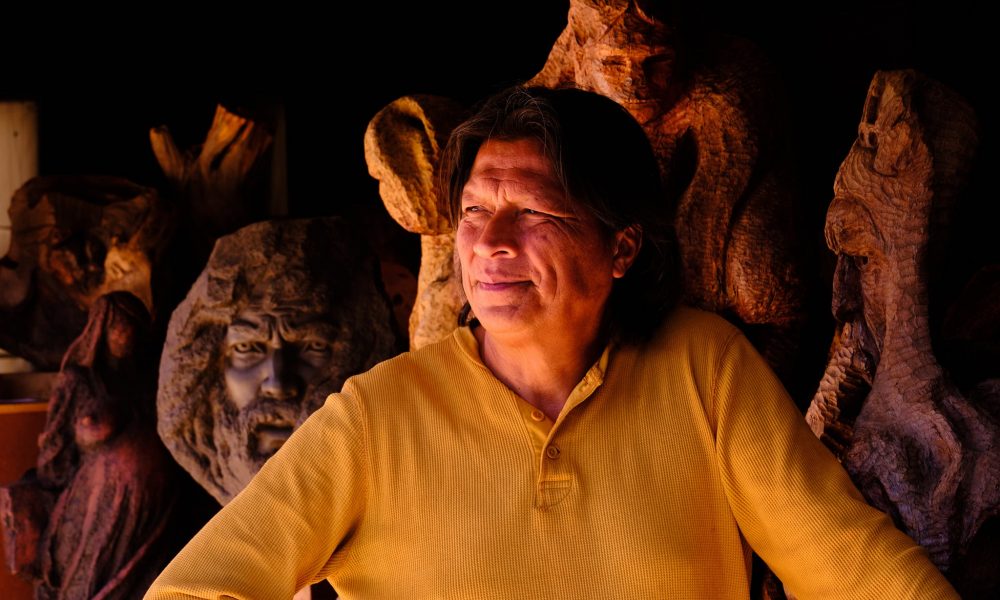
Today we’d like to introduce you to Ramon Rodriguez Crespo.
Hi Ramon, thanks for joining us today. We’d love for you to start by introducing yourself.
I was born in Chaco Pampa. It is a tiny pueblo in Bolivia where seven other families lived kilometers apart from each other. Quechua and Spanish were the languages we spoke. I have fond memories of when I was two and a half years old. My mother, Severa, worked very hard raising seven children alone.
We lived by working in agriculture. It was a fertile and productive environment. In my childhood, I would sometimes be home by myself while my mother and siblings went to work the fields. When I was four years old, I started going out and exploring the land on my own. It was a magical world. It was my world. The beauty of the place called to me. That was a treasured time of my life. I admired the plants, animals, birds, and all the colors of the earth. The landscape was hauntingly beautiful.
In my solitude, I began expressing my artistic inclination. Drawing on barrels of DDT that were stored in our one-room adobe house were some of those earliest memories. The barrels were stored in the corner of our house by health workers that fumigated our pueblo monthly to exterminate for malaria-carrying bugs and vinchucas, which spread Chagas (kissing bug) disease. I perceived the barrels as special vessels. They were made of stiff cardboard with metal rims at the top and bottom. Once empty, my mother used the barrels to store clothes, corn, and potatoes. We did not know then that DDT was a dangerous chemical. We were told it would keep us safe.
I drew pictures around the barrels with a pen the health workers forgot at our house. I cherished that pen and drew all around the barrels. I had never seen a pen before and used it constantly. I was amazed at how such a thin line could come from such an object. We only knew objects we found in nature or made ourselves. With my enthusiasm, that pen did not last long. I later discovered the colored pebbles I found on the river’s edge in my pueblo. With those wet-colored stones, I drew on other larger stones. Those would be my first watercolors.
At the river’s edge I drew on rocks, I ate clay and sediment of different colors that was brought by the rain from the surrounding ravines. I had my favorite ones that had a delicious taste.
When I was five, I started school and walked five kilometers with friends from my pueblo. I had no shoes and walked the distance barefooted. When it was hot, I would run from the shade of one tree to another. Those were wonderful times being with friends, absorbing the beauty of the mountainscapes, and learning.
When I was seven, my aging grandmother, Mauricia, came to our house to ask my mother if I could accompany her and help her with her crops and beloved animals. I was surprised when my mother said, “Sure, go ahead and take him.” I went with my grandmother to live with her about fifty miles away. There I was nurtured by the magnificence of my blessed grandmother and her natural world.
Abuela Mauricia understood plants, spirits, seasons, the cycles of Pacha Mama, or Mother Earth. She used herbs and leaves to heal and had a vast knowledge of local plants and their medicinal use. We lived surrounded by animals: condors, eagles, hawks, doves, armadillos, deer, pumas, bears, iguanas, and the many other animals that roamed freely around our small humble homemade of adobe and branches from the surrounding trees. We had horses, donkeys, cows, goats, pigs, ducks, and chickens.
My grandmother was herself, nature in its purest form. She exemplified harmony just like the beautiful mantle of landscape where we lived. It was like we lived embraced in a poncho verde, green cloak. Her respect for Pacha Mama was the essence of her life. Her love for Mother Nature was for her, life itself. It is these lived experiences and my observation of nature that I attempt to reflect in my artistic expression throughout my artistic trajectory.
After two years with my grandmother, I returned to live with my mother and my younger brother. My elder siblings had already left home. The three of us moved from one pueblo to another three times seeking opportunities to live a better life. Omereque was the last pueblo where we lived and where I continued my studies through seventh grade.
I frequently helped our priest in Omereque with work around the church. He saw something in me and sent me to Aiquile, a provincial town, to attend pre-seminary boarding school. There, I completed pre-seminary education through 12th grade.
In 1987 I moved to Sucre, the capitol of Bolivia, to attend San Cristobal Seminary. In 1988 I moved to La Paz to another seminary. In 1989, I left seminary knowing that priesthood was not my calling. The stirrings towards art were beckoning. My calling towards art was more profound than my calling to serve as a priest. Despite it being difficult to leave seminary, I left and worked for a year helping my family in the back-breaking work in the fields. I sometimes helped our priest from Omereque and noted that the small church did not have the stations of the cross. I painted them in that challenging and instrumental year in reaffirming my path towards art and away from the priesthood.
In 1990 I entered Raul G. Prada art school. After four years, I graduated with a specialty in Sculpture. The year I graduated, I entered the 14 de Septiembre National Art Competition. Surprised and unknown, I was awarded the National Grand Prize. The piece that won was a sculpture titled “Cristos Rotos” or “Shattered Christs.” I worked on that series for a year after art school and was shocked that my first entry in a national competition received an award. I continued to submit my work in national competitions and continued to receive awards in sculpture, oil painting, watercolor. This work has become part of the permanent art collection at the La Casona Museum in Cochabamba, Bolivia and other Bolivian museums.
The angst about leaving seminary and redirecting my life towards art was waning and I came to see that I had made the right decision. The ceremony for my first national award was held at one of the national art galleries. The guard at the door would not give me a program or allow me in. Since I was an unknown in the national art scene and obviously from the countryside, he assumed that I did not belong there at the ceremony. I waited outside until one of my art professors saw me waiting and insisted that I be admitted. That feeling of being kept out, not being invited to participate and hold power, and being seen as different from the other artists found expression in my work.
I met my wife, Debbie Rodriguez, in 1996 when she was a Peace Corps Volunteer in Bolivia working with homeless and underprivileged girls. We started an artist group together and traveled throughout Bolivia teaching and sharing art with underprivileged populations, with whom I especially could relate to. We also collaborated with artists to develop avenues for sales of their work. In Bolivia, when someone asks what you do and you reply you are an artist, their response is, ‘Lo siento’ or ‘I’m sorry.’
I married Debbie and our two sons, Mayu and Rumi, were born in Bolivia. Their names mean River and Stone in Quechua. We moved to Long Beach in 2002 where we continue to reside.
Since I have been in the U.S. I have continued to share my art and my culture within Long Beach where I have lived for twenty years. I am active on Facebook and Instagram. I have had gallery shows, Dr. Robert Gumbiner acquired four of my paintings for the Museum of Latin American Art collection. A piece of my sculpture was on long-term loan for display in MoLAA’s Sculpture Garden. I have shown my work in southern California, Santa Fe, NM; Taos, NM; Scottsdale, AZ; and is in various museum collections in South America and the U.S. I look forward to showing my work on a larger scale. I think my work has a message, especially timely, in this moment of history in which we live.
I have designed and painted murals throughout California. I collaborated with kaboom!, Maria Shriver, and the Cesar Chavez Foundation on a mural design that was painted in 30 communities throughout California by local artists. I painted the inaugural mural in downtown Los Angeles with Maria Shriver, Antonio Villaraigosa, and members of the Chavez family. I have received Professional Artist Fellowships, awards, and recognition for my work.
Would you say it’s been a smooth road, and if not what are some of the biggest challenges you’ve faced along the way?
The biggest obstacle I have encountered is the language. I have had a difficult time with English. I speak Spanish and Quechua, however, English has proven difficult. American culture is so different from Bolivian culture and there have been many challenges navigating the two cultures. I also miss my family and the beautiful landscape of Bolivia. Adjusting to my new reality, albeit difficult at times, has allowed me to continue my artistic trajectory in the U.S.
Thanks – so what else should our readers know about your work and what you’re currently focused on?
I am passionate about my creative work in the following areas: Sculpture in wood, clay, and stone.
Painting in oil, acrylic, and watercolors
Drawings on paper and recycled materials
Murals
Bolivian folk music
Gardening
How can people work with you, collaborate with you or support you?
Teaching painting and sculpture; Bolivian folk music and folkloric instruments; and gardening. I share my knowledge in hope of conserving and expanding the understanding and beauty of Bolivian culture, language, and wisdom.
My gardening overlaps with my art in that through my work, I attempt to show the importance of caring for Pacha Mama, Mother Earth. I approach Pacha Mama with reverence and awe and hope. I seek to share the beauty of Bolivia and of nature to viewers through my work. I believe, like my grandmother, nature is life itself. It is the foundation of all my work.
I garden with Long Beach Organic Gardens and help build a community where people can feed themselves organically be healthy by consuming organic, seasonal, and delicious produce.
I share Bolivian folk music at schools, churches, concerts, and wherever we are invited to play. We play in a family band. I taught my wife and sons Bolivian folk instruments and music. We sing and Spanish and Quechua and carry forward the beautiful and strong musical tradition highlighting Bolivian folkloric instruments.
I have donated hundreds of my paintings to nonprofit organizations, schools, churches, sports groups, and organizations that have beliefs that support the arts, education, gardens, libraries, inspired leadership, aging, and social justice.
Beyond painting, sculpture, and the expression of my culture, I enjoy sharing my philosophy of living simply and in a healthy manner in collaboration with Mother Earth. Living peacefully and respectfully with nature is for me, of great importance. Nutritious eating is a passion of mine because a physically and emotionally healthy community can nurture its members and focus on living better and more simply.
I would like to find galleries that would show my work and competitions to submit my work for consideration.
I want to expand my reach and show in galleries, museums, and alternative art spaces so my work reaches larger audiences. I want to educate about my culture and expose people to its beauty. I would like to meet collectors who would be interested in finding out more about my work. I would like to write books about my life, my art, and my culture; collaborate with museums, galleries, schools, and libraries to extend my work and my message out into the community.
In my art, I express my philosophy of living in communion with agriculture, the importance of advocacy and action in social justice issues, reverence for nature. I value the importance of collaboration, education and supporting other creatives. All this helps me feel like I am contributing to our community. And this makes me content and grateful with my life.
This is the humble contribution I make to my community and our world.
Contact Info:
- Email: [email protected]
- Website: https://www.etsy.com/shop/StudioRumiMayu?ref=profile_header
- Instagram: https://www.instagram.com/ramonrodriguezcrespo/
- Facebook: https://www.facebook.com/profile.php?id=100007093388252
- Twitter: https://lbopenstudiotour.com/ramon-rodriguez/
- Other: https://www.instagram.com/studiorumimayu/


 Image Credits
Isaac Sweeney Instagram: _Isaac_Sweeney
Popular
-

Linda Villines on Releasing Stored Struggle and Reclaiming Ease Through the Body
-

Candice Swanson on Honoring the Sacred Early Days of Motherhood Through Intentional Photography
-
Michael Johnson on Telling Untold Stories of Identity and Leadership Through SQUAD
-
Owning the Narrative: Drew Dusterhoff Steps Into Power with Lincoln Must Die
-

Portraits of the Valley
-

LA’s Most Inspiring Stories


