




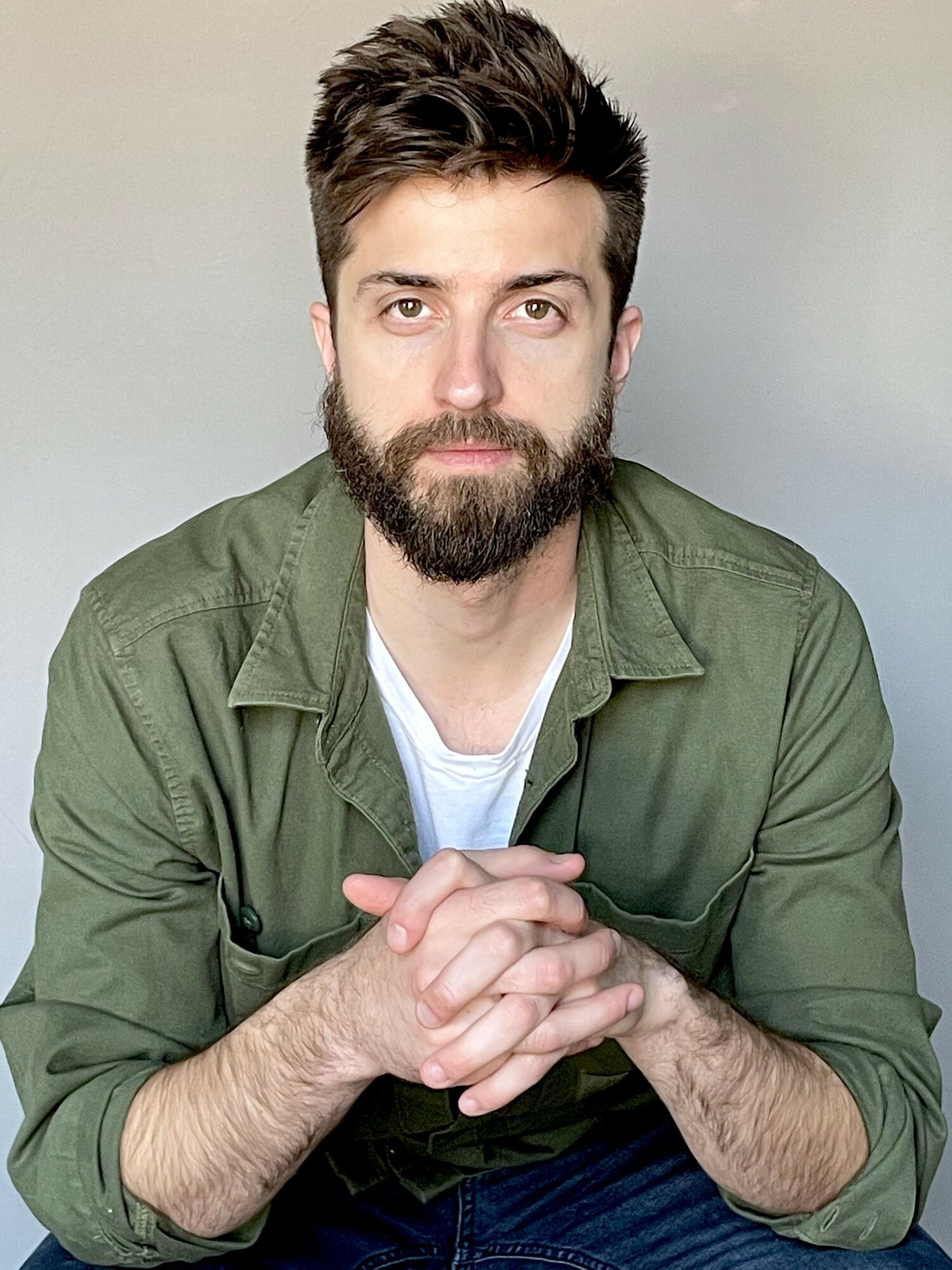
Today we’d like to introduce you to Eric Schabla
Hi Eric, please kick things off for us with an introduction to yourself and your story.
I started as a theatre actor working at equity houses around the country. It was a precarious period, but I was driven by a passion for heightened language and ensemble-based storytelling. There was a certain ascetic thrill in following the work from city to city; I was broke, it was impossible to set down roots, but it forced me to live simply and view the work as an end in itself. I remember it as an oddly monastic time. The way I relished the constant toil and solitude reflects a self-flagellating, protestant ethic which tends to emerge unconsciously as any true midwesterner matures. Work til it hurts or your sins are absolved!
It was during this nomadic phase that I started writing, in part because it was the only hobby I could sustain. Paper costs nothing, and you can take it anywhere. But after a few years as an actor, writing was starting to consume a greater share of my creative bandwidth. I felt restless and unfulfilled in rehearsal rooms. I had things to say which I couldn’t express as an actor, which is – even at its most fully realized – an interpretative occupation.
Then as I was starting to invest real time and energy in dramatic writing and had finally stirred up a little momentum— the pandemic hit. It’s hard to understate the fear that gripped the American theatre… a fear that, in my view, led to a period of abject paranoia and conformity and risk aversion. Like many of my peers, I saw the writing on the wall and thought – inexplicably – it was a good time to move to Hollywood.
Fast forward a bit and… I’ve just graduated from the screenwriting program at the American Film Institute. It was a dizzying couple of years. But the mentorships I found in the program have become some of the most enriching creative relationships in my life. Most importantly, I’m deeply proud of the work I did at AFI. And I hope the scripts I wrote there reflect a sense of care and rigor and authenticity.
Now that I’m back in the world, it’s unfortunate to see how tough a time this is for all storytelling media. And there’s a temptation to respond with fashionable cynicism to the looming contractions, the impending strikes, and the byzantine corporate mergers. But as I look forward to what’s next, I’m reminded of a deceptively simple precept from the great television writer David Milch — “Don’t give up on mass culture!”
Can you talk to us a bit about the challenges and lessons you’ve learned along the way. Looking back would you say it’s been easy or smooth in retrospect?
No working artist or creative professional I know has had a “smooth road”. One of the first things you learn to accept if you want to have any longevity in a creative field is a non-traditional life/career trajectory. To give you an idea, in my early 20s I had a stint working as a groom at an elite horse stable while understudying Romeo and Juliet at Chicago Shakespeare Theatre. Not exactly a normal career path.
Now, in many ways, I’ve been quite lucky, but… along the way, I’ve struggled with status anxiety, poverty, periodic unemployment, loneliness, cockroaches, exhaustion, injury, tax liabilities, underemployment, dental ailments, and car trouble… but I have very, very rarely been bored.
For me, the biggest struggle of all is best captured by this very tricky paradox — by definition, an artist in any discipline must have a deep personal investment in their work. Life and livelihood are intertwined. But on the other hand, there’s real peril in allowing your work to subsume your personhood. It can’t become the single defining feature of your identity. Once you start playing that game, the normal vicissitudes of a career can make life miserable. It’s also the road to solipsism and self-indulgence. Sooner or later, every person engaged in professionalized creative work has to reckon with that tension.
Thanks for sharing that. So, maybe next you can tell us a bit more about your work?
I’m a writer and an actor. At the moment, I make my living as a screenwriter, but I also write plays, poetry and the occasional short story.
I’m not sure I’m “known for” much of anything, but in my writing I aim to hold contradictory truths, feelings or realities in the same space. I don’t love neat endings, or facile morals. And muscular language has always appealed to me.
Both as a child and in my adult life, I’ve spent a lot of time around people who work with their hands — I once apprenticed with a farrier in southwestern Wisconsin. So I suppose I try to capture that tactile spirit on the page. Sometimes that shows up in a cognitive or narrative sense… lots of my stories are concerned with rural life and people struggling in various ways against their environments. Other times it’s more diffuse and unconscious and hidden deeper in the form of the thing.
One of the pieces of which I’m most proud is a feature screenplay called The Foal, which I wrote in my first year of grad school. Think of Jane Campion’s film the Power of the Dog, but with a female lead, a few elements of magical realism, and set on a wheat farm in Wisconsin instead of a ranch in Montana. It’s a very quiet, strange, slow-moving piece, and it will almost certainly never be made. But I needed to write it.
If we knew you growing up, how would we have described you?
I had eclectic influences and interests. My extended family is mostly working class and Eastern European- very grounded, austere and practical people. So most of my literary interest I inherited from my parents and older brothers. I was also lucky to be surrounded by music. My father and brothers tinkered incessantly with a variety of instruments, and through them I was exposed to an almost comical range of music. In high school, I listened – earnestly, I might add – to as much Goran Bregovic as The Beatles.
My early teenage years were dominated by a destructive streak, but I had the good fortune to discover Shakespeare around that age… it sated my adolescent appetite for all things violent, sexy and profane. And I became obsessed with those plays. To this day, I credit Shakespeare with mostly saving me from that weird, truculent male apathy which can take so long to outgrow.
It seems odd somehow, but I remember that as my tastes broadened, I became more introverted. I started to withdraw socially. I discovered the pleasure of spending time alone, and the rewards of an active inner life. The downside was that, for a while, I took myself much too seriously. But I liked living in my head — no interest was too strange, no world was out of bounds, and gradually I learned the virtue of curiosity.
Contact Info:
- Website: https://www.ericschabla.com
Popular
-

Christina Wren Steps Into the Director’s Chair to Tell Stories That Feel Like Home
-

Portraits of the Valley
-

LA’s Most Inspiring Stories
-

JordanL on ‘Breathe,’ Belief, and Building a Movement Beyond the Music
-
Megan Birney Rudert on How Access to Light Is Powering a More Sustainable and Equitable Future
-

Linda Kneidinger on Building Lasting Change Through Small Steps and Self-Compassion


