




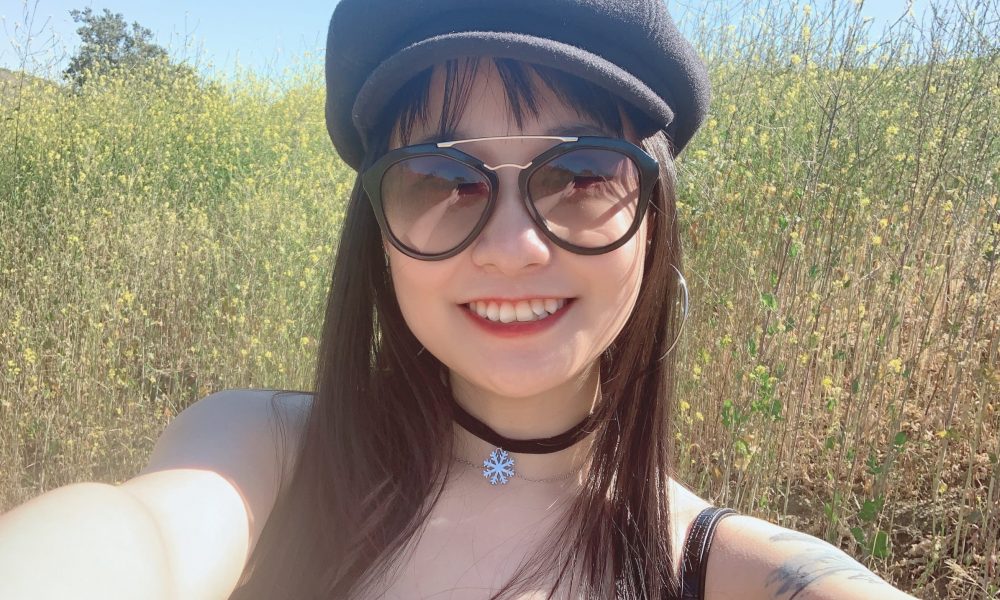
Today we’d like to introduce you to Cici Zhu.
Hi Cici, it’s an honor to have you on the platform. Thanks for taking the time to share your story with us – to start maybe you can share some of your backstory with our readers?
I come from a small city in China. I came to the United States five years ago, and I just finished my bachelor’s degree at ArtCenter College of Design last year. I am a freelance concept artist now.
When I was a little girl, my mom arranged plenty of hobby classes for me, including dancing, piano, art, and mental abacus… You can definitely tell she was desperate to cultivate my skills. I showed a deep interest in art, and later on I kept learning Chinese painting, calligraphy, traditional drawing and painting. I was hoping to develop art as my future career and lifetime goal, but my understanding towards art was very limited to fine art.
A summer vacation during middle school changed my life; it was the first time for me to play the Assassin’s Creed II franchise. I was amazed by the beautiful landscape and the breathtaking adventure stories in the game, but the most shocking part was to see the concept artwork of the game. In 2010, digital art was still not extensively well-known in the Chinese art community, and video games were very new to me, so it was very hard for me to believe that there were many fantastic artists behind the game, bringing such a dazzling visual experience to the players.
Among all the artists, there was one person suddenly captured my attention. Her name was Donglu Yu; she was Chinese and developed her education and career in video game art in Canada. Her artwork was vivid and exquisite, picturing a world and suggesting a path that I have never seen or imagined before. At that moment, I was deceived to be a concept artist for video games just like she was.
Later on, I put every effort to realize my dream. ArtCenter College of Design became my first goal, as I learned that many masters in the film, animation and video game industry graduated from ArtCenter, including Sid Mead and Scott Robertson. Fortunately, I had the chance to get accepted for the Entertainment Design undergraduate program, thus began my four years journey at ArtCenter. It has been a very challenging yet progressive path and one of the best life experiences for me.
Although I have finished my study at ArtCenter, the learning and pursuing of art is endless. There is a long way for me to achieve my dream, and I am glad I have taken a big step.
Can you talk to us a bit about the challenges and lessons you’ve learned along the way. Looking back would you say it’s been easy or smooth in retrospect?
I believe no path could be smooth along the way to realize dreams and pursue life goals, so is my path.
The first big challenge was to get my parents to support my art dream.
Many years ago in China, even till now, there were stereotypes that art was not seen as proper work or duties, and artists couldn’t make a living. Most parents would prefer their children to be civil servants or business elites – so did my parents. Not to mention that most parents saw video games as poison; my dream was nonsense to my parents at first. But they kept an open mind, patiently listened to me talk about future plans, allowed me to clear their prejudice and saw my passion for art. Eventually, they agreed to support my art dream, and they defended me whenever others say things like, “Oh Cici should go to a law school”. I really appreciate my parents’ understanding.
Another inevitable challenge has to do with AI art.
With no doubt, the most recent AI technology of creating artwork is a huge shock to the art community. On one hand, the incredible efficiency of generating various artwork is unbelievable, and the speed for AI to learn and adopt is super fast. On the other hand, the assets and resources from which AI learns are artwork from other artists, thus originality and copyrights become very questionable.
. This creates a problematic situation that AI crazily stresses artists and some programmers steal artwork to recreate and resale.
To be honest, even myself is one of the victims of AI art. I lost my first job mainly because the studio chose to use cheap and fast AI art instead of me; the studio broke our agreement, pushing me to a dilemma where I almost lost my visa.
I was very frustrated because I used to be convinced that my first job would be very promising and my life would go on track, but everything turned into bubbles. The fact that AI can generate high-quality images in seconds makes my years of learning and practicing art seem meaningless. I could not help to wonder if learning art was a mistake and all the efforts I made were gone for nothing. I even regretted choosing art as my career and life goal. For a long time, I was swallowed by these negative thoughts.
But later on, as I kept doodling, I started to understand something. Even though AI may be extensively used in all artistic fields in the future, it can never take away the meaning of art. Everyone has their own opinions on what art means to them. I believe creating artwork is not just a way to get a college diploma, to make a living, or to gain attention on social media, but it’s also a way to express. It’s a way and language to show how I see this world, to tell stories in my mind, to express my emotions and thoughts. No matter how AI advances, it can never take away people’s passion for art or stop people from making their own art.
As I realize this, I feel my mind is eased and freed more than ever before, I see value in my own work again, and I find my passion back again.
Alright, so let’s switch gears a bit and talk business. What should we know about your work?
The job for concept artists is to produce visual designs and art for projects such as video games, animation, TV shows and films in the early stage of production. In the video game production process, first, concept artists create concept art, making a number of artistic decisions such as how the character looks like, how the character’s weapon works, how a vehicle functions, how to communicate the overall mood of the story… etc.
These artworks will become guides for 3D artists, then 3D artists build models based on the concept art. Later on, 3D artists and programmers will introduce the models into game engineers. After a long time of coding, testing and marketing, the game will launch.
Different artists may be proficient in different tasks. For me, I focus on environmental design. To be more specific, my job is to design things like landscapes, architecture, interior spaces, and environmental props.
Normally I would have tasks to establish a certain area. There may be instructions and requirements on the function of this area, a layout of space or a map. I need to figure out the appearance of the objects that show up in this space, such as rocks, vegetation, buildings, roads, furniture… My job is to create a believable space and make it as cool and interesting as possible.
I am proud of my work because I believe it can solve problems. Design work is much different from artwork, that is because designs are required and commissioned by clients, but art is commonly produced spontaneously. So the major responsibility for concept artists is to provide cool visual solutions fitting in certain rules and settings.
For example, there was once I had the task to design some religious items influenced by magical power.

The background of the story happened in an imaginative city in the Tibetan region, where some people worshiped dragons, and some people believed in Buddhism. To design a piece of such a religious prop, I must learn what kind of religious artifacts Tibetan people use in real life, what type of material they use. Then I tried to combine the style and features of the real artifacts with fantastical dragon elements; this allows me to create convincing visual representations. The last step was to show different levels of erosion brought by the magical power, and I kept it to be beautiful but also dangerous.
Practices like this happen a lot, sometimes it can be very challenging, but I always find the process of pushing myself very interesting.
What matters most to you?
The thing that matters to me most is persistence.
When I was young, I watched Naruto; it’s a Japanese Anime telling a story about how the young boy Naruto gets over all obstacles, achieves his dream and becomes the NO.1 ninja. Naruto has a saying that “I’m not gonna run away and I never go back on my word; that is my ninja way!”
I deeply believe that his courage to face the dillams directly and persistence to keep moving forward are the keys to succeed in everything.
I know that practicing art is a long yet hard way; it’s like swimming against the current, if you don’t keep swimming forward, you will fall back quickly. Not to mention that it’s not an easy thing to make your hobby into a professional career. Sometimes the stress consumes your passion, making it difficult for you to gain pleasure from it.
That’s where life challenges us, and that’s where we must show persistence. I’m experienced with depressive feelings towards art. If I stayed away from art, I would remain disappointed in myself. But if I keep drawing and doodling, soon I will regain the passion and create better works. So I always believe it’s never THE TIME to stop or give up, and persistence will push me to be a better person.
Contact Info:
- Website: https://www.artstation.com/cicizhu
- Instagram: https://www.instagram.com/incrediblecici.psd/
- Linkedin: https://www.linkedin.com/in/cici-zhu-8b3246214/


Popular
-

Matthew Hill on Turning Holiday Rituals into Haunting, Habit-Forming Storytelling with Long Winter Nights
-

Linda Villines on Releasing Stored Struggle and Reclaiming Ease Through the Body
-

Candice Swanson on Honoring the Sacred Early Days of Motherhood Through Intentional Photography
-

Michael Johnson on Telling Untold Stories of Identity and Leadership Through SQUAD
-

Owning the Narrative: Drew Dusterhoff Steps Into Power with Lincoln Must Die
-

Portraits of the Valley


