



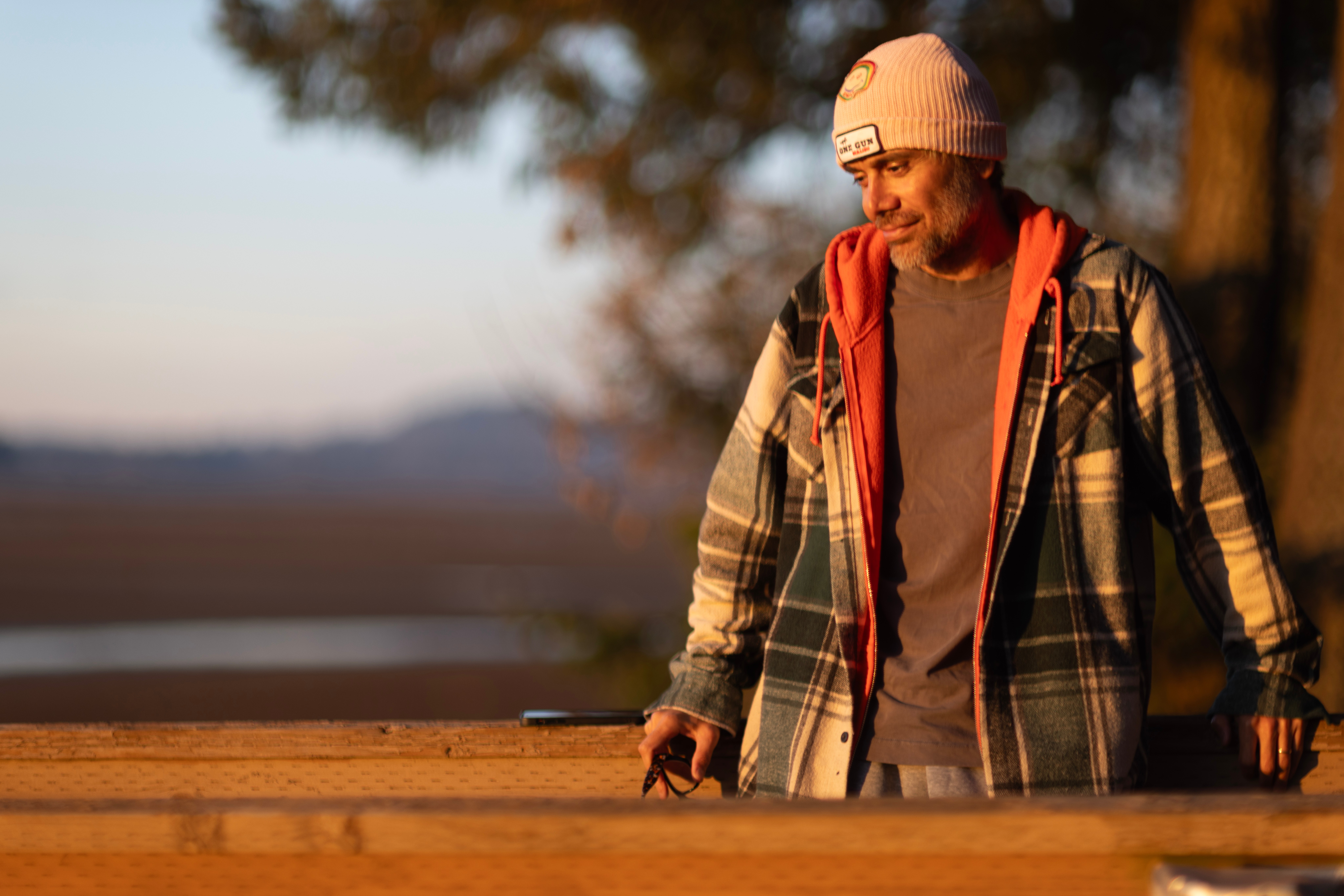
Today we’d like to introduce you to Aslan Ahmadov.
Alright, so thank you so much for sharing your story and insight with our readers. To kick things off, can you tell us a bit about how you got started?
I was born in Baku, Azerbaijan, and my life has always been connected to images, people, and stories. But I didn’t begin with photography. I studied stage directing at the Azerbaijan State University of Arts, and later continued my education in directing in Moscow. Looking back, I think directing taught me something that has stayed with me ever since: to observe people.
I spent more than three decades in Moscow, working as a photographer, filmmaker, and director. During those years, I photographed many well-known artists and public figures, directed more than 50 music videos, and developed my own exhibitions and personal art projects. One of the most personal of them eventually became a book, My Lucy — a photographic project about actress Lyudmila Gurchenko, created from many years of photographing her. My work has also been exhibited at the Moscow Museum of Modern Art.
But I’ve never been very comfortable defining myself by one profession. Photography, filmmaking, directing — for me they are simply different languages for talking about the same thing: people. I’ve always been much more interested in what lies behind a face than in creating a technically perfect picture of it. Sometimes one photograph can tell me more about a person than an entire conversation.
Then, at an age when most people are settling into the life they’ve built, I did almost the opposite.
In 2023, I moved to the United States and started again. New country, new language, new professional environment, new people. It wasn’t always easy, and I don’t want to romanticize it. Starting over when you are no longer twenty is a very different experience. You arrive with a lifetime of experience behind you, but in some ways you become a beginner again.
Los Angeles became an important part of that new chapter. One of the projects that grew out of my life here is Faces of Melrose. For about a year and a half, I photographed people along Melrose Avenue. I wasn’t looking for celebrities or conventional ideas of beauty. I was interested in people whose faces, style, and individuality seemed to belong specifically to that street and to that moment in the life of Los Angeles.
Over time, I began to see the project as something more than a collection of portraits. It became a kind of record of time told through faces — different ages, backgrounds, styles, and lives, all briefly connected by the same street. Years from now, the clothes will change, storefronts will disappear, and Melrose itself may look completely different. But those faces will remain — a small visual document of what this part of Los Angeles looked and felt like at this particular moment.
Documentary filmmaking has also become an important part of my recent work. I directed a documentary about Lala Huseynzade, winner of Miss Universe International 2025, which is now in the final stages of post-production. I also produced an album for singer Miranda Mirianashvili and directed a documentary about its recording, currently in post-production.
More recently, I’ve been working with my friend and musician Sergey Shendrik on a project centered around the Cristal Baschet — an extraordinary instrument made of glass rods and metal, played with wet fingers. We’ve traveled through different parts of America, filming performances in deserts, mountains, forests, and open landscapes, where the location becomes not simply a background, but part of the music itself.
I think that is where I am today — still moving, still looking, and perhaps less interested in building a conventional career than in following whatever genuinely interests me.
If there is one thread connecting Baku, Moscow, Los Angeles, and everything in between, it is probably curiosity. I still want to know what is behind the next door, what a person looks like when they stop posing, and what happens if you are brave — or foolish — enough to begin again.
Alright, so let’s dig a little deeper into the story – has it been an easy path overall and if not, what were the challenges you’ve had to overcome?
No, it hasn’t been a smooth road. And I don’t think there is much value in pretending that every difficult experience was somehow necessary or good for me. But difficulty does change you.
I’ve had several moments in my life when something I had built seemed to disappear and I had to start again. Probably the biggest one was moving to the United States in 2023. By that point, I had already spent decades building a career, a reputation, professional relationships, and a life in Moscow. Then suddenly I found myself in a country where almost none of that history existed for the people around me.
It is a strange experience. You know what you are capable of, but nobody else is required to know it. Your past accomplishments don’t automatically open doors. You have to introduce yourself again, prove yourself again, learn how a different culture and industry work — and sometimes accept things that, earlier in your life, you might have considered a step backward.
There were personal losses too. Like most people who have lived long enough, I’ve lost people, relationships, friendships, money, opportunities — and sometimes a sense of certainty about what came next. I don’t think any of that makes my story exceptional. It simply became part of it.
Difficulty also changed my idea of success. When I was younger, success meant recognition, bigger projects, important names, exhibitions, another music video. I don’t measure it that way anymore. Today, success is having the freedom to choose what I want to work on, who I want to work with, and whether something is worth my time at all.
Starting over taught me something very simple: experience is valuable, but you can’t live inside your own biography. At some point you have to stop telling people what you have done and make something new.
I’m still doing that.
Thanks – so what else should our readers know about your work and what you’re currently focused on?
My work moves between portrait photography, filmmaking, music videos, documentary projects, and personal art projects. I don’t really think of these as separate careers. After many years of working across all of them, one naturally influences the way I approach another.
I’m probably best known for portrait photography, particularly my work with artists, musicians, actors, and other public figures. Many of the people I’ve photographed are very accustomed to being in front of a camera. That creates an interesting challenge: they already know how they want to be photographed. My job is often to get past that.
What I’m most proud of, though, is not the number of projects I’ve done, the famous names I’ve worked with, or any particular exhibition. It’s trust.
For me, a portrait really begins when a person stops performing for the camera. You can’t force that moment. A person has to allow you past the version of themselves they are accustomed to showing the world. Sometimes it happens quickly, sometimes it takes time, and sometimes it doesn’t happen at all. But when it does, that is usually where the photograph begins.
I don’t think my job as a photographer is simply to make someone look beautiful. Beauty alone doesn’t necessarily make an interesting portrait. I’m much more interested in what makes one person unmistakably different from another — sometimes it’s strength, sometimes vulnerability, sometimes something contradictory or even uncomfortable. I don’t want to replace those things with a more flattering version of the person.
My background in directing influences the way I photograph, and photography influences the way I make films. Directing taught me to pay attention not only to what a person does, but to what happens between those actions — a gesture, a pause, a glance, something that may last only a second. Photography taught me not to miss it.
After many years, the technical side of photography is almost instinctive to me. But technique can only take you so far. The difficult part is recognizing when something real is happening in front of you — and not missing it.
That is probably what defines my work more than anything else. I’m not particularly interested in photographing how people want to be seen. I’m interested in who they are in the brief moment when they forget to control it.
What would you say have been one of the most important lessons you’ve learned?
The most important lesson I’ve learned is that you have to be willing to change — even when the version of your life you already have seems perfectly established.
For a long time, I thought experience was something you accumulated: knowledge, work, reputation, connections, achievements. And of course it is. But experience can also become a trap. You can become so attached to who you have been that you stop discovering who you might still become.
Moving to another country later in life made this very clear to me. Suddenly, many things that once defined me mattered much less. I had to become curious again. I had to ask questions, make mistakes, meet completely different people, travel to unfamiliar places, and sometimes feel like a beginner.
Surprisingly, I discovered that being a beginner is not such a terrible thing.
I’ve also learned not to postpone life until everything is perfect. The perfect moment almost never comes. People disappear. Circumstances change. Plans collapse. We change. If there is someone you love, tell them. If there is somewhere you want to go, go. If there is something you genuinely want to create, begin.
At this point in my life, I’m much less afraid of uncertainty than I am of repetition.
Maybe that is the most important lesson: don’t become a prisoner of your own biography. Respect your past, but leave enough empty pages for something you cannot yet imagine.
Contact Info:
- Instagram: https://www.instagram.com/aslanahmadov?stkn=MTk5OGJwNjd1MHY1cg%3D%3D&utm_source=qr
- Facebook: https://www.facebook.com/share/1FFW8AzFLr/?mibextid=wwXIfr
- Youtube: https://youtube.com/@12027300?si=R5bgFsDrMptuhgu9
Popular
-

Portraits of the Valley
-

LA’s Most Inspiring Stories
-

Greg Hex Is Turning the Everyday Kitchen Knife Into a Modern Design Object
-

Rick Norris Learned That Building a Successful Business Means Building a Life You Actually Want to Live
-

How Olivia Rush Turned Survival Into a Mission to Help Others Keep Going
-

How Bibi Goldstein Is Helping Entrepreneurs Reclaim Their Time by Embracing the Power of Delegation


