




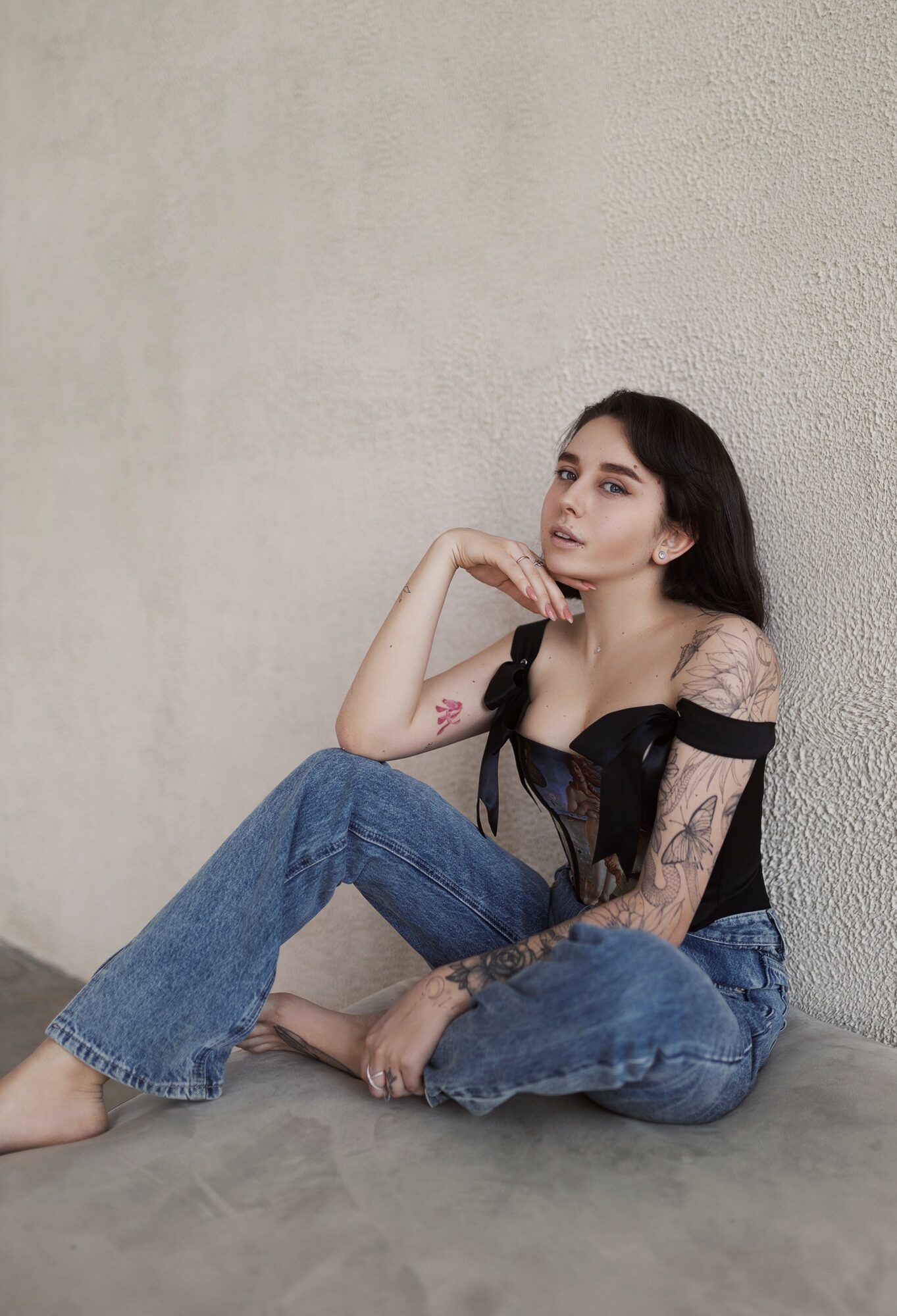
Today we’d like to introduce you to Anastasiia Pakhanova.
Hi Anastasiia, please kick things off for us with an introduction to yourself and your story.
My journey as an artist began long before I ever picked up a tattoo machine. I was born in Kazakhstan and grew up in Saint Petersburg, Russia, after moving there at the age of seven. I attended two art schools and later studied graphic design at the Stieglitz State Academy of Art and Design. Art has always been the most natural way for me to express myself and understand the world around me.
I have been tattooing for more than twelve years. At the beginning of my career, I explored different techniques and artistic directions while learning how an image changes when it is created not on paper, but on the human body. Over time, I developed my own visual language, combining botanical imagery, delicate shading, fine lines, microrealism, and ornamental elements.
One of the most recognizable directions in my work is my interpretation of botanical X-ray tattooing. In these pieces, flowers appear translucent, layered, and almost weightless. Other artists work with a similar aesthetic, but each of us approaches transparency, depth, and light differently. My work can be recognized by the way I build shadows, create soft transitions, and pay close attention to the anatomical structure of plants.
Before moving to the United States, I had already built an established career in Russia. I founded and operated two large tattoo studios, one in Saint Petersburg and another in Moscow, built my own team, and launched a line of branded merchandise. This experience taught me not only how to create tattoos, but also how to build a business, work with people, and develop a community around my art.
A little over two years ago, I moved to the United States with my family after receiving an O-1 visa as an artist. Starting over in a new country was both exciting and challenging. Despite all of my previous experience, I had to rebuild my clientele, adapt to a new culture, and learn how the American tattoo industry works. Over time, Los Angeles became my home and the foundation of a new chapter in my life and career.
Since moving to the United States, I have had the opportunity to work with clients from across the country, participate in major tattoo conventions, receive awards for my work, and serve as a judge at several events. At the same time, I continue to evolve as an artist. Every tattoo I create is designed individually for the client, with close attention to their story, anatomy, and the way the composition moves with the body.
Looking back, I realize that every stage of my journey—from my formal art education and building my own studios to starting a new life in Los Angeles—has helped shape the artist I am today.
Would you say it’s been a smooth road, and if not what are some of the biggest challenges you’ve faced along the way?
My journey has not been a smooth one, and the first challenges appeared at the very beginning of my career. When I started tattooing more than twelve years ago, there were not nearly as many accessible courses, educational resources, or openly available professional materials as there are today. Training with the artist whose work and style I truly admired was far beyond what I could afford at the time.
Instead, I began learning from another artist who worked in a completely different style—realism. He gave me the essential technical foundation and taught me the basic principles of working with a tattoo machine and with skin. From that point forward, however, most of my development was self-directed. I studied different approaches, analyzed my mistakes, practiced constantly, and gradually refined my technique. There was no ready-made course or clear system for me to follow, so I had to find many of the answers through experimentation and hands-on experience.
That process eventually allowed me to develop my own artistic language. Rather than trying to replicate the work of other tattoo artists, I looked for ways to bring my formal art education and my interest in botany, transparency, light, and soft shading into tattooing. Over time, this led me to the visual approach and technical level that define my work today.
The next major challenge was moving to the United States. By that point, I had already established a successful career in Russia, with a loyal clientele, two tattoo studios, a team, and a recognizable name. After relocating, I had to rebuild my professional life almost from the ground up: develop a new client base, adapt to a different culture, and understand the American tattoo industry.
The language barrier was another significant challenge. Tattooing is a deeply personal process, and it is important for me to understand each client’s story, wishes, and emotions precisely. At first, it was difficult to express all of my thoughts freely in English, but I continued learning and never allowed the language barrier to compromise the quality of my communication or my work.
I also had to prove my professional value again in a country where almost no one knew me. I traveled extensively, participated in tattoo conventions, worked in different cities, and gradually earned the trust of a new audience.
Each of these challenges—from learning much of the profession independently to starting a new life in another country—has made me more resourceful, adaptable, and persistent. This experience taught me not to be afraid of a difficult path and to keep growing even when there is no clear roadmap or familiar support system.
Can you tell our readers more about what you do and what you think sets you apart from others?
I am a tattoo artist specializing in botanical compositions, microrealism, fine-line work, and ornamental pieces created with soft shading. The most recognizable direction in my work is my interpretation of botanical X-ray tattooing. In these pieces, flowers appear translucent and layered, with petals showing through one another as they would in an actual X-ray image. This effect is created without heavy outlines, using carefully constructed shadows, soft transitions, and varying levels of black-and-grey saturation.
Although other artists work with a similar aesthetic, my approach is distinguished by the way I build shadows, my attention to the anatomical structure of plants, and my desire to preserve a sense of lightness. It is important to me that even a complex and highly detailed composition never feels heavy on the body.
Another important part of my work is shadow-based ornamentation. These pieces are also created primarily without defined outlines, making the pattern appear like a natural extension of the body. Regardless of the style, I pay close attention to human anatomy. A composition should complement the body’s shape, move naturally with it, and look harmonious from different angles.
Most of my work is custom-designed. I do not copy other artists’ tattoos, and I try not to repeat even my own previous designs. I want to understand each client’s story, the meaning behind the tattoo, and the emotions they want it to carry. I then combine those personal ideas with my artistic vision. As a result, the finished tattoo becomes more than a beautiful image—it becomes a collaboration between the client and the artist.
I am especially proud that my work has received recognition within the American tattoo industry in a relatively short time since my move. This summer alone, I received seven tattoo awards at conventions in different cities across the United States. I have also had the honor of being invited to serve as a judge at Villain Arts conventions and the Golden State Tattoo Expo. Evaluating the work of other artists has been both an important form of professional recognition and a great responsibility.
My creativity is also gradually expanding beyond tattooing. Recently, a local clothing brand based in Utah discovered my work and invited me to collaborate. I created an original print for the brand’s first collection of thermal base layers designed for snowboarding and other winter sports. It was especially exciting to see how my artistic language could be transformed and exist not only on the body as a tattoo, but also through clothing design.
Above all, however, I am proud of the trust my clients place in me. Some travel from other cities and states to receive a piece created especially for them. The opportunity to transform someone’s personal story into art they will carry for the rest of their life is the most meaningful part of my profession.
We all have a different way of looking at and defining success. How do you define success?
For me, success is not defined by a single award, title, or number. It means having the opportunity to do what I genuinely love, remain true to my artistic vision, and continue evolving.
One of the clearest signs of success for an artist is when people begin to recognize their work without seeing the name attached to it. It is especially meaningful to me when someone sees a tattoo and knows that I created it because of the distinctive use of shadows, transparency, and composition. It means that I have succeeded in developing my own visual language.
Success also lies in the trust my clients place in me. When someone travels from another city or state, shares a deeply personal story with me, and allows me to transform it into a tattoo, I consider that a great form of recognition. It is especially important to me that the finished piece is not only visually beautiful, but also carries a profound personal meaning for the client.
Of course, awards, invitations to judge the work of other artists, and professional collaborations are very meaningful to me. They show that my work is being noticed and respected within the industry. However, they are not the ultimate goal on their own.
True success, to me, means having creative freedom, supporting my family through my art, choosing projects that inspire me, and never stopping my growth. I consider myself successful not because I have reached some final destination, but because I continue moving forward, and each new chapter brings opportunities that I could only have dreamed of a few years ago.
Contact Info:
- Website: https://taplink.cc/pakhanova
- Instagram: https://Instagram.com/pakhanova


Image Credits
Maria Buzina
Popular
-

Greg Hex Is Turning the Everyday Kitchen Knife Into a Modern Design Object
-

Portraits of the Valley
-

LA’s Most Inspiring Stories
-

Rick Norris Learned That Building a Successful Business Means Building a Life You Actually Want to Live
-

How Olivia Rush Turned Survival Into a Mission to Help Others Keep Going
-

How Bibi Goldstein Is Helping Entrepreneurs Reclaim Their Time by Embracing the Power of Delegation


