




Today we’d like to introduce you to Octavia Tulip.
Hi Octavia, thanks for joining us today. We’d love for you to start by introducing yourself.
Lush green summers with birds swooping from tree to tree, aromatic sweet grass gently rustling in the fertile summer light, and bitterly cold winter nights that would freeze your nose hairs the moment you step outside; this is what defined my childhood. One of the extremes. The whole atmosphere of Michigan changes drastically from eye-watering beauty to frigid stillness, and it was mirrored in my personal life as well. I struggled to make friends as a child and fell deeply sick on my 11th birthday. I spent months sleeping away every second I could, to escape the overwhelming nausea that radiated to my bone.
In the moments between that respite, I’d binge movies and tv shows, anything to distract my mind from my reality. I developed an intricate and lush interior world that would rival the Michigan summers. Both achingly beautiful and more than occasionally morbid. A strange side effect of what would later be diagnosed as celiac disease was a magnetic draw toward black and white. I wanted to paint my entire life black and white. The stark contrast, the boldness, the clear delineation.
This symptom only became clear as a symptom as I began treating the celiac disease and suddenly, without any perception of it myself, my color palette expanded again. Others around me drew my attention to this fact, and I wanted to understand the connection of this visual-graphic symptom of an autoimmune digestive disease. The doctor that had diagnosed me explained that the gluten I was eating caused toxicity in my brain and visual cortex, such that I was drawn to higher contrast imagery – why I had requested that every last present I was given on my 11th birthday was in a black and white color palette.
I credit those early struggles with developing a more profound sense of color than I would have had otherwise. At 11, I had simplified my external color palette down to two extremes, and subsequently, as I healed my body, I was born anew to the colors of the world. (Of course, some psychotropic substances helped enhance that understanding years later, too, but who’s counting?)
My time in Michigan developed my ethics and preferred method of fashion design too. The natural world that surrounded me, and the liberal bubble I was raised in, made it abundantly clear to me that sustainability is critical, and looking around then, I didn’t see enough people doing anything about it. Every single being who has existed thus far has done so by way of this earth. The earth connects not only every human being, but every animal, every plant, and every organism. We are in a connected, closed system, and the fashion industry is the 7th largest source of pollution in the world. Right up there with oil drilling and construction.
At the same time, on a much more personal scale, I found joy in going to the local basement-priced thrift store and spending hours digging through the clothes. So many textures, materials, gems, wrecks… It was an adventure every time. I had learned the core basics of sewing at 9, but this was how I taught myself a deeper understanding of garments. I’d cut them up to see how they were made inside and then devised ways of making the patterns to construct them into garments anew.
When I dove back into sewing at the age of 14, my first project was a tight-laced corset, with cobalt blue silk and steel boning, that reduced my waist by two inches. That is to say, I went hard from the start. Over the next four years, I time and again made corsets and bodysuits. The rigid structure and body manipulation fascinated me. When it came time to apply to colleges, I applied only to one. I wanted the old-school craft and technical training of a trade school, and in my view there was no better school for that than the Fashion Institute of Technology in New York City.
My time there was inspiring and challenging. Riding the subways and regularly walking upwards of five miles a day, I was exposed to endless streams of people and their styles. Everyone had somewhere to be, something to do. Manhattan felt like “Victory City”, it was all people at the top of their class. Inspiring in a good dose, as well as mentally and physically grueling. It felt like there was no rest, no respite from the noise, the chaos, and the odors. All this in sharp contrast to the quiet and peaceful, albeit boring, hometown I’d grown up in. It was only a matter of time before I had to get out and move somewhere a bit more pleasant. I’m grateful to call sunny Los Angeles home now and still find a little slice of New York in my downtown living.
Since my professional training, I’ve spent countless waking hours contemplating how to build a business that is sustainable, both environmentally, creatively, personally, as well as financially. Too often money and sustainability seem at odds with each other in our capitalist society. It’s why the fashion industry is such a large source of pollution. Clothes are always needed, but the amount of clothes we’ve been sold as “needing” is far from accurate.
After much pondering, I came to the point that undergarments are some of the most continually necessary pieces of clothing, and unlike many other pieces, they don’t change style drastically through the seasons. I went to work building a comfortable and sustainable line of basic garments and decided the star of my show would be a beautiful and thick black jersey made of hemp. I could deliver a whole Ted talk on why hemp is an exceptional material, but I’ll spare you the nitty gritty.
Each clothing style I develop, I wear myself as an exercise in user experience. I tweak the details over multiple iterations until I’m satisfied enough with the design and then I recruit my friends and family to wear the styles in their everyday life and give me feedback. Thankfully it never takes much convincing for them to wear my clothes.
A main tenet of sustainability to me is good design. If I make shitty underwear from sustainable materials, I haven’t in fact made a sustainable product. It’s only when the underwear looks and functions and feels as good or better than similar products made of less sustainable materials, that I’ve made something worthwhile.
The official release date of the underwear line is a couple of months off as I finish tweaking the styles and fit. In the meantime, my line of laser-engraved stainless steel chokers and bracelets are available for purchase, if you’re keen to support the vision and look slick while doing it.
We all face challenges, but looking back would you describe it as a relatively smooth road?
It’s never been smooth, but then again, I never expected going off the beaten path would be. When I have a breakdown, I take some time to feel the feelings, the disappointment, the frustration, the exhaustion, and then I pick my chin up and look for another way around to where I want to go. Be like water, to paraphrase Jackie Chan. Water is fluid and can easily change directions after coming up against a solid boundary. With time and persistence, water can also reshape entire landscapes, look no further than the Grand Canyon. This keeps me going.
Thanks – so what else should our readers know about your work and what you’re currently focused on?
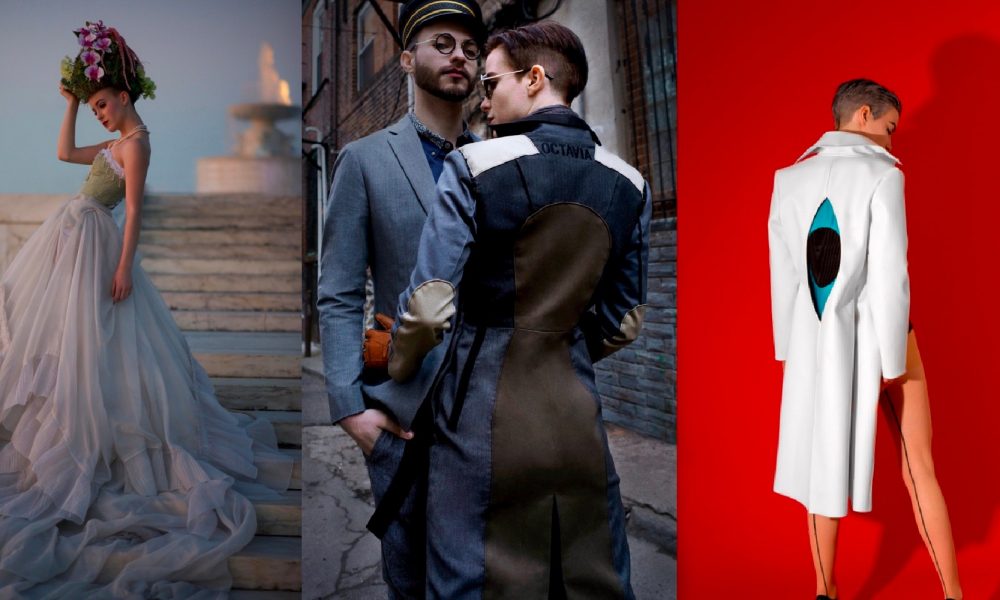
Influenced by everything from Alexander McQueen to Looney Tunes, the natural world around me, and back to Peaky Blinders, my design has a distinctly theatrical and surreal bent to it. One of my most arresting fashion pieces to date came to me in a food-poisoned fever dream. In a flash, an image of a faceless figure wearing a cross between a white lab coat and a trench coat flashed into my mind. The long white coat opened into a single sinister eyeball, recessed into the center back seam, and the figure was stamped in triplicate. Three faceless beings, three sinister unblinking eyeballs starring out from three sterile white trench coats. It was about three years from that vision to when I made the physical jacket, as the image haunted my mind. Another four years since, and I’m still proud of that jacket. It was too blindingly bright white to wear out in the subways of New York, but the two times I had the opportunity to wear it, I was continually stopped for a photo by people on the street. I could feel so many pairs of eyes on me, sticking out in sea of black jackets. That’s why I call it the Eyeconic Jacket.
More accessible however, is the hemp boxer briefs I’ve designed and iterated over the past four years. I developed a proprietary fly that works for both male and female genitalia without sacrifice in form or function. I’ve also worked to develop a lace boxer brief which has charmingly captured the attention of most people I’ve shown it to, and has an ever-growing pre-sale list long before it’s even begun commercial production. I’m truly flattered by the interest. It’s rewarding to design something as good quality as I can and have it so positively received.
Alright so before we go can you talk to us a bit about how people can work with you, collaborate with you or support you?
I’m always looking to connect and collaborate with new models, stylists, photographers, videographers, designers, artists, lighting, and sound people. Honestly, just about anybody creative, talented, and open-minded! You can easily get in touch with me by sending me a message on Instagram, my email, or through the contact form on my website.
If creativity isn’t your roundhouse, but business building, marketing, sustainability, or intellectual property and fashion law is, please, reach out!
You can also support my work through purchases of my jewelry, sharing my information to those in your network who might be able to help, or would like my design work, and just dropping by and sending me a note. I love to hear from strangers! It makes our world more connected and vital.
Pricing:
- Stainless Steel Curb Choker – $80 to $100 depending on the length
- Stainless Steel Curb Bracelet – $40
Contact Info:
- Website: www.octaviatulip.com
- Instagram: www.instagram.com/OctaviaTulip/


 Image Credits
Melanie Goulish, Detroit Bird, Zach Miscavage, Heather Delaney, Montrel
Popular
-

Que Johnson on Building Brands That Last: From Visibility to True Market Authority
-

Christina Wren Steps Into the Director’s Chair to Tell Stories That Feel Like Home
-

Portraits of the Valley
-

LA’s Most Inspiring Stories
-

JordanL on ‘Breathe,’ Belief, and Building a Movement Beyond the Music
-

Megan Birney Rudert on How Access to Light Is Powering a More Sustainable and Equitable Future


