




Today we’d like to introduce you to Marina Efimova.
Hi Marina, so excited to have you on the platform. So before we get into questions about your work-life, maybe you can bring our readers up to speed on your story and how you got to where you are today?
I don’t think there was ever one specific moment when I decided, “That’s it, now I’m a designer.” It happened gradually.
I’ve always had a strong need to create something visual, to come up with new ideas, and to build a beautiful environment around me. But for a long time, it existed more as an inner instinct than as a clearly defined profession.
At some point, I started working very actively with AI. For me, AI was never just a tool for quickly creating beautiful images. I was much more interested in another question: what if ideas that usually exist only as digital concepts could actually be brought into the physical world?
I started creating interiors, furniture, and art objects, experimenting with forms, materials, and prints. Over time, an audience grew around these experiments, and eventually I felt the need to stop simply visualizing ideas and start producing them.
That’s how my furniture brand, MARYEEFI, was born.
Today, most of my work exists somewhere between digital and physical design. I can start with a completely unrealistic idea on a screen and then work with production teams to break it down literally centimeter by centimeter — fabric, patterns, construction, printing, seams, module connections — until it becomes a real object.
That transition from imagination to something physical is probably what interests me most right now.
And I like the fact that my path has never had a pre-written script. I’m still figuring out a lot of it as I go.
We all face challenges, but looking back would you describe it as a relatively smooth road?
No. And even now, I definitely wouldn’t call it smooth.
When people see a finished object or a beautiful image, it’s easy to imagine that the process was simple: there was an idea, then it was produced, and then there was a beautiful sofa.
In reality, there are a huge number of mistakes between those points.
Sometimes the fabric is printed incorrectly. Sometimes a print looks perfect on screen but behaves completely differently once it’s placed on a three-dimensional form. Sometimes patterns have to be remade several times. Sometimes you spend months solving a problem you didn’t even know existed when you started the project.
One of the hardest parts was moving from digital design into real production.
In a digital space, you are almost unlimited. In the physical world, fabric stretches, paint has technical limitations, a sofa has a construction, and manufacturing has its own rules.
I had to learn a lot.
And not as someone who simply hands over a sketch to a factory, but by becoming deeply involved in every stage of the process.
There were many moments when it would have been much easier to say, “This is impossible, let’s simplify it.”
But usually, that’s exactly the moment when I become more interested.
Because if an idea can be produced easily in a standard way, it probably doesn’t contain enough experimentation for me.
I’ve also completely changed the way I see mistakes. Before, a mistake felt like proof that something was going wrong. Now I understand that when you’re trying to create something new, mistakes are simply part of the process.
Almost every strong result I’ve achieved came after several failed versions.
Alright, so let’s switch gears a bit and talk business. What should we know about your work?
It’s difficult for me to define myself with one profession.
I’m a designer and creative director, but probably the most accurate way to describe what I do is that I create ideas and try to find a physical form for them.
Right now, my main focus is object design, furniture, and art pieces.
I work a lot with prints and with the relationship between graphic design and three-dimensional form.
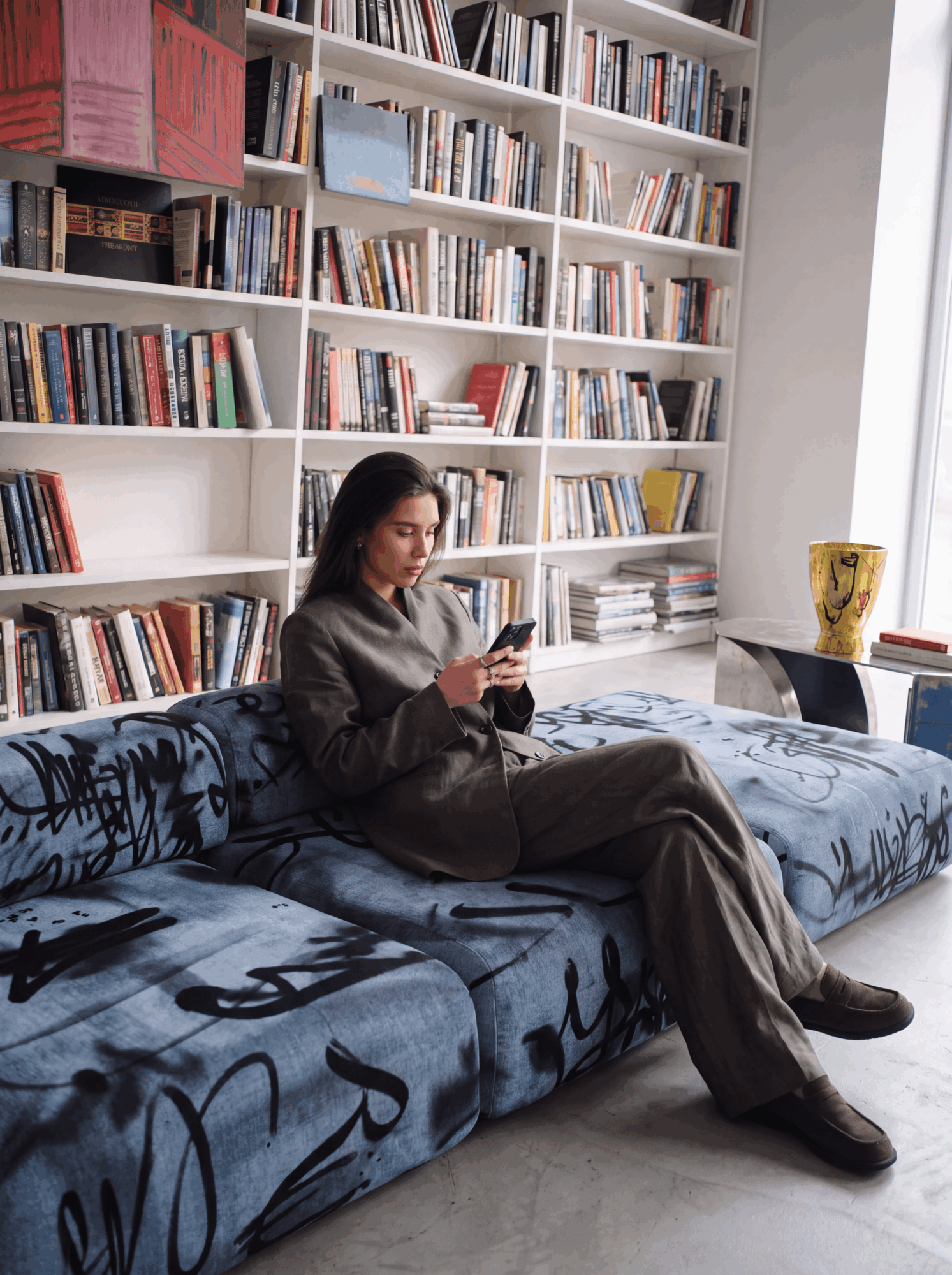
For example, one of the main products at MARYEEFI is a modular sofa with interchangeable art covers.
I wanted to rethink the idea of furniture as something permanent.
We are used to buying a sofa and living with the same object for years. I was interested in creating something that could change together with the space and with the person.
Today it can look almost neutral, and tomorrow it can become a giant graffiti piece or a bold art object.
So for me, it’s not just a sofa with unusual fabric. It’s more like a platform for art.
What I’m probably most proud of is that my ideas gradually stopped existing only as images.
Seeing an object that first existed only in your head, and then suddenly standing in front of you in real life, is still a very powerful feeling.
At the same time, I’m not very interested in following the traditional furniture market and making another variation of something that already exists.
I consciously try to stay slightly outside of it.
I’m much more interested in looking at street art, fashion, digital culture, architecture, music, and contemporary art — and then unexpectedly connecting those worlds with furniture.
I think that is what really sets my work apart.
I don’t always begin with the question, “What should a sofa look like?”
Sometimes the questions are completely different:
“What if furniture could behave like a canvas?”
“What if its surface could change?”
“What if an interior object could exist somewhere between design and art?”
That’s usually where my projects begin.
Can you talk to us a bit about the role of luck?
I believe in luck, but probably not in the traditional sense.
I think luck often only looks like chance from the outside.
You can spend years creating, experimenting, sharing your ideas, meeting people, and making mistakes — and then one meeting or one project suddenly changes your entire direction.
From the outside, people might say, “She got lucky.”
But usually, there is a huge invisible amount of work behind that moment.
At the same time, there have definitely been lucky coincidences in my life. Certain people appeared exactly when I needed them. Sometimes a completely random idea opened the door to a new direction.
And there were also situations that felt like bad luck at the time.
A failed project. A production mistake. Time that felt wasted. Something that simply didn’t work.
But later, many of those moments turned out to be the beginning of a stronger idea.
So now I try to stay calm about both good and bad luck.
I try to use the good luck when it comes.
And I try to take something useful from the bad.
Maybe the most important thing is simply to keep moving long enough for luck to have a chance to find you.
Contact Info:
- Website: https://maryeefi.com/
- Instagram: https://www.instagram.com/maryeefi/
- Facebook: https://www.facebook.com/profile.php?id=61573006971622
- LinkedIn: https://www.linkedin.com/company/maryeefi/


Image Credits
I have all rights for photos
Popular
-
Greg Hex Is Turning the Everyday Kitchen Knife Into a Modern Design Object
-

Portraits of the Valley
-

LA’s Most Inspiring Stories
-

Rick Norris Learned That Building a Successful Business Means Building a Life You Actually Want to Live
-
How Olivia Rush Turned Survival Into a Mission to Help Others Keep Going
-

How Bibi Goldstein Is Helping Entrepreneurs Reclaim Their Time by Embracing the Power of Delegation


