




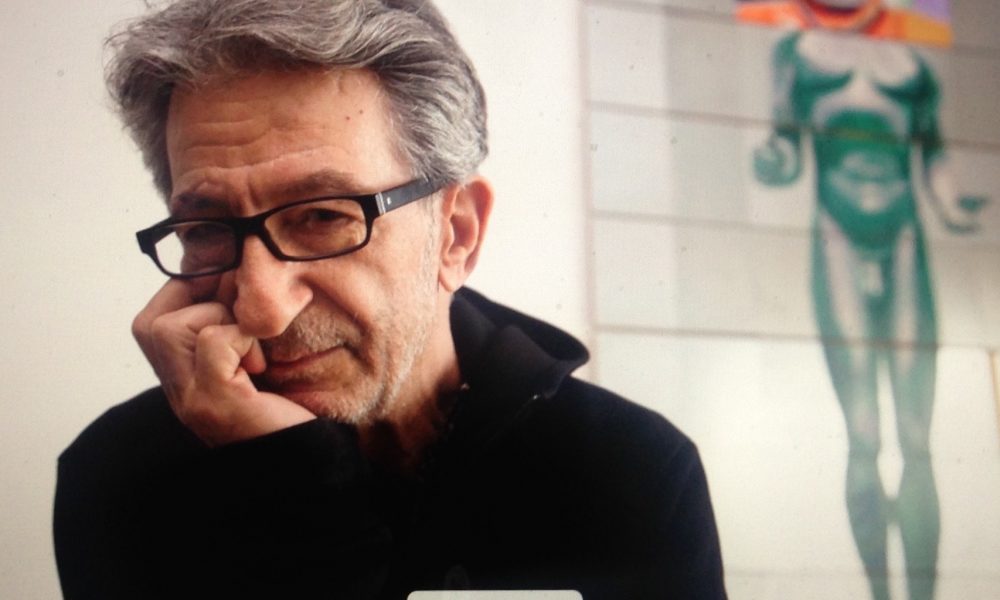
Today we’d like to introduce you to Alex Kritselis.
Alex, we’d love to hear your story and how you got to where you are today both personally and as an artist.
I was born and raised in Athens, Greece just a few years after the WW2 and during the devastating civil war that followed. In my father’s family, my grandfather and his four sons had enlisted in the military. During those years, under very difficult circumstances my dad was able to attend and finish law school, a step that opened a number of opportunities for him and his family. In my earlier years, and then again in high school, my father was stationed in small towns away for Athens and in those times I lived with my maternal grandparents so I could attend school in the capital. During those times, on the rare occasions, I was with my parents, I observed my father making small drawings and was impressed with his facility, a talent he was not able to pursue. Today, as I think back, his skills opened the way and gave me the license to also try my hand in the arts. I first started by carving bars of green soap into tiny boats and animals, painting small seascapes with oils while using olive oil for a medium – few of these pieces that remain are still wet – and in high school, sculpting figures in the sand. About the same time, I started taking art lessons and practicing my foundation skills. Although my parents wanted me to become anything but an artist when I graduated from high school to my surprise, they gave me a year to prepare to take the exams for the Academy of Athens and that was all I needed. I studied sculpture and as with most art academies, the training was rigorously traditional and excluded everything that had been done after WW2.
Three of my five years at the Academy coincided with the time Greece was under a military dictatorship. During those days, expressing dissent, at minimum, could get one picked up and put away. Yet, it also fostered a rebellious attitude and a strong curiosity about the bigger world and the state of the arts outside of Greece. At that time, in the absence of today’s “social media” and lacking credible uncensored national news, we followed the BBC and Voice of America radio programs; our only legitimate sources for what was going on inside and outside the country. Quite soon it became clear to me that there was another universe out there and I was really interested to find more about. This feeling was reinforced through the art history lecture classes and art magazines, like Art In America, which we browsed through in the evening when the librarian would sneak us into the magazine section of the Academy’s library. Although these magazines were available in the library our instructors, for some reasons, didn’t want us to know about them. Eventually, whenever I could, either by myself or with a group of friends, I started traveling outside of Greece visiting European museums to actually see and experience these artworks for myself. First I went to Paris and the south of France then to Madrid, Barcelona, Rome, and Florence and finally to London and Amsterdam.
After I finished the Academy, I left Greece to do my graduate and post-graduate work in London and later in Florence. Eventually, despite my strong feelings and reservations about US foreign policy – both the Greek military coup and Turkey’s military invasion of Cyprus had been encouraged by the US – I decided to travel to the US. Little did I know at that time that this country was going to become my home and, since 1984 I have lived in Los Angeles where I practice and exhibit my art. Traveling is an essential part of my life, as it confirms the existence of a wide world worth time and attention and full of amazing things to discover both culturally and in terms of the arts.
During my first year in the US it became clear that teaching was something I enjoyed – and because my personal work was research-based, I chose teaching as my main patron, my main source of income. I taught art both on the undergraduate and graduate levels for several private and public institutions and, finally, just a few years ago, I ended my academic career as Dean of the Visual Arts and Media Studies at Pasadena City College.
My work has been exhibited and collected both nationally and Internationally in venues that include the Grand Palais Des Champs-Elysees in Paris, Museum of California Art in Pasadena, Museum of Art and History in Lancaster, West Bund International Art Fair in Shanghai, China, Corpus Christi Museum of Art and Voreas Museum of Contemporary Art, in Athens. In addition, I have curated exhibitions and installed several public site-specific video installations and mixed media works, often collaborating with my wife, filmmaker and installation artist, Joey Forsyte. Since the summer of 1984, I have maintained a studio at the Brewery Arts Colony in Los Angeles.
We’d love to hear more about your art. What do you do and why and what do you hope others will take away from your work?
My work is informed by a number of things – our civilization’s trajectory, historic and current socioeconomic quagmires, and conflicts and the collective behavioral patterns they generate. As a transplant to this country with an immigrant experience, I am predisposed to subjects and narratives that address issues about the human condition and the global cyclical displacement of individuals and populations. I am in awe of people’s astonishing strength, determination and desire to risk everything in the pursuit of a better life, in a new place, for themselves and their children. Immigrants are the engine of renewal and hope and I have faith in their desire and ability to do well, succeed and contribute powerful first-hand human narratives that celebrate our capacity to reach and exceed our potential. In terms of my own specific experience, I feel very fortunate because I was welcomed and, other than a rare, often humorously delivered, toxic comment, I have felt no animosity or resentment; instead, I was embraced and given every opportunity to succeed.
I am an ardent consumer of history, science, politics and world news that unfold endlessly in real time before our eyes and ears. These are the sources I harvest for my work along – that and my own life and personal history. Last year, as an example, I came across a photograph taken by the Italian photographer Antonio Masiello of a small boat loaded with Syrian refugees arriving from Turkey to the island of Lesbos. His image struck me hard as it stirred up suppressed family and personal histories. In 1921, following the disastrous war with Turkey my mother, only a few months old, was expelled along with her family from Izmir, Turkey. In my grandmother’s arms, during that radical displacement of a million Greeks under horrendous circumstances, they crossed the Aegean on a boat for Athens. The photograph captured the moment a young boy was transferred from the overcrowded dinghy to those waiting on the island which I saw as a promise and a gift for a new home and a solemn offering of trust and hope. I was compelled and inspired by the currency and power of that image to convey the urgency of that moment and responded by creating the largest single image I had ever done. In that painting, I addressed the endless and cyclical forced migration of populations under unspeakable circumstances occurring way too often around the globe.
My creative process serves my subject’s needs as honestly and straightforwardly as possible and without stylistic boundaries. My palette reflects the range of my interests and is a collection of ideas, materials, and means. Although I was a trained sculptor, my works range from small assemblages to bronze figures, to 40 feet long paintings, to video installations that fill 32 windows of a 200 feet long edifice. I am fascinated by how materials and methods carry their own dialog and how their unique properties inform the final work. When I start a new piece, I tend to almost forget how to go about it. I start with a broad idea but I never know exactly how it will unfold and what it may require. I no longer work from preliminary drawings, as I prefer to approach the making of each work as directly as possible. The only thing I know is that with each new piece I bring with me everything I know and that my knowledge and experience will eventually lead me to the right approach; a working process that is both scary and exhilarating.
The stereotype of a starving artist scares away many potentially talented artists from pursuing art – any advice or thoughts about how to deal with the financial concerns an aspiring artist might be concerned about?
As a younger artist, I was concerned about how my work was going to be received. With time it became clear that making what inspired me mattered a lot more. Keep your antennas up, stay honest to your motives and intentions, challenge yourself, and always take seriously what you do and the opportunities that come to your direction. Cultivate a healthy circle of friends and colleagues and be kind and supportive of others and their work. Art isn’t a business that provides any guarantees and one should be prepared for frequent and occasionally long periods of struggles and uncertainty. Be mindful that “getting there” is more interesting and fun than the final destination. Successful outcomes of your efforts will come through your labor, dedication, discipline, and willingness to share your findings with the world.
Do you have any events or exhibitions coming up? Where would one go to see more of your work? How can people support you and your artwork?
I have recently completed a series of small-scale assemblages about the intersection of lowbrow and highbrow cultures combining original works of mine with found objects and small video screens and I am looking for opportunities to show them. I have also been working, over the past two years, on a large, room size “Temple/People and Places of Glow and Sorrow” installation about my ongoing exploration to decode and deconstruct ancient history and myth in relationship to contemporary mores and narratives. This installation will be comprised of 900 wood and metal painted panels individually hanged and several digital monitors. I have worked with panels for a number of years, enjoying the way they can be recombined into new narratives. Composing with individually detailed fragments, the work is assembled in a modern context, as if pixel-by-pixel. Despite its apparent architectural structure, the individual pieces retain their capacity to adapt to new spaces and assume new configurations, operating as a metaphor for a world made of fragments that multiply and connect, not unlike molecules creating living and ever more complex organisms. Moreover, in my personal search for meaning, each work comes together, apart, and together again over time in revised narrative forms – to essentially retell ancient human stories for the ages in new ways for a new time. I always look for opportunities to collaborate with artists on larger projects as in the “ONE YEAR – The Art of Politics in LA” exhibition for the Brand in Glendale which I co-curated and exhibited in 2018. My artwork can be seen in Los Angeles’s galleries, museums, and non-profit alternative spaces and by appointment at my studio and during the fall and spring Brewery art walk.
Contact Info:
- Address: 2020 North Main Street, Studio #224
Los Angeles, CA 90031 - Website: alexkritselis.com
- Phone: (626)354-4097
- Email: alekos@ix.netcom.com


 Image Credit:
The portrait of me is by Lefteris Padavos.
Getting in touch: VoyageLA is built on recommendations from the community; it’s how we uncover hidden gems, so if you know someone who deserves recognition please let us know here.
2 Comments
Leave a Reply
Popular
-
Robin Olive on Building an Inclusive Performing Arts Movement and Expanding Opportunities for Every Student
-

Portraits of the Valley
-

LA’s Most Inspiring Stories
-

Que Johnson on Building Brands That Last: From Visibility to True Market Authority
-

Christina Wren Steps Into the Director’s Chair to Tell Stories That Feel Like Home
-

JordanL on ‘Breathe,’ Belief, and Building a Movement Beyond the Music




sotos alexiou
February 5, 2019 at 14:18
My dear friend and colleague, Kricelis, is a rare artist with a positive view of art, and here in Greece his friends are watching with interest his art career
sotosalexiou
milo reice
March 4, 2019 at 23:33
Terrific Alex!!!