



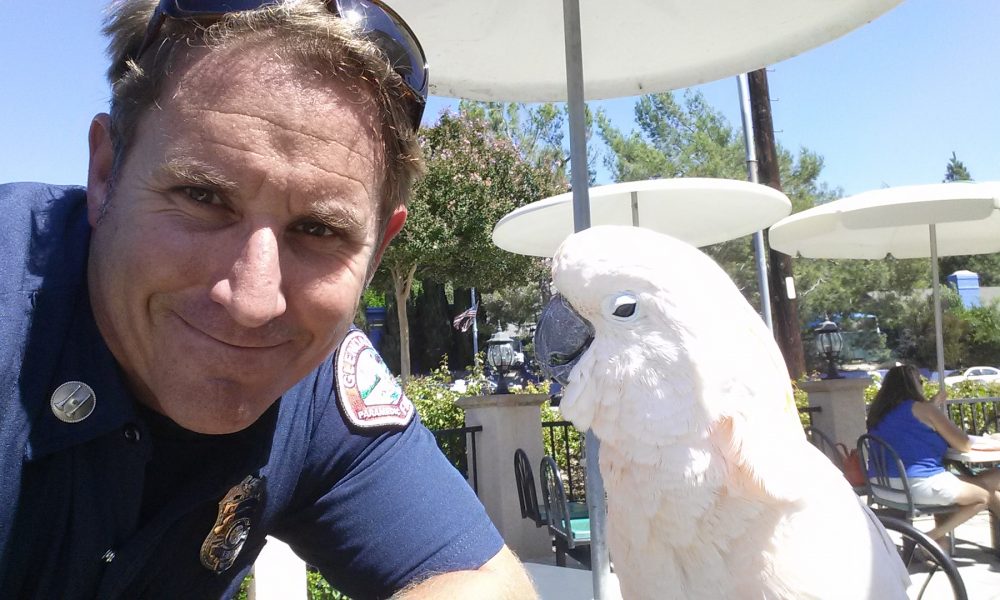
Today we’d like to introduce you to Phil Ambrose.
Phil, let’s start with your story. We’d love to hear how you got started and how the journey has been so far.
I have been an emergency first responder for several years, with most of those years in hazardous materials response. I am currently a Paramedic Fire Captain in the Los Angeles area. As an instructor, I was not happy with the ineffective ways in which we were teaching very dangerous subjects. With the help of my brilliant nephew I was able to develop what would become a training tool used by emergency responders across the U.S. and Canada. My product, the HazSim Pro, makes first responders safer through realistic effective hands on training.
Dangerous jobs require hands on interactive training, and my patented system provides a realistic and safe simulation training environment. My product has allowed me to provide training and learn from other first responders across North America. Along the journey I also started a news and training platform specifically for those in HazMat emergency response, www.hazmatnation.com. My goal is to improve training and bring together fellow first responders and share experiences and improve our safety and the safety of those we serve.
Over 150 HazSim systems are in use today by Firefighters, Military, Training Academies and Private Companies to improve the safety of their responders.
Has it been a smooth road?
Ideas are easy. Implementation is hard. When someone pitches me their idea I tell them to write down the idea, then crumple it up and throw it in the trash. I am half joking, but if you are not ready to make serious sacrifice acting on your idea is not so easy. Be ready for lots of hard work and several mistakes. I gave up long distance paddling (I raced in the Catalina Classic – from Catalina to Manhattan Beach in support of the Sarcoma Alliance several years in a row) due to time needed for my business. I often joke I would gladly paddle back and forth across the Channel instead of working on my business. I would say, swinging my arms for hours in rough seas is easy and brainless, making business decisions takes effort.
The work/life/family balance of starting a company is incredible. When you start out, you are doing everything. You are ‘pushing the rock uphill’ as I call it. You would love someone to come along and push that rock for you but that often turns bad, so you are stuck pushing your rock. Since you have more work than time and we live in a 24/7 tech world it is a challenge to fit it all in, prioritize, and know when to stop.
Landing the first customer. Hiring the right people. Wearing many hats. Keeping your vision on track with those who come along. These are a few of the challenges. Early on I found I didn’t know what to worry about, and often put energy in to the wrong things. There is no replacement for hard work though, combined with an understanding family and a good network. I have gained an excellent network of experts in both business and hazmat response.
It is all worth it knowing we are making it safer for our fellow first responders. The positive feedback from our customers drives me towards new ideas and improvements that will reach more people. I love that the response community is more connected than ever and able to share ideas in real time.
So let’s switch gears a bit and go into the HazSim story. Tell us more about the business.
I invented Hazsim to add the ‘dread factor’ or ‘pucker factor’ to training. With the HazSim we can create realistic scenarios and even add to the stress by hitting the student with real time questions via the system to continuously test if they are learning the material. Prior to Hazsim, students were getting all of their information via prompts or cues from the instructor, except for rare cases at facilities which could use live agents.
I noticed that students trained in the old way expected the clues and cues and were not using their meters (which were not getting readings anyhow) or developing life-saving decision making skills. We also require no dangerous substances which could harm the student and environment.
The Hazsim Pro looks and sounds like an actual handheld hazmat detection meter but it is controlled by the instructor. This enables realistic meter readings and provides an immersive training environment for the student. We can also challenge the student with questions relevant to the subject matter via the Hazsim device.
Ultimately, instead of the student expecting verbal cues, they are now forced to rely on good metering skills as they would have to do in a real-life incident.
We are the experts in hands on hazmat simulation. We are proud that we have customers all over the country and several at prestigious first responder training facilities. Our customers are committed to improving training for their students and we are proud to be able to help them.
Our product was invented by a first responder and our training staff consists of first responders who know what it is like to train for and respond to emergencies.
How do you think the industry will change over the next decade?
We always have trends such as our current opioid epidemic which has caused concern also for the HazMat responders. Previous ‘front page dangers’ were Anthrax and Ebola.
What remains consistent and will be for the next 5-10 years is the need for hands on interactive training. Despite new technologies in response and detection of chemicals it will always be a person involved in making the rescue or stopping the leak. People make the emergency decisions and will always need the hands on skills.
Our company focuses on training people and providing training systems with emphasis on the basics. Dangerous jobs require effective hands on interactive training. HazSim improves first responder safety through effective and realistic training.
Contact Info:
- Website: www.hazsim.com
- Phone: 310-997-9030
- Email: info@hazsim.com
- Instagram: @hazsim
- Facebook: www.facebook.com/hazsimsimtraining
- Twitter: @hazsimtraining
- Other: www.hazmatnation.com


Image Credit:
Phil Ambrose
Jason Rogers
Getting in touch: VoyageLA is built on recommendations from the community; it’s how we uncover hidden gems, so if you know someone who deserves recognition please let us know here.
Popular
-

Que Johnson on Building Brands That Last: From Visibility to True Market Authority
-

Christina Wren Steps Into the Director’s Chair to Tell Stories That Feel Like Home
-

Portraits of the Valley
-

LA’s Most Inspiring Stories
-

JordanL on ‘Breathe,’ Belief, and Building a Movement Beyond the Music
-

Megan Birney Rudert on How Access to Light Is Powering a More Sustainable and Equitable Future