


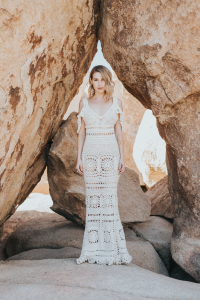
 Today we’d like to introduce you to Dominique Calvillo.
Dominique, can you briefly walk us through your story – how you started and how you got to where you are today.
I grew up in Los Angeles, part of a very large and creative family. My father’s mother who bore twelve children was a highly creative and talented woman. Being one of the youngest of 30 grandchildren, I did not get to spend much one on one time with my grandparents, however, when I was about 6 years old, my grandmother taught me to crochet and welcomed me into her crochet club famously named “The Happy Hookers.”
I fell in love with crochet and was mesmerized by the beautiful patterns, textures, and rhythms of the art and my young mind was determined to understand how they were made. I crocheted all the way into adulthood usually around the holidays and came up with a few basic designs to give my friends as gifts.
In 2013, I was invited to go to India with the International Princess Project (IPP.) IPP is an organization that works with women who are being reintegrated from human trafficking and need a way to support themselves and their families. I was thrilled to have the opportunity to work with these beautiful and resilient women and decided to sell crochet products in order to fund my trip.
Being in India absolutely changed my life. I discovered a deep love and calling on my life to work with survivors of human trafficking. I had always thought that Human Trafficking was too big of an issue for me to make a difference in. I assumed that I did not have the education, skill set or even physical attributes of someone who could confront the issue. While in India, I discovered that I could change a life with something as “small” as teaching haircuts or sewing.
One day, my team headed out to spend a day playing in the Arabian sea with a group of women and I had brought a small crochet project to work on during the journey. One of the women saw me and with much skill, took over my project. Tears filled my eyes as I watched a woman from across the world, with a story I will never quite comprehend, start to make the same pattern with the same rhythm. Just like my mother, my grandmother and myself, she understood this ancient magic that women all over the world share. It was a moment I’ll never forget.
I continued my work in anti-human trafficking by traveling to various countries in South East Asia. In 2015, I began a month-long trip to Cambodia and Thailand where I was teaching cosmetology to young girls who had been affected or were at risk of human trafficking. Upon arrival, my team and I visited torture camps and killing fields where thousands of people had been killed during the Khmer Rouge genocide. The genocide was so recent and so devastating that the country is still cleaning up the aftermath. Wherever you go, you can see cases full of human skulls, and bones. I was devastated by what I had seen. A heaviness and deep depression overtook my heart as I continued my month working and being confronted with the ugliest parts of humanity. During that trip, I witnessed slavery within the coffee industry, the child begging system and was apart of the rescue of a three-year-old Thai girl who was being sold for sexual acts by her mother. I came home with crippling anxiety about war.
Anxiety had never been a part of my life or experience before so I had no idea how to cope with the obsessive and fearful thoughts that possessed my thinking. I had always been a can-do, independent person and suddenly tasks would terrify me to the point of breakdown. Some days, I was unable to get out of bed. During my first therapy session, my therapist asked me what I’d like to talk about. I’ll never forget his face when I promptly answered his question: genocide. I was encouraged by many to take antidepressant medication and though that is helpful for some, I knew that this was not apart of my usual make-up so I sought to overcome homeopathically.
I found solace in crochet. It had always been a very peaceful and calming activity for me and the meditative aspect of it was quickly becoming crucial to my mental health. I started to learn new stitches and designs because counting and focusing on patterns pulled my mind away from the destructive loop it was trapped in. Most days, I spent 2-8 hours meditating with my crochet, lost in the beauty of the stitches instead of dwelling on fearful thoughts.
I started to make dream catchers, blankets and pillows and then attempted to turn a skirt I’d made into a dress. I had no expectation of creating anything wearable and unraveled multiple attempts but as my skill improved, I was able to assemble my first dress. By the time it was completed, I had been working on the design for two years. I was shocked by the response I received from friends and family who saw the dress. I decided to continue to attempt new designs.
Being that I do not know how to read crochet patterns, I have designed all of my pieces through trial and error. It usually takes several attempts before I am happy with a design and have become accustomed to unraveling hours and hours of work to try again. In the design process, I constantly remind myself that the goal is not the finished product but the time spent in meditation with my art. It seems that with each new design, I learn a bigger truth about myself and the heart of God. I love that each stitch becomes a mantra, which is then a part of a bigger beautiful picture. It has taught me so much about peace, patience and being in the moment.
Since my first dress design, I have created 15 gown designs which have been featured in wedding magazines, worn on the red carpet and have been viewed as a collection for a RAW Artists runway. I am currently taking bridal and celebrity commissions.
My hope is that Namaste and Crochet will one day be a clothing line that will benefit the lives of women affected by human trafficking.
Great, so let’s dig a little deeper into the story – has it been an easy path overall and if not, what were the challenges you’ve had to overcome?
Due to the fact that I have not been properly trained to read patterns, coming up with my designs proved to be an uphill battle. Many times, I have cried in a pile of unraveled string frustrated by the trial and error process. My determination to see a piece come to life has kept me going through these moments to the completion of a project.
As I look for manufacturing, the issue I continue to face is that the fashion industry is completely set up for fast and unethical manufacturing. It is amazing to me how many offers I have had to turn down due to unethical labor and material sourcing. However, I believe that if I am unwavering in my decision to be a sustainable and fair trade company, I will find the perfect way to scale my line.
The advice I would give to any young artist is this: Do not wait for permission to do what is in your heart. If you dilute your message, your product or your art, it is a disservice to yourself and the world. No one will be able to see your vision as you can. Be relentless in making it come to life. I am a firm believer that if someone is inspired to make art (whatever medium) there is someone in the world who needs to experience what you have to give.
Please tell us about Namaste and Crochet.
I design and hand make crochet clothing and home decor. I am most known for my wedding gowns and innovative dress designs. I am proud that no one else on earth is doing what I am doing. Though there are many crochet designers, I have not seen another designer in a similar style. I am proud of the message and heart behind Namaste and Crochet. More than the products, I hope my brand will make a difference bringing awareness to human trafficking and conscious consuming.
Do you think there are structural or other barriers impeding the emergence of more female leaders?
The fashion industry has always been a battleground for women. It exacerbates insecurity, perpetuates stereotypes and has sold us an idea of unattainable beauty. It has always been my goal to champion other women by making sure all ethnicities and body types are represented and celebrated by my brand. While producing and editing photo shoots I am diligent to make sure that no photoshop is used to edit a woman’s body. To me, beauty should be raw and unapologetically human. Though I am constantly having to manage the insecurities and requests of models to be seen a certain way, it is my desire to help them and my viewers to see the beauty that is real and help put an end to the unattainable ideal.
Contact Info:
- Website: Namasteandcrochet.com
- Email: hello@namasteandcrochet.com
- Instagram: @namaste_and_crochet
- Facebook: https://www.facebook.com/Namaste-And-Crochet


Image Credit:
Emily Birkland, Kofi Dodi
Getting in touch: VoyageLA is built on recommendations from the community; it’s how we uncover hidden gems, so if you know someone who deserves recognition please let us know here.
Popular
-

Que Johnson on Building Brands That Last: From Visibility to True Market Authority
-

Christina Wren Steps Into the Director’s Chair to Tell Stories That Feel Like Home
-

Portraits of the Valley
-

LA’s Most Inspiring Stories
-

JordanL on ‘Breathe,’ Belief, and Building a Movement Beyond the Music
-

Megan Birney Rudert on How Access to Light Is Powering a More Sustainable and Equitable Future