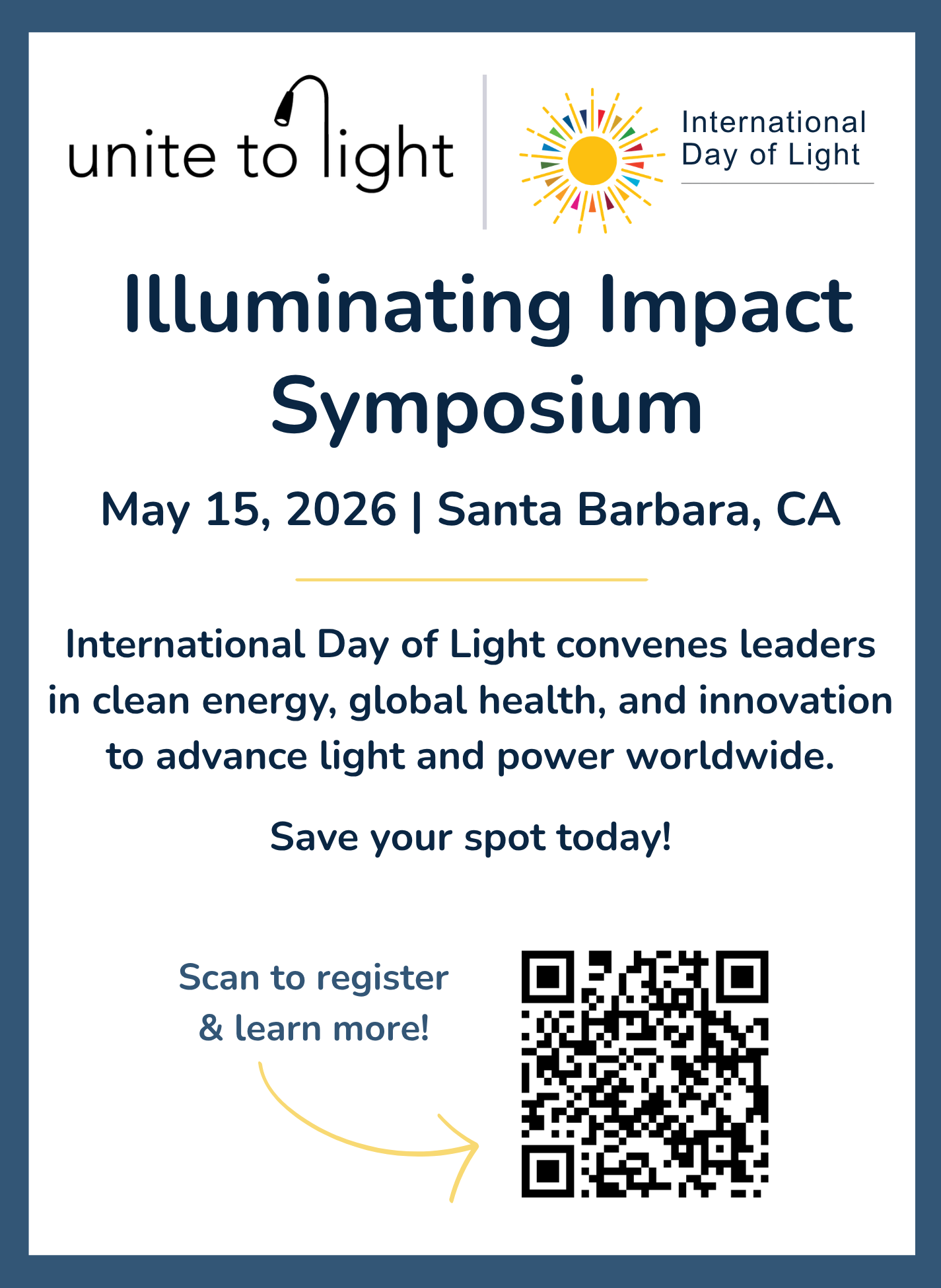
Megan, what inspired Unite to Light to center this year’s symposium around the theme “Light for a Sustainable Future,” and why is that message especially urgent right now?
The theme “Light for a Sustainable Future” actually comes from UNESCO’s official theme for the International Day of Light—we didn’t create it ourselves. But it resonates deeply with Unite to Light’s work.
At its core, our mission sits at the intersection of clean energy access, climate resilience, and human well-being. Light is one of the most immediate and tangible entry points into sustainability—it enables education, supports healthcare, improves safety, and replaces harmful, carbon-intensive energy sources like kerosene.
The urgency of this message right now is hard to overstate. We’re seeing the impacts of climate change accelerate, while at the same time nearly 700 million people still live without access to electricity. “Light for a Sustainable Future” captures both the challenge and the opportunity: that expanding access to clean, reliable light isn’t just about meeting basic needs—it’s a critical part of building a more equitable and sustainable world.
The event brings together leaders from multiple sectors. How do you ensure these conversations translate into real-world impact beyond the symposium?
While we can’t control what every participant does after the symposium, we’re very intentional about designing the event to spark action.
For Unite to Light, these discussions directly inform our strategic priorities, partnerships, and program design. We’re constantly looking for ways to apply what we learn, whether that’s improving how we deliver light to healthcare workers, strengthening our climate resilience efforts, or identifying new collaborators.
Beyond our own work, we also build in follow-up with attendees to help carry momentum forward. That includes sharing key takeaways, making introductions across sectors, and creating opportunities for continued engagement after the event. The goal is to move people from inspiration to implementation.
Ultimately, bringing together leaders from different sectors isn’t just about exchanging ideas, it’s about creating unlikely connections that can lead to tangible solutions.
Unite to Light has already reached 80 countries. What have been some of the most powerful or unexpected outcomes from providing access to light and energy?
One of the most powerful lessons we’ve seen is that access to light and energy is never just about light. It’s about everything that comes with it: food security, community, and safety.
A single solar light can shift how a family allocates its limited resources. Instead of spending money on kerosene, a mother can buy food. It can change how people connect: a granddaughter can safely walk to her grandparents’ home in the evening to share a meal. And in some communities, something as simple as a light can protect livelihoods by helping keep animals like hyenas away from livestock at night.
What’s been most striking, and sometimes unexpected, is how quickly these ripple effects take hold. Light creates opportunity almost immediately, in ways that are deeply human and often hard to predict—but always meaningful.
The panels cover everything from health to climate to equity. How does access to light serve as a unifying solution across these different challenges?
Access to light is a uniquely unifying solution because it sits at the foundation of so many critical systems.
In healthcare, it enables safe childbirth and allows providers to deliver care after dark. In education, it gives students the ability to study and teachers the ability to prepare. From a climate perspective, replacing kerosene with solar light reduces emissions and indoor air pollution. And from an equity standpoint, access to reliable light helps level the playing field, particularly for women and girls, who are often most impacted by energy poverty.
What makes light so powerful is its immediacy and versatility. It’s not a single-sector solution. It’s an enabler across sectors. By addressing energy access at a basic level, you unlock progress in health, education, economic opportunity, and environmental sustainability all at once.
For those attending whether in person or virtually. What do you hope they walk away with after experiencing the Illuminating Impact Symposium?
I hope people walk away with a renewed sense of what’s possible and their role in making it happen.
It’s easy to feel overwhelmed by the scale of global challenges like climate change, energy poverty, and inequity. But what this symposium shows is that there are tangible, proven solutions that are already making a difference. Access to light is one of them, and it’s something people can understand, support, and scale.
I also hope attendees leave feeling connected. When you bring together people from different sectors and perspectives, it creates a sense of shared purpose and momentum that doesn’t exist in isolation.
Ultimately, if people leave both inspired and activated, whether that means rethinking their own work, forming new partnerships, or simply choosing to support solutions like ours, then we’ve done what we set out to do.
Link: