




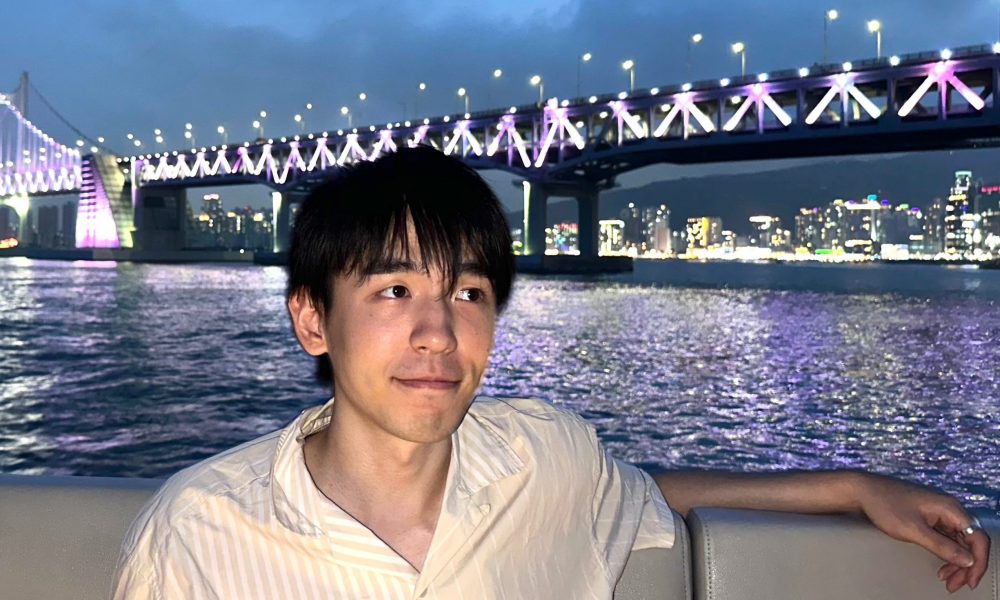
Today we’d like to introduce you to Satoki Takamatsu.
Hi Satoki, it’s an honor to have you on the platform. Thanks for taking the time to share your story with us – to start maybe you can share some of your backstory with our readers?
For the first half of my life, I grew up in Sydney, Australia where I was fortunate enough to attend a school that recognizes the importance of the arts and creativity for children. We were not only encouraged to learn instruments, but it was a requirement, and I chose the lyre and the violin. Around that time was also when my brother started to learn the piano, and I–being a little brother–followed suit. In fact, my brother was the first to be super passionate about music as he started playing many instruments, joining bands and even composing his own music. He essentially pioneered my path toward music as I tagged along his passionate journey. I still remember the joys of listening to Beethoven’s symphonies together, pretending to conduct, trying to read the full score–even though I honestly couldn’t read music very well at the time.
I’ve always loved music, but I think my path toward a career in music became a little clearer during my time at an international high school in Japan. Just like my brother, I started playing in bands with my friends, performing on stage and learning more instruments, this time for the school’s orchestra. However, my passion for composition started as a simple school assignment. I loved playing and listening to music but never seriously considered making my own. When I was given the task of creating a piece using the sonata-allegro form inspired by Western Classical music, I just… went for it. I stayed up late for multiple nights trying to complete the piece, not because I couldn’t complete it, but because I wanted to keep adding more and developing it further, seeing where I could take it. Ever since then, I became a lot more enthusiastic about making music, and my days would consist of thinking about how I could improve my compositions. With music so heavily on my mind, I eventually caught myself noticing music in places I hadn’t before, like the movies. I started thinking about the intricate techniques used in the music of films and how each piece flows together with the films’ stories. This is also when I realized how music can play a key part in helping us feel excited, anxious, melancholic, in love–essentially, any and all emotions in life.
Eventually, it came time to apply for college, and the only thing I could see myself doing with a true passion was music, so I applied for composition programs across the world. I ended up finding myself pursuing a degree in Film Scoring and Contemporary Writing and Production with a minor in Video Game Scoring at Berklee College of Music. Now I am finishing this degree, hoping to move to LA to either further my education or officially start my career.
Would you say it’s been a smooth road, and if not what are some of the biggest challenges you’ve faced along the way?
I knew pursuing a career in music wouldn’t be easy, but it is definitely difficult. Perhaps more difficult than I ever thought, especially when I go to a school full of talented people. I always see my friends create and do amazing things, and it’s definitely a struggle not to compare myself to them, not just in terms of the quality of work but also in just how much they’re able to produce. Of course, sometimes this motivates me and pushes me to be more like the friends I admire, but it would be a lie to say that I’m not discouraged at times as well. I find myself asking questions like: “Am I doing enough?”, “Do I need to do more? Do better?”. This often puts me in a constant state of anxiety as I worry about my future and what I can achieve. Reminding myself that everyone has their own separate journey makes it a little easier to stay motivated but the only thing that truly helps is to stay true to myself and keep making music.
And of course, there’s procrastination, a phenomenon that I’m sure my fellow musicians are very familiar with. When the stress about my work and my future becomes too much, I find myself becoming easily overwhelmed, which makes it incredibly difficult to do even basic things in life. I feel lost and out of control. Although I still find myself struggling at times, recently I’ve been getting better at avoiding the emotional death spiral, and I just remind myself that I’ll probably feel worse later if I procrastinate any longer. Usually, starting a task is the hardest part, but once I’ve started, it only gets easier from there. I say all this because I feel like it’s important to share these internal struggles, as I know firsthand just how isolating it can be in your own head without anyone to connect with. Normally, I’d be afraid to share these kinds of thoughts on such a large platform, but what better way to start?
Before I came to Berklee, most of my ideas for my compositions came from things around me or my own thoughts. However, since coming to Berklee, I have had to rewire my brain into thinking about what the media I’m composing for needs instead of what I want to write. I had to put myself in the shoes of the audience/consumer, and I felt like that was really limiting at first. This was a completely different method of creation than what I was used to, and it was difficult to navigate how much of “me” I should insert into the art. If the music is rejected, how much of the rejection comes from other aspects, and how much comes from “me”? Learning to separate myself from my art has been difficult to learn, and knowing how much of “myself” I could allow to bleed into the music just to be judged by others was difficult to balance. I think one of the biggest things that has helped me handle this is to just find enjoyment in the creative process and not dwell too much on the outcome. I feel like I have found joy in figuring out what kind of techniques or styles work for different scenarios in the same way one might enjoy figuring out how a small puzzle piece fits into the whole picture.
Appreciate you sharing that. What else should we know about what you do?
I specialize in scoring for films and other media, such as games, as well as arranging and producing songs. One of my strengths however, is my adaptability in writing in many different styles. I take pride in my ability and versatility in arranging jazz tunes for big bands, scoring orchestral music, writing for film, producing songs for artists, creating interactive scores for video games, and more. If you are looking for some niche type of music, no matter how obscure you think it is, I will be able to provide that for you. One time I was lucky enough to work with three animators from MassArt College for their films, all at the same time, and they all had very different types of music in mind. One asked for a film-noir-esque cue with jazzy improvisation, while another asked for a more ethnic middle-eastern style cue with ambient electronic undertones. The last animator asked for a more traditional cue with oboe, clarinet and bassoon (which was particularly difficult as there were very specific tempo changes to suit the flow of the film, which we had to record with varying clicks in multiple takes).
Although a lot of my strengths lie in my adaptability, I feel like this doesn’t give a good picture as to my personal writing style. My voice comes from a unique perspective of a Japanese person who has grown up in both Australia and Japan; Around nature and the city. I see myself taking influence from a variety of Japanese music, such as film scores by Joe Hisaishi, game scores by Mahito Yokota (think Super Mario Galaxy), or even indie Japanese ambient music by the likes of Haruka Nakamura. But I especially think a lot of my musical style comes from my openness to connect with nature, which perhaps stems from my childhood experiences living and playing in the forests of Australia.
One of the first pieces that I challenged myself with was an orchestral piece in which I created an entire story about the sun setting and nocturnal animals coming out, representing wolves howling and critters running about through choices in instrumentation and musical techniques. More recently, I had the opportunity to take an ecomusicology class in which I was made even more aware of the sounds of nature and how that connected with music. I feel like I like to base a lot of my music in natural settings as well as incorporating or mimicking the sounds of nature in my music. For example, I would mimic the rustling of leaves with tremolo strings or rain droplets in a cave with pizzicato or pitched percussion.
So maybe we end on discussing what matters most to you and why?
Of course, I would love to create hit songs or score films and games that I can be proud of, but I’ve learned that what matters even more is to be able to inspire people and help people in one way or another through my music. As I’ve mentioned above, I have struggled through hardships that I think many people can relate to, and I would say that music has been a major helping hand in feeling and processing my emotions. As cliché as it may sound, my mission statement as of now would be to be there for people through my music and to help foster a sense of peace and kindness in people’s hearts. We all breathe music. Let the music hold your hand.
Contact Info:
- Website: satokitakamatsu.com
- Instagram: https://www.instagram.com/satoki808/
- Linkedin: https://www.linkedin.com/in/satoki-takamatsu
- Youtube: https://www.youtube.com/@satokitakamatsu


 Image Credits
Personal Photo: Aly Han – Additional Photos: Aly Han, Will Tiong
Popular
-

Portraits of the Valley
-

LA’s Most Inspiring Stories
-

Robin Olive on Building an Inclusive Performing Arts Movement and Expanding Opportunities for Every Student
-

Que Johnson on Building Brands That Last: From Visibility to True Market Authority
-

Christina Wren Steps Into the Director’s Chair to Tell Stories That Feel Like Home
-

JordanL on ‘Breathe,’ Belief, and Building a Movement Beyond the Music


