


Today we’d like to introduce you to Noelani Riehle.
Noelani, please share your story with us. How did you get to where you are today?
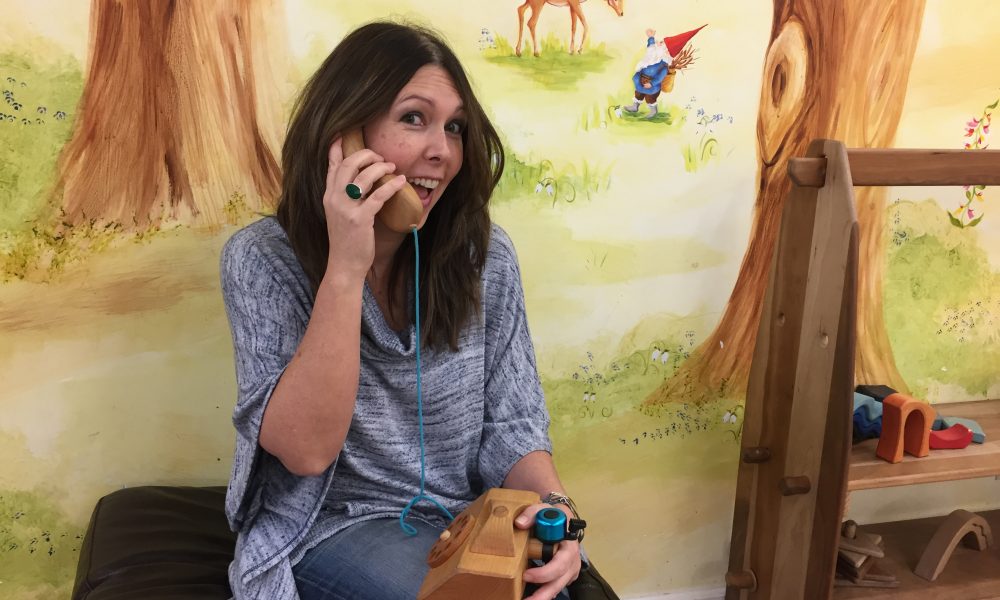
I worked in the entertainment industry for almost ten years before I left my job to open A Magic Forest. I was ready for a change and wanted to do something that would give me more flexibility to be with my daughter, who was then 2. Building A Magic Forest was actually an impulsive, lightbulb moment kind of idea. I had always had a fantasy of owning a cafe, but the fantasy never took hold. Then one day, I attempted to take my daughter to an indoor play space, and upon arrival realized she was not only too young, but that space itself didn’t feel developmentally appropriate for a toddler or welcoming or inspiring to parents. I thought, why aren’t there any play spaces that are more in tune with Waldorf, an educational route I had already decided on for my daughter when she was ready for preschool. That’s when the idea struck- a play space that meets the needs of both parent and child (play, coffee, and community), and is also entirely different than anything else out there, in that it is inspired by Waldorf education. Many customers may not even know what that means, but that’s okay. They walk in and immediately sense that we are different- the toys are handmade from natural materials like wood, felt and silk; there is no media, loud colors or loud music. It’s like a living room with all your favorite toys. We encourage open-ended play that isn’t informed by media, but the child’s own imagination. A place where parents can feel safe giving their young children space to freely explore. And of course, we offer a variety of party packages, which give parents a lot of flexibility in the context of budget and theme. To round it out we have the café and toy store.
Has it been a smooth road?
I don’t think opening your own business can ever be a smooth road. I had no idea what I was doing. The first thing I learned is that everyone says no at first. The amount of research I had to do on city codes just to find a business model that the city would say yes to would make your head spin. Thankfully I used to be a fact checker, so this part was actually very satisfying and even helped me come up with my model. And then there are the permits. And the build out. You bleed money.
My husband would ask me questions, like how will you find staff? Customers? Toy vendors? I kept saying, “Build it, they will come.” And sure enough, they did. We did a soft opening before my café buildout, so I was able to get a small cash flow going. Word of mouth was great. I grew in increments. And then I needed staff. I had one friend who I hired from the get go and she had a toddler and was pregnant. What a perfect place for a mom to work and have her child with her. When she left to have her baby, I’d only been open a few months, and one of my customers dropped her husband off with their daughter. Within five minutes of being there, he told me I should hire his wife. She came back in the next day and I hired her on the spot. And the next thing I knew, I had built a business where moms could actually earn an income while having their children with them, in an environment that is actually appropriate. It wasn’t planned that way, but it’s turned out to be one of the greatest things I’ve been able to offer as an employer and mom, But it’s also been a struggle, one which has cost us, customers. Often times staff have to split attention between child and customer, or a customer might feel like the staff isn’t properly supervising her child. The flip side is that staff children offer a constant for regular customers and the familial environment really fosters a sense of community, and supports the adage that it takes a village. It’s created quite a bit of discourse on motherhood, working moms, and customer service. We’ve had to figure out how to balance it all out. We aren’t just providing a space for children for play, but a place where motherhood and childhood actually take shape. That takes a lot of work and we are figuring things out as we go along.
OF course, another struggle is cash flow. Business isn’t always consistent, particularly given the mild weather of southern California. It’s hard to grow a business when you are concentrating on all the little daily particulars of running the business and don’t have consistent cash flow. We aren’t backed by investors, So when we have a slow week, you worry about paying the bills. The things you should be concentrating on to grow the business get sidetracked by any number of little things, on top of being a working mom. Ha, I guess this is all to say that time management is also a big struggle!
So let’s switch gears a bit and go into the A Magic Forest story. Tell us more about the business.
I addressed much of this while answering the other questions, but in a nutshell, there is no other play space that I know of like ours. As a Waldorf-inspired play space, we filled a void. I’ve had many customers tell me that they had no idea they were looking for a place like A Magic Forest until they walked in, and immediately had that feeling of, “Ah, yes.” I feel strongly that children are constantly bombarded with inappropriate images, sounds, and ideas, and this is partly due to over exposure to media and societal tendency to make them grow up faster. And also the fact that they don’t get to freely move around as much. We offer an alternative to all of that– children who play, who play a lot, in a developmentally appropriate way, will not need to be “entertained.” They will have a full, inner life that will be evident in their play, their interactions, and their spirit. They will blossom. And you don’t have to ascribe to the Waldorf philosophy of education to appreciate that. Even the smallest influences can have a great effect and that’s how I see A Magic Forest.
I am also proud of the fact that I have a business that allows mothers to be at work with their children. Where else does that happen? If there’s one place a mom should be able to bring their child to work, it’s a play space. In the almost five years we’ve been open, I’ve watched my staff’s children (and my daughter, too), grow up. I’ve seen them develop lasting friendships with some of our customers. I’ve watched a community take shape and it’s inspiring. Customers build lasting friendships with one another, too. We’ve witnessed I can’t tell you how many first birthdays, first words, first steps in our customers’ children.
Our birthday parties are also unique, partly due to the inherent fact that our space is unique, and also because of our high level of customer service. One could say we are like a “boutique” party venue, with a variety of options to fit within varying budgets and styles.
The fact that we have a full, licensed café serving organic Groundwork coffee and espresso, as well as teas and snacks, is also a bonus. Most of the play spaces in the area don’t have a legally licensed café.
How do you think the industry will change over the next decade?
This is a tricky one. I’ve found over the almost five years that I’ve been open that parents want and needs change pretty quickly, and it can be hard to adapt. When I first opened, parents loved that we were just a drop-in play space where children could play and explore. From a Waldorf perspective, young children don’t need classes, scheduled peer activities, etc. They simply need to be given the time and space to play, indoors and out. We offer that. But then about a year ago, I started getting lots of inquiries as to what kinds of classes we offered for babies and toddlers. We had a music class and that was it. So as an experiment we started offering developmentally appropriate classes to meet those demands, but there wasn’t enough to sustain our program and customers were bummed we took away some drop-in play time. Now that we are back to our old model, customers want to know what happened to the classes. As a business, it’s tough to figure that all out without losing money. We are still trying to figure out within the context of being a Waldorf-inspired play space.
I also worry how a tiny business like mine will be able to stay open as minimum wage increases (which I voted for by the way because I believe in it) and commercial rents go up. It’s difficult to raise prices to the degree that will be necessary to sustain the higher wages, taxes. costs, etc. Unless customers are willing to pay substantially more. I guess we’ll see in a couple years. But this is why I think it’s laughable to be considered a small business. The current economic environment makes it very difficult for a tiny business like mine to thrive, particularly in our real estate market.
From a retail perspective, while the toys we sell are handmade, or mostly European wooden toys, they can all be purchased on-line, even through Amazon. So it’s really hard to compete with that, too. Thankfully, the parents who shop at A Magic Forest do so because they want to support a local business.
The one thing for sure is that parents are always looking for activities for their children. As the owner of a Waldorf play space, that promotes play above all else, and whose existence is itself somewhat of a rejection of mainstream conspicuous consumption and media branding of our children, I hope that moms, who have incredible purchasing power, will see past the “noise,” seek the community that we are building at A Magic Forest, and be willing to spend their money at a simple, back to the basics, but magical kind of play space.
Pricing:
- $10 Drop-in Open Play (all ages); $8 siblings
- Discount pricing on Multi-packs and Monthly Passes
- Private parties starting at $375
Contact Info:
- Address: A Magic Forest
12512 W. Washington Blvd.
Los Angeles, CA 90066 - Website: www.amagicforestculvercity.com
- Phone: 310-397-9400
- Email: [email protected]
- Instagram: https://www.instagram.com/amagicforest/
- Facebook: https://www.facebook.com/AMagicForest
- Twitter: https://twitter.com/AMagicForest
- Yelp: https://www.yelp.com/biz/a-magic-forest-los-angeles


Image Credit:
Jay Sharman Photography and A Magic Forest
Popular
-
Los Angeles Barea on Turning Green Superheroes into a Global Movement for Youth-Led Change
-

Trisha DuVivier on Bridging the Franchisor–Franchisee Divide with Workhero and “Franulate”
-

Portraits of the Valley
-

LA’s Most Inspiring Stories
-

Cedar Boschan on Elevating Black Music Rights and Driving Urgent Conversations Around Credit, Equity, and Artist Protection
-

Robin Olive on Building an Inclusive Performing Arts Movement and Expanding Opportunities for Every Student