


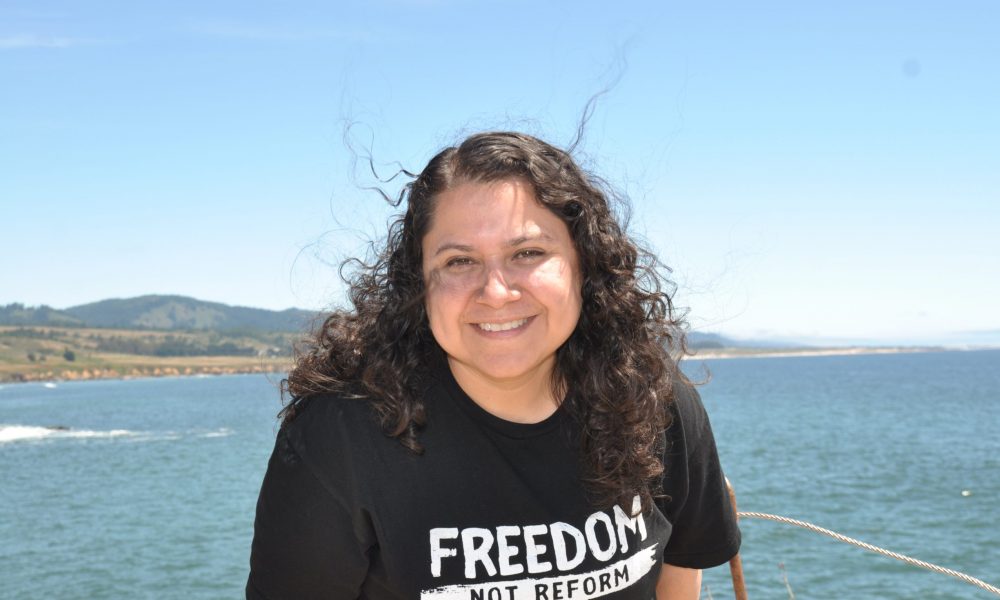
Today we’d like to introduce you to Leisy Abrego.
Leisy, let’s start with your story. We’d love to hear how you got started and how the journey has been so far.
I was born in San Salvador, El Salvador. My family and I arrived to Los Angeles in 1980 at a time when many Salvadorans and Guatemalans were fleeing their homelands. I grew up in the Pico-Union area and in East Hollywood. I attended public schools through the 9th grade when two of my teachers — Ms. Ellen Jaffe-Gill (Formerly McClain) and Mr. Nader Delnavaz — took it upon themselves to get me enrolled in a private prep school. They convinced my parents and even took time off from work to drive me to interviews. I ended up attending an elite private school where I struggled socially while benefiting immensely from the kind of education that we all deserve, but only the wealthy usually get. They set me on a path to a highly selective liberal arts college where graduate school and PhDs were the normal next steps. That is how, as the very first person in my entire extended family in the US to attend college, I came to believe that I could also belong in a PhD program.
I applied to PhD programs with very little knowledge of what I was getting myself into. I had been working in college admissions for two years and I desperately missed reading and having intellectual discussions. I had been a Spanish major (concentration on Latin American literature), but through a fellowship, had been able to travel to Latin America. In southern Mexico, Panamá, Uruguay, and Chile I interviewed women in marginalized communities and I was moved by the learning that comes from engaging with other human beings. I naively thought graduate school would be a good place to receive training to conduct better interviews. So I did basic searches about what kind of disciplines might offer such training. I came up with Sociology and Anthropology. And even though I had only taken one intro course in Sociology as an undergrad — and I had not particularly enjoyed it — I thought that the dissertation titles sounded more interesting, so I applied to three sociology PhD programs in southern California. I was admitted to all three and chose the one that provided most funding.
I had no idea what I was doing! Thankfully, there were enough people — my professors and peers — willing to break things down for me and I slowly learned how much I love research. I did my best to follow the unspoken rules of academia (as explained by my advisor who had also been a first-generation college student).
Publishing my first article as an advanced graduate student opened up a new world to me. The article was about undocumented high school and college students. I had been volunteering with a group near Downtown L.A. where I met organizers and students who were just learning about the consequences of being undocumented as they neared the end of high school. I put together flyers to hand to elected officials and joined them as a chaperone to Sacramento where they lobbied and testified in front of the state senate. I spent so much time with these students and was so inspired by their fight that I wrote my M.A. thesis about their experiences and published one of the first academic articles documenting how immigration policies block Latina/o/x possibilities for thriving in this country. Soon after it was published, I started receiving emails from students around the country in similar situations and I was floored by the way the stories circulated and helped people make sense of their lives.
In every publication since I think of who might read those words and see themselves in the stories. That vision has helped me to navigate academia while staying true to who I am. I am now Full Professor and I’ve worked on various pieces about the ways that US imperialism and immigration policies play out in people’s day-to-day lives. I try to document the consequences of law far beyond the instrumental purpose that lawmakers claim. How we understand our relationships with loved ones; how we develop resentments based on what we read as individual decisions; how we feel unworthy of basic human rights – all of these are informed by laws and their implementation in a society that claims to be all about “law and order.”
Has it been a smooth road?
Academia has a long history of excluding people like me. That has led to various kinds of challenges at every stage of my training and career, but I’ve had consistent family and community support to help me stay focused on what I need from academia while not allowing me to get pulled into the aspects of it that can be toxic. Some of the tools of academia – the writing, the methods, the critical perspectives – help me understand the world around me in powerful ways. On the other hand, it is often a world of egos, inequalities, and bureaucracy that can be hard to navigate. As a graduate student, for example, I sat through class discussions about whether it is useful to learn Spanish in Los Angeles beyond the need to give orders to one’s gardener. That conversation silenced me. I thought of all the people in my family who do this kind of work and their value as human beings that was diminished to their labor, to what they can do for those who felt comfortable in the classroom that day.
As a professor, sometimes the challenge is that people don’t think that someone in my body could be a professor at all. One day I was meeting with a student in my office, trying to help her get past her writing block to finish her Honors thesis. A white man not affiliated with the university walked by, read my nameplate outside the door, interrupted me and my student, and said, “I know you’re not the professor, but do you think the professor might be interested in selling me some books?” I responded, “No.” And I continued with my student. She asked me, “Why didn’t you correct him?” I said that I could waste my energy on being mad about that, or keep trying to inspire her to finish her important project.
Those kinds of moments add up and can get in your head, but with support from my partner and friends, I prefer to stay focused on the many ways that I can use my energy to support students or social movements.
We’d love to hear more about your work and what you are currently focused on. What else should we know?
I had a special moment recently. This weekend, a coalition of Salvadoran folks that included elders in our community whom I admire and respect – Rossana Perez and Dora Olivia Magaña — organized a 6-hour intergenerational event to discuss identity-related topics, including various aspects of historical memory and healing. They invited me to speak on a panel about my journey at the end of the day. I arrived early to attend a workshop and catch up with Salvadoran scholar friends who were also there. Most touching for me were the young people I met for the first time who approached me with love, some in tears. They wanted to tell me in person what my work has meant for them. I cannot describe how much pride and humility it gave me to hear the titles of my books and articles coming from their mouths. One young woman told me she used my piece, “On Silences,” to develop her Master’s thesis and inform a series of public history events.
Another heard me introduce myself and came over, barely able to speak through the tears, to let me know that she came to the event that day just to meet me. She wanted to tell me in person that my book, Sacrificing Families, helped her understand her own family’s experiences and she was so grateful. In other spaces, immigrant rights activists and lawyers have reached out via email or in person to tell me what my work has meant to them as they fight against the violence of the immigration regime. It is always my goal to use the tools of academia to amplify the voices of my multiple communities. These interactions, these conversations, these hugs from total strangers who saw themselves in the words that I wrestled with on the page, that I wove carefully into long narratives — these moments are everything.
Let’s touch on your thoughts about our city – what do you like the most and least?
Though I wasn’t born here, Los Angeles is my home. It is a large, sprawling, unequal, often segregated, and imperfect city, but it is home. I have found home in its street vendor culture, immigrant-owned businesses, and activist spaces. I live for the purple of the jacarandas in April and May and the lines of palm trees against the urban skyline. At the same time, it pains me to witness daily the vast inequalities and the spread of gentrification across city neighborhoods that are displacing more and more people to the streets where they are entirely unprotected. I ache at the way elites in the city are able to hoard money and resources while so many others are not guaranteed the basics of a dignified life.
Contact Info:
- Website: http://chavez.dept.ss.ucla.edu/person/leisy-j-abrego/
- Twitter: @AbregoLeisy


Image Credit:
Nancy Zuniga, Elizabeth Arrazola
Suggest a story: VoyageLA is built on recommendations from the community; it’s how we uncover hidden gems, so if you or someone you know deserves recognition please let us know here.
Popular
-

Jolana Nika on Redefining Modern Connection Through Intentional, Real-Life Experiences
-
What did suffering teach you that success never could?
-

Who saw you clearly before you could see yourself?
-

Who taught you the most about work?
-

Is the public version of you the real you?
-
What are the biggest lies your industry tells itself?