




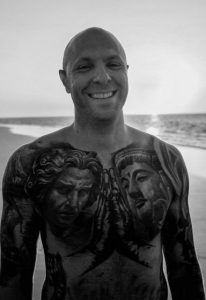
Today we’d like to introduce you to Chris Howard.
Hi Chris, so excited to have you on the platform. So before we get into questions about your work-life, maybe you can bring our readers up to speed on your story and how you got to where you are today?
I grew up in Los Angeles in the 90s. That was a time where you had to be home when the street lights came on and we had unfettered access to roaming the streets and figuring out how to navigate life as an adolescent. Most of the people I grew up with were from broken homes. We were lucky enough to have a couple of moms that let us use their homes as safe harbor for sleepovers and community gatherings. As a result, my friends became my family.
Growing up in Los Angeles, I was exposed to drugs, graffiti, and gang culture, so that is what I gravitated towards. I grew up in poverty so that seemed like the natural course of action for me. When there are a lot of opportunities and you see other people making money in various different ways, you get creative. By the time I was 16, I was selling drugs to support myself and my habit. At one point, I found myself running guns for a local gang, which in hindsight was me trying to follow a rite of passage into adulthood. At this point in my life, I was trying to earn some prison time, whether I was willing to acknowledge that or not.
Basically, I believed if I did a “stretch”, typically five years in prison, that would make me into a man. All of the people I looked up to and everything I wanted to be were emulated in people who did prison time. I was a misled youth. The truth is I wasn’t built for that life, but I easily could have meandered farther down that path.
Eventually, my house was raided by the police and I ended up going into a long-term recovery program. In that program, I learned the value of personal accountability and social responsibility and how the construction of character is everything. I adopted this ideology relatively easily because so much of it coincided with the street world. Principles like honesty, open-mindedness, integrity, and accountability were the cornerstone of the program. I found myself enjoying working with other addicts and alcoholics and I eventually started to work in that program. After that, the rest was history and I dedicated my life to working with families that have loved ones who struggle with mental health and substance abuse issues. I have been in the trenches ever since.
Would you say it’s been a smooth road, and if not what are some of the biggest challenges you’ve faced along the way?
It has not even been close to a smooth journey. I think the biggest struggle was coming to terms with the state of the behavioral health industry. There is a lot of “snake oil” in our industry and really good marketing tactics, but the “meat and potatoes” of these programs are straight garbage.
I think what particularly bothers me is luxury based treatment for young adults. The idea that when you relapse, you are going to end up in a residential facility that looks more like the four seasons doesn’t make sense to me. In fact, I believe it reinforces relapse. Think about it for a second… If every time you relapse, you end up in a country club spa where they’re cooking you meals and catering to every one of your needs, what do you think will happen the next time they want to relapse? BINGO!!!
To be clear, I mean this specifically for young adults who are not financially independent and cannot take care of themselves. The treatment interventions need to be dramatically different for this demographic. If you’re an executive and can afford to blow all that cash, be my guest.
Thanks – so what else should our readers know about your work and what you’re currently focused on?
I’m a Substance Abuse Counselor, Coach, and Interventionist/Crisis Interventionist. I specialize in working with failure to launch cases, primarily males in young adulthood and adolescence.
Most of the work I do is within family systems, helping parents navigate the substance abuse and mental health treatment world while holding boundaries with their child who is subsequently usually in treatment. I would say my passion is working with families.
I would say I’m known for my direct approach with clients and not sugarcoating what the problem is. I tend to work with a subset of clients that have no boundaries or limitations because they come from wealthy families. Often, they don’t think there’s a problem because everything else in their life looks really good (e.g. nice house, fancy car, good schools, etc.) Meanwhile, they have legal issues, their interpersonal relationships are in disarray, they have mental health issues as a result of the problems in their life, they lack purpose, etc. Usually, by the time I’m talking to families, there has been a laundry list of problems in typically a few treatment centers. Essentially, the identified patient isn’t getting the message that they are the source of a lot of problems.
The thing I’m most proud of is my recovery home, Ethos Recovery: Structured Sober Living for Men, located in Los Angeles, California. The house is more like a family system than a sober living. Guys typically stay in the program 14 to 20 months and during that time, we get to see a miraculous transformation from a boy into a man. The house is truly a rite of passage into adulthood for those who can’t figure it out any other way. I’m grateful for the impact I get to have on these individuals and their families. It warms my heart when we have big community gatherings and all of the families are there who have been reunited as a result of their loved ones taking the steps necessary for their recovery.
The crisis has affected us all in different ways. How has it affected you and any important lessons or epiphanies you can share with us?
Don’t get complacent as a result of what’s happening in the world. I found myself getting lazy and not doing what I was supposed to be doing during the COVID-19 pandemic and I later found out what that trade-off was.
As a result of this experience, I look at everything as a trade-off. Basically, I don’t believe there is just one solution to a problem, I believe there is a trade-off. If I’m a lazy ass during COVID-19 and not handling my business responsibilities, my business will suffer. I see this in areas like exercise and mental health quite frequently with the people I work with. I think it is important to hold yourself accountable and not be dictated by what is happening in the world. I’m slightly ashamed that I compromised my character but I’m paying the price so there’s that.
Contact Info:
- Email: Chris@
LifestyleInterventions.com - Website: https://www.
lifestyleinterventions.com/ - Instagram: https://www.
instagram.com/chowardgo/ - Other: https://www.instagram.
com/lifestyleinterventions/


Popular
-

Mason Ewing Is Bringing a World of His Imagination to Life Through Film
-

Dr. NanaEfua Afoh-Manin Is Rethinking What It Means to Be Healthy, Not Just Healed
-

Portraits of the Valley
-

LA’s Most Inspiring Stories
-

Greg Hex Is Turning the Everyday Kitchen Knife Into a Modern Design Object
-

Rick Norris Learned That Building a Successful Business Means Building a Life You Actually Want to Live


