




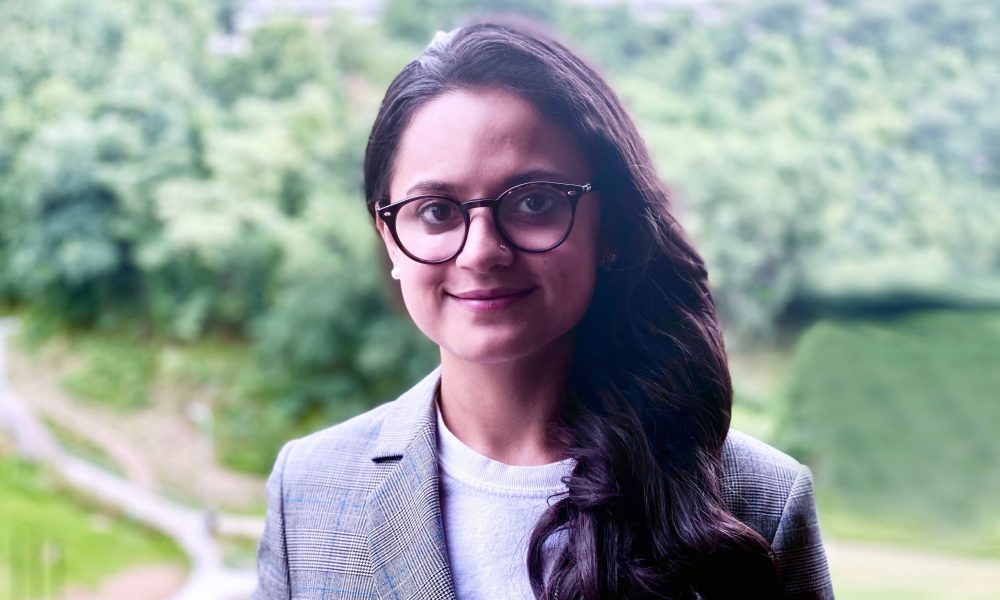
Today we’d like to introduce you to Aditi Sharma.
Hi Aditi, thanks for sharing your story with us. To start, maybe you can tell our readers some of your backstory.
From the beginning, my career aspirations have been inseparable from my zest for design-led sustainable societal impact. Even with limited resources, I observed my parents find creative ways to sponsor girls’ education and economic sustenance for older adults, shaping my foundational belief that we can change the world. I use design as the medium to bring positive impact by establishing programs that — champion inclusive technology practices, build with sustainable methodologies, empower women, and support economically challenged communities.
I was always interested in product design, and my aspirations led me to study design at the National Institute of Fashion Technology in India. I started internships as soon as my second year of college and was hired as a product designer with Jindal Architecture, an urban infrastructure company where I focused on material and product R&D with a human-centered approach. I worked on programs like the Commonwealth Games, designing street furniture and signages. That’s when I got interested in pursuing Industrial design and received a scholarship to go to Loughborough University’s Industrial Design program in the U.K. I continued to consult with clients in India. After pursuing my master’s, I founded Adisha — a social impact design agency whose work was recognized by the President of India. At Adisha, despite nominal budgets, we successfully launched packaging for female condoms, a 2G network tool for rural communities to interact with the central Govt., water recycling systems, tiny house kitchens, and handmade products for mainstream consumers to support local artisans.
After five years leading Adisha, I ventured to the U.S. and enrolled in Stanford’s Inclusive Design program with IDEO and then on to the Human-Computer Interaction program at MIT, subsequently landing a role at Accenture Interactive in New York City, working with clients such as Walmart, DuPont, Cargill, Exxon Mobil, and Doctors Without Borders. Then, as an Executive Director at JPMorgan, I headed the payments operations team while also serving as a lecturer at Pratt Institute – facilitating one of the top 10 UI/UX design programs in the U.S., leading me today to AWS, where I am heading research and design building 30+ FinTech product that tracks revenue, usage, cost, and enable better decisions through AI/ML forecasting models.
Through my contributions, I have been honored with the prestigious ‘Dr. Sarojini Naidu’ award from the Government of India, ‘Woman Who Builds’ award from Globant, and was named an inspirational woman in STEM by Authority Magazine. My thought leadership was featured in multiple publications and conferences. I am regularly invited to share thought leadership across print, keynotes, and podcasts. Such as for CampaignLive, Business Insider, AI & Data Analytics Network, Tech Circus, Interaction Design Association, Brave UX, Leading Design, Inclusive Design Association, Customer Experience Network, Finance Magnates, South by Southwest (SXSW), and Product-Led Alliance (PLA) to name a few.
We all face challenges, but looking back would you describe it as a relatively smooth road?
My biggest challenges have stemmed from stereotypes and struggles as a woman of color and an immigrant pursuing a thriving career in an emerging field. As an immigrant, to pursue my passion, I constantly have to fend for seeking a work visa. It means my options are usually fewer, and I must prove myself to be better than others to convince firms to sponsor. As a woman in STEM, we are typically paid 89 cents per dollar that men in STEM make. It means we may work the same (often more) hours than men, only to make much less. Most women in tech tend to quit their jobs due to a hostile work environment and a ‘boys club’ mentality. Being interrupted, talked over, ignored, or penalized for speaking out is common for women when men outnumber them. Many women-focused initiatives worldwide aimed to bridge this gap inspire me daily at Amazon and outside the org. Still, we must do more to create a culture of respect for creative expression based on merit, irrespective of where you come from. The onus is on everyone; if you see something defeating inclusive thinking, raise your voice and be the change agent.
Thanks for sharing that. So, maybe next you can tell us a bit more about your work?
As the head of research and design at Amazon (AWS), I am responsible for driving the delivery of 30+ products that help shape how business leaders make critical finance decisions, balancing the needs of continued revenue growth with more significant usage and managing costs to serve by tracking CapEx or OpEx. I lead a team of leaders spread across the U.S. that manage research, content, design, and build of these digital products.
I have set up scalable development processes by forging deep partnerships across Amazon, such as the common patterns program, enabling economies of scale by leveraging commonalities in financial workflows such as notifications, approvals, data grids, and data visualization. So far, we are projected to save over 5,000 hours for the org and are on a path to improve customer satisfaction with a 10/10 favorability rate. I also empower innovation efforts by infusing technological best practices such as Gen AI and AI/ML to improve customer experience across the AWS FinTech product suite. By creating over 20+ templates to conduct a user-centered development process, I have boosted familiarity with CX best practices by 62%, reduced the churn in development post-launch with a more robust understanding of customer requirements upfront (40 hours less time spent per feature per development cycle), and collaboration cross-org has increased by 62%.
The success in these efforts can be attributed to my inclusive design and research methodology that is based on the trifecta of listening, linking, and learning. I start by listening to help cross-functional teams to set the baseline on current systemic problems by studying market trends and outlining the metrics of success that not only relieve current pain points but lead to building an organization’s competitive edge. Then by linking the target state vision with service blueprints and low-fidelity prototypes, I unify cross-functional teams with common goals ingrained in research insights. Lastly, to learn I create set-based designs, diverging at first with multiple low-fidelity concepts and then converging into higher-fidelity prototypes while making data-informed decisions with usability sessions.
Where we are in life is often partly because of others. Who/what else deserves credit for how your story turned out?
Teachers played an influential role when I was pursuing science in school. I am also thankful to the leaders I worked with daily, who recognized my passion and supported my growth at the firm more actively. Most of all, I am grateful to my parents, who have always encouraged me to pursue creative design and technology endeavors. As the youngest of three girls, growing up in India, despite limited means, our education was still the top priority for my parents. My mother has always been my role model; she devoted her life to female education in underserved Indian communities as a teacher, poet, and playwright. She is a published author and was recently awarded an honorary doctorate for her work in education. My mother got me my first drawing book, pushed me to participate in public speaking competitions, and ignored her own needs to support me financially through education. As an educator, she pushed me to give back to the STEM community and was delighted when I started as a visiting faculty at Pratt. I am indebted to her for the many sacrifices she made to get me where I am today. Thanks, ma!
Contact Info:


Popular
-

Cedar Boschan on Elevating Black Music Rights and Driving Urgent Conversations Around Credit, Equity, and Artist Protection
-

Portraits of the Valley
-

LA’s Most Inspiring Stories
-

Robin Olive on Building an Inclusive Performing Arts Movement and Expanding Opportunities for Every Student
-

Que Johnson on Building Brands That Last: From Visibility to True Market Authority
-

Christina Wren Steps Into the Director’s Chair to Tell Stories That Feel Like Home


