


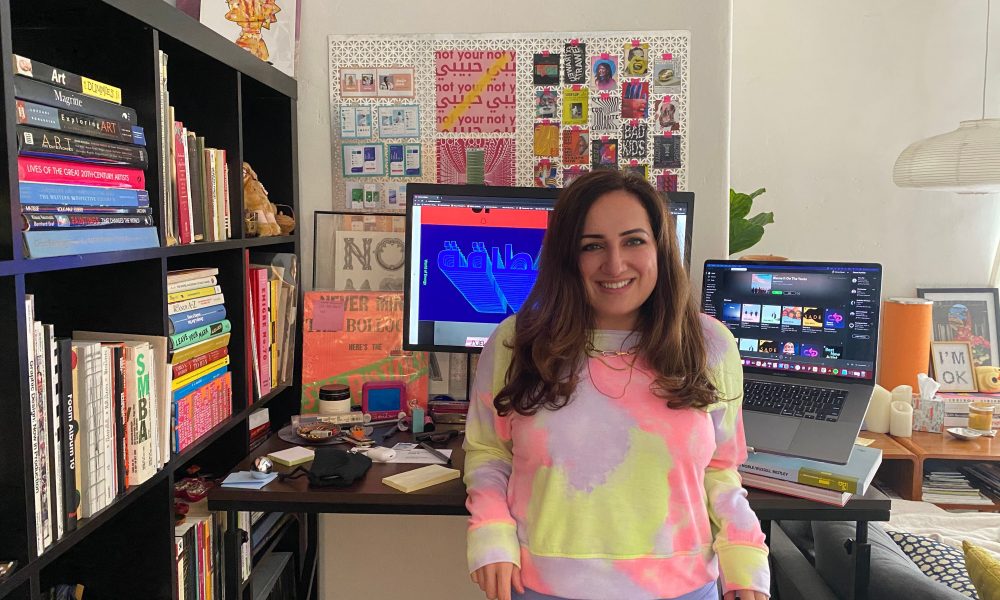
Today we’d like to introduce you to Marina Murad.
Hi Marina, it’s an honor to have you on the platform. Thanks for taking the time to share your story with us – to start maybe you can share some of your backstory with our readers?
I was born in Baghdad, Iraq. After the Gulf War, my family and I escaped to Amman, Jordan. From there, we immigrated to Southern California where I grew up in a town called Redlands, just 70 miles east from Los Angeles. I have lived in Los Angeles for ten years now. Los Angeles is where I call home. I started drawing from a very early age. When I immigrated to the U.S., I didn’t speak any English and it was extremely hard to relate to kids and to make friends. So art became my escape from reality. Almost like therapy. I became consumed with sketching and daydreaming to make the time pass. All my drawings were done by hand until in the mid 90s my dad brought home a computer that we all shared as a family. I would spend endless hours drawing on the Windows Paint program. My dad saved my digital drawings on 5.25 floppy disks that I still have, but the floppy disks are so old, no one has ever been able to retrieve the files for me. (If you have any recommendations, please let me know).
When high school came around, I was fortunate enough to have a fantastic art program with resources at my disposal. I also had a great art teacher who would write me excuses to skip classes so I could focus and paint in his classroom during his next teaching session. (Don’t worry I had decent grades). He encouraged me to have my first solo art show in the school’s art gallery. One of my paintings from that show still hangs in Redlands East Valley High School’s library to this day. In college, I pursued a degree in art from University of California, Riverside, despite my immigrant parents’ dismay. Of course, every immigrant parent dreams that their child will become a doctor, lawyer or engineer, but that was just not going to happen because I was stubborn as hell and always knew what I wanted to do. During this time, I was going through some serious health issues. My degree in art became my healing therapy. Art came to my rescue yet again, and this saved me from what I was going through at the time. I had outstanding professors who really influenced my conceptual thinking/making and pushed me to talk about what I was experiencing by making sculptures and large paintings-mediums and scale that I had never experimented with before. Because of them, I had solid work to show for, and I sold one of my thesis paintings to the Arab Film Festival, a non-profit organization that nurtures and showcases Arab talent in the U.S.
At the end of my senior year in college, I interned in the graphics department as a full-time production designer for ESRI, a software cartography company. This was the same tech company that hired my father and brought my family to the States with Visas. I was managing all the print production work: lamenting large-scale graphics, trimming them and packaging them up for trade shows. I had awesome mentors at this job who nurtured my curiosity. I learned the Adobe Suite program in my downtime at work. I would drive to Art Center College of Design, 3/5 days out of the week, to take graphic design courses. So I knew that my next step would be to pursue an MFA. I applied and to my surprise, I got accepted to my first choice at Otis College of Art and Design in Los Angeles. It was a dream come true for me and one of the most humbling experiences of my life. After college, I stayed in Los Angeles and worked for various tech and entertainment clients as a freelance designer and art director. This gave me the opportunity to develop my style and skills and made my work more eclectic and desirable for potential clients. My work has been shown on the covers of Adweek and Advertising Age magazines. My past clients have included Apple, Netflix, Amazon Prime Video, Snapchat, Mattel Games, Yahoo, Verizon Media, DC Comics, Academy of Motion Picture Arts and Sciences (Oscars), Live Nation Entertainment, The Hollywood Reporter, Billboard, Natural History Museum of Los Angeles County, and various Los Angeles based start-ups and businesses.
We all face challenges, but looking back would you describe it as a relatively smooth road?
My career choice to become a graphic designer was definitely the road-less-traveled by for an immigrant female with an Iraqi background. Not only was my career choice challenging, but I struggled to talk about myself or my background with coworkers due to the stigma associated with being from the SWANA region (South West Asian/ North African). There is always an uncomfortable silence that follows so I appreciate the people who ask more questions to get to know me. I think opening up this dialog is very important. And it’s not until recently that I finally began to feel somewhat confident to talk about my background with professionals. With that said, it would have been really nice to find people to relate to during the process of my journey to becoming a graphic designer. I can’t stress enough the importance of representation in the creative industry—or any industry for that matter. I rarely see women of color in leadership/Creative Director positions. And I hope this changes soon so that this field becomes more diverse and inclusive. Overall, I would say being a graphic designer is not for the faint-of-heart. You have to work really hard and put in very long hours. You become an expert in putting up with lots of rejection. Rejection from clients, rejection from jobs, and your work constantly being edited and critiqued by your colleagues. This of course makes you a stronger designer and business marketer in the long run. You have to be bold and have to have thick skin in this industry. It’s a very competitive field. You really have to have the drive to keep going no matter what.
Appreciate you sharing that. What else should we know about what you do?
I am a graphic designer and art director and I help my clients find visual solutions for complex business problems. To put it simply: I create designs that are easy to digest using words and images in advertising campaigns. I’m mostly known for my creative-outside-of-the-box thinking and for pushing and breaking the rules when it comes to design. My superpower would be I know how to switch things up: when to be more business/corporate oriented…to going wild for campaign ideas. My specialty is coming up with a story or narrative that drives the creative deliverables: this can be anything large scale like a 360 campaign to micro scale like a social media campaign. I am not sure what sets me apart from others. But I would say speaking Arabic is pretty different! I’ve recently been commissioned by the entertainment industry in Dubai (which commissions most entertainment work in the SWANA region) to design title sequences for broadcast television networks and for films. I never in my wildest dreams would have thought I’d use my native language for design. I think I am most proud of bringing delight to audiences across the globe through my work in advertising. Leaving Easter eggs here and there for them to discover or to bring a smile to their face. Invoking any emotional response in ad campaigns is the definition of success in my opinion.
Any big plans?
I recognize all the privileges and opportunities I’ve had to be where I am at today. My goal for now is to speak my truth and to share my story. I want to be a mentor for younger generations who are seeking creative careers. I hope that by sharing my experience and background that it inspires young immigrants to pursue their dreams in design. Because who would have thought hours spent on Windows Paint would lead to a legit career in advertising?!
Contact Info:
- Email: [email protected]
- Website: https://www.marinamurad.com/
- Instagram: https://www.instagram.com/marina__murad/
- Twitter: https://twitter.com/marinammurad


Popular
-
Los Angeles Barea on Turning Green Superheroes into a Global Movement for Youth-Led Change
-

Trisha DuVivier on Bridging the Franchisor–Franchisee Divide with Workhero and “Franulate”
-

Portraits of the Valley
-

LA’s Most Inspiring Stories
-
Cedar Boschan on Elevating Black Music Rights and Driving Urgent Conversations Around Credit, Equity, and Artist Protection
-
Robin Olive on Building an Inclusive Performing Arts Movement and Expanding Opportunities for Every Student