




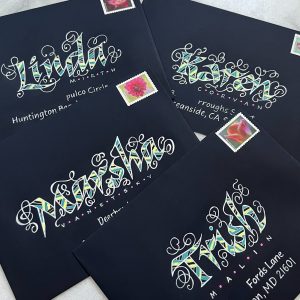
Today we’d like to introduce you to Lona Lee.
Alright, so thank you so much for sharing your story and insight with our readers. To kick things off, can you tell us a bit about how you got started?
Like many of us who have fallen in love with letterforms, I attribute my interest to my childhood years. I loved copying everyone’s handwriting and signatures (especially my mom’s); my pencil cases were stacked with gel pens; and my notes from school were always re-written at home with “perfect” handwriting. In many ways, these things helped me battle what I now know as childhood OCD.
In my mid-twenties, with the notion that I may never make enough money with a liberal arts degree, I rolled the dice and got a Master’s in Business Taxation. I worked as a tax professional for about ten years, and after having reached my career goal, I found myself still carrying an incessant void. I was first introduced to calligraphy by a colleague but during the pandemic in 2020, I took advantage of not having to commute into the office every day and picked up my hobby earnestly.
Calligraphy provided me an escape, a form of meditation, and conjures up all forms of nostalgia. After joining scores of workshops with respected calligraphers and artists, long nights of practice, and pondering, I decided to follow my heart, leave my corporate job, and feed this starved creative child living inside of me. A dream come true in my humblest opinion. I continue to study and attend as many calligraphy and lettering workshops as I can. A lot of my inspiration comes from my teachers and favorite artists from formal to street, including Rick Paulus, Sue Greenseth, Carol DuBosch, Massimo Polello, Yukimi Annand, Viktor Kams, Jurgen Vercaemst, Eleanor Winters, Nina Tran, Ken Barber, the late Ed Benguiat, David Choe, Jung Sook Hyun, and many more.
Nowadays, I am working on finetuning my formal calligraphy and also dabbling into some expressive work. The great thing about calligraphy is that there’s always room for improvement and opportunities to step out of your comfort zone. I make greeting cards for a local flower shop here in Lomita and sell them on my website as well. I enjoy designing wedding invitations with full calligraphy and watercolor decorations, chalkboard lettering for seating charts, chalkboard lettering for storefronts, and other custom projects as they come. I am an active member of the Society for Calligraphy, a long-standing calligraphy guild serving Los Angeles and Southern California. I am also a contractor for the County of Los Angeles in the Graphic Design and Scrolls department.
Can you talk to us a bit about the challenges and lessons you’ve learned along the way. Looking back would you say it’s been easy or smooth in retrospect?
My enthusiasm was in the driver’s seat when I started calligraphy in 2019. I was so eager to learn, make things, and then sell things. I was so eager to put myself out there. I bought a lot of expensive supplies, printed greeting cards and my calligraphy work from very expensive printing studios, and bought quality frames. I prepared for a handful of craft markets, and 3 out of the 5 times, I didn’t sell nearly as much to make up for even the entrance fee. I was naïve and literally just went for it.
After a couple of years, I realized that I needed to focus on my skills and also what I sell. I often overestimated how much I’d sell and had a lot of inventory left over. I’m still in the process of getting rid of some of my beginner artwork! The biggest lesson for me was that success takes time. All the failures and slow struggles ultimately made me stronger and more focused on my goals.
Can you tell our readers more about what you do and what you think sets you apart from others?
I am a lifelong student of calligraphy and lettering. I love drawing and writing letters that relay the message in a fun and delightful way. One of the ways that I get to express this is by making greeting cards. My childhood dream was to work for Hallmark or have my own stationery store, so this makes my inner child very happy.
Creating chalkboard signage, including wedding seating charts and storefront signage, allows me to work on a slightly larger scale, off the paper and desk. In addition to the design and layout of the signage, it’s important for me to ensure that the message gets across with conciseness and brevity – whether that’s the ease of finding your name on the seating chart or attracting customers into your store with simple, clean, good letters.
I am the most proud of my dedication to the art of calligraphy and taking the leap when I quit my corporate tax job in 2020. I am proud of how far I’ve come in a short period of time.
My ability to interpret words is what sets me apart from a lot of other new calligraphers. Writing beautiful letters is a special skill that takes time to learn and fine-tune. You have to study the letterforms and practice diligently. There’s no such thing as an overnight sensation in calligraphy. In addition, to really make art out of calligraphy, you have to consider the meaning behind the words you’re writing. You have to choose the appropriate calligraphic style, create an appropriate layout and design, make good color choices, consider the emotions evoked from the words, etc. I’m constantly learning and working to better all these aspects and not just “writing pretty letters.”
We’re always looking for the lessons that can be learned in any situation, including tragic ones like the Covid-19 crisis. Are there any lessons you’ve learned that you can share?
Covid is what jumpstarted my calligraphy practice! When I was working from home in my corporate tax job, I would find every opportunity to practice calligraphy on the side. The passion just got more serious with each passing week, and it was my stress reliever.
What I learned from Covid, after all those months and years of being separated, is that as humans, it’s important for us to feel connected. It’s true, Covid built a lot of fear in people too but ultimately, so many of us longed for this special human connection that we can’t get from staying at home and not socializing. Another important thing I noticed amongst my friends and neighbors is that those who had a creative outlet thrived during Covid. Those without a creative outlet – whether that’s in movement practice, gardening, crocheting, or painting – had a much more difficult time getting through the monotony of isolation. I think creativity is essential to our wellness, and connection with others is just as important too. I couldn’t live without both, and Covid brought that to the surface.
Contact Info:
- Website: https://www.lonalee.com/
- Instagram: https://www.instagram.com/lona.letters/
- Linkedin: https://www.linkedin.com/in/lonalee/


 Image Credits
Client’s wedding photographer, POEIMA (@poiemampls)
Popular
-

Portraits of the Valley
-

LA’s Most Inspiring Stories
-
Robin Olive on Building an Inclusive Performing Arts Movement and Expanding Opportunities for Every Student
-

Que Johnson on Building Brands That Last: From Visibility to True Market Authority
-

Christina Wren Steps Into the Director’s Chair to Tell Stories That Feel Like Home
-

JordanL on ‘Breathe,’ Belief, and Building a Movement Beyond the Music


