




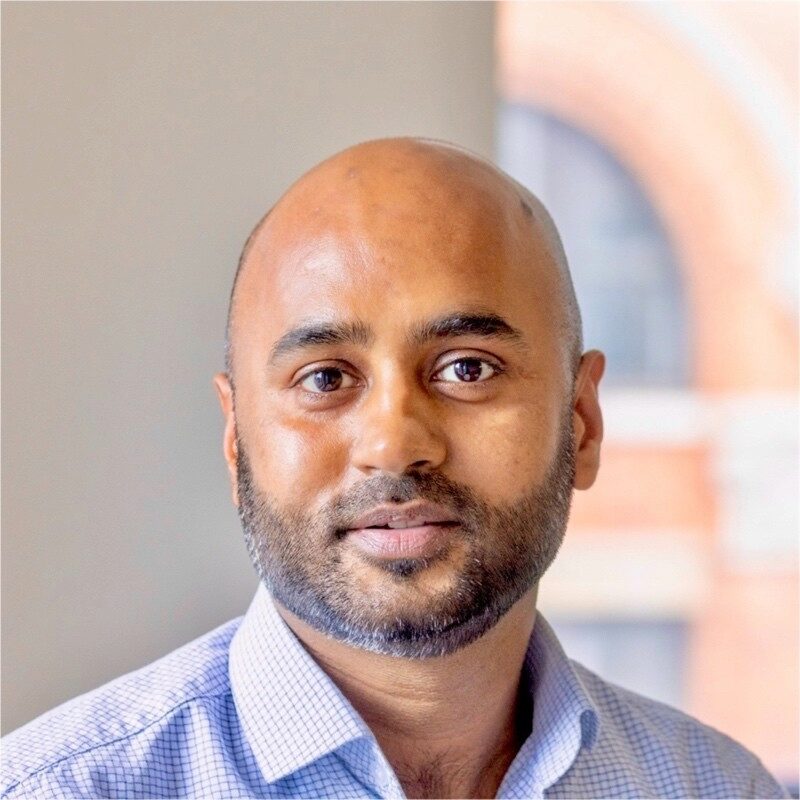
Today we’d like to introduce you to Rahul Vishwakarma.
Hi Rahul, we’re thrilled to have a chance to learn your story today. So, before we get into specifics, maybe you can briefly walk us through how you got to where you are today?
There are journeys that begin not with a single step, but with a question whispered in youth’s quiet hours. Mine materialized in libraries, where biographies of scientists revealed how invisible dreams take tangible form through patient devotion.
My path led first to SRM Institute of Science and Technology, where I studied computer science. After graduation, I spent over a decade at Hewlett Packard Enterprise and Dell Technologies, contributing what became more than sixty issued patents spanning machine learning, artificial intelligence, and storage systems. This work earned recognition from professional societies. I was elected Fellow of the British Computer Society and Senior Member of IEEE, honors reserved for distinguished contributions to computing. Throughout these years, I maintained active research, publishing peer-reviewed papers on hardware security and uncertainty quantification.
At California State University, Long Beach, I deepened my expertise under Dr. Amin Rezaei while serving as AI Research Club vice president. Now, as Research Engineer at WorkOnward, I work alongside Founder and CEO, Holly Diamond, developing artificial intelligence systems connecting workers with local employment opportunities. Here, technical excellence serves human dignity, algorithms deployed with genuine compassion for underserved communities.
Alright, so let’s dig a little deeper into the story – has it been an easy path overall and if not, what were the challenges you’ve had to overcome?
The path toward meaningful contribution is never smooth, nor should it be. My journey has been marked by the particular struggle of maintaining research excellence while meeting demanding industry obligations.
At WorkOnward, we chose the harder path: serving workers traditional platforms ignore. Building genuinely fair AI systems, resistant to bias and treating every user with dignity regardless of background, requires sophisticated approaches beyond simple optimization. We developed novel bias detection techniques and transparent decision-making frameworks, making our contribution both technically challenging and genuinely meaningful.
Thanks for sharing that. So, maybe next you can tell us a bit more about your work?
My work exists at the confluence where machine learning meets human trust. As Research Engineer at WorkOnward and as a Fellow of the British Computer Society and Senior Member of IEEE, I have devoted myself to a particular question: How might we build artificial intelligence systems that know not only what they know, but also what they do not know?
My patent portfolio, numbering sixty issued inventions, spans an unusual breadth—from blockchain-based data storage to DNA as a medium for digital information, from neural networks for hardware Trojan detection to reinforcement learning for multi-modal transportation networks. What unites these diverse threads is a consistent philosophy: technology should be reliable, transparent, and ultimately in service of human flourishing.
What sets my approach apart, I believe, is an insistence on philosophical rigor alongside technical depth. I am drawn to the boundary questions, the places where engineering meets ethics, where optimization confronts uncertainty, where efficiency must bow to fairness. At WorkOnward, this manifests in our commitment to building AI systems that actively work against bias, that seek to create opportunity rather than merely sort candidates. We are developing solutions to detect and eliminate bot-generated profiles and AI-generated applications, preserving the human element in hiring.
What am I most proud of? Perhaps it is this: that among my sixty patents, the one that brings me the greatest satisfaction returns to my undergraduate thesis from 2009 on high-density data storage in DNA. More than a decade later, that early dream found expression in an issued patent for storing digital data using smart contract and blockchain technology. This experience taught me that ideas have their own gestation periods, that understanding matures slowly, and that persistence in contemplation yields fruits that immediate productivity cannot.
I am known, I suppose, for bringing together disparate fields, for seeing connections between storage systems and machine learning, between hardware security and conformal prediction, between academic research and startup innovation. But beyond any specific achievement, I hope to be known for approaching technology with humility, and always in dialogue with a reality more complex than our constructions.
What does success mean to you?
I define success as the moment when one’s work transcends personal ambition and becomes an offering to the collective human endeavor. It is waking each morning with gratitude for another day to wrestle with meaningful questions, to contribute something genuine to the world’s understanding. Success is integrity maintained through inevitable compromises, the quiet satisfaction of knowing one’s efforts served something larger than oneself.
Contact Info:
- Website: https://rahvis.github.io
- Instagram: https://www.instagram.com/rah.vish
- LinkedIn: https://www.linkedin.com/in/rahulvishwakarma/
- Other: https://orcid.org/0000-0001-6452-1612
Popular
-

Portraits of the Valley
-

LA’s Most Inspiring Stories
-

Que Johnson on Building Brands That Last: From Visibility to True Market Authority
-

Christina Wren Steps Into the Director’s Chair to Tell Stories That Feel Like Home
-

JordanL on ‘Breathe,’ Belief, and Building a Movement Beyond the Music
-
Megan Birney Rudert on How Access to Light Is Powering a More Sustainable and Equitable Future


