




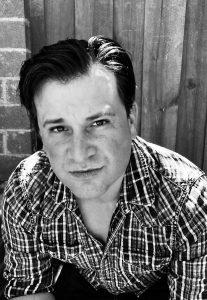
Today we’d like to introduce you to Joseph Schneider.
Hi Joseph, we’re thrilled to have a chance to learn your story today. So, before we get into specifics, maybe you can briefly walk us through how you got to where you are today?
It took me a long time to find myself. I’ve carved out this weird niche where I teach during the day and write mystery novels at night, and it’s perfect and I love it, but I never could’ve predicted it. For a long time, I thought I’d be an actor, but I was no good. Too self-conscious, too worried about being liked. Got my degree in theater from UCLA, then spent my 20’s working as a magician and going out for auditions whenever I could book them. Along the way, I taught ballroom dance and studied to be a projectionist and did a bunch of other things that for one reason or another didn’t become my career. I loved collecting experiences but couldn’t seem to nail down just one exclusive thing that fulfilled me. And basically, I ended up saying to myself, if I become a writer, then everything’s open to me. Writing’s a skeleton key. You want a job where you can learn to make decorative tiles, dust a crime scene for prints, and soak up the vibe in a tiki bar, become a writer. I saw I didn’t have to limit myself to any one thing. So I adopted a very focused approach from then on. All my energy was geared toward developing myself as a writer. I went back to school, got my master’s, and things finally started moving in a more linear direction.
We all face challenges, but looking back would you describe it as a relatively smooth road?
My career’s been hammered, honed, and tempered by failure. Thing is, I wouldn’t say any of it was a waste of time because it all contributed to where I am now—creatively and professionally. Sure, if someone had offered me a way out when I was at my lowest point, I would’ve taken it, but thankfully that didn’t happen. Suffering clarifies who you are, and if clarifies what you really want to do with your life. I think all too often we’re taught in this culture to follow our dreams, but that’s actually pretty terrible advice. Sweet and well-intentioned, but terrible. Dreams are a more palatable way of saying “fantasies,” and we know that fantasies are by definition unrealistic, idealized versions of the real thing. No, the question shouldn’t be “What have you always dreamed of doing?” Man, I sure hit a lot of dead ends chasing that one. I finally realized I was asking the wrong question, so I changed it to “How much are you willing to suffer for what you’re after?” It was only then that I began to achieve anything resembling success. If you’re in a similar place to where I used to be, either stuck and frustrated or bouncing aimlessly from one thing to another, maybe give it a try. I bet you’ll find out very quickly if you’re on the right path.
Can you tell our readers more about what you do and what you think sets you apart from others?
I always knew that whatever I ended up doing, I’d only find fulfillment if it included Los Angeles. Every artist has a core, something that acts as a creative wellspring. For me, it’s LA. She’s been with me my whole life, and I don’t write a page without thinking of her as my main character. The biggest compliment an Angeleno can give me is that when they read my work, they feel the city come through to them.
When it comes to the actual craft, I think a lot of the talk surrounding writing is overly mystified. I hear a lot of advice thrown around that doesn’t merely misrepresent the process but could almost certainly sabotage you if you listened to it. Stuff like, “It’s all about self-expression” and “Put yourself on the page.” Nonsense. No one outside my family cares a wit about my self-expression (and even then there are serious limits as to how much of my bullshit is tolerated). Writing is so much more like building a house than it is about baring your soul to the world. Pay attention to the stuff that matters—story, plotting, character, suspense, formatting, and mechanics. Let self-expression emerge in the wine a character drinks or the music she likes. But in terms of percentage of content, keep it in the single digits.
Can you talk to us a bit about the role of luck?
Tom Savini once said in an interview that, “The more you do, the more you get to do,” and for me that encompasses the way I feel about luck. I think if you embrace as much as you can in life, more things just kind of tumble in your direction. I’m always looking out for new experiences and hobbies and subjects I can learn about and master. These often lead to other opportunities. The very first writing job I ever got came to me through my work as a magician. The producers approached me initially as a technical consultant, but they liked my ideas and told me to throw them some episode outlines, which I got paid for. So you could look at that as luck, but really it was an opportunity borne out of an existing passion.
Contact Info:
- Email: joseph@jschneiderbooks.com
- Website: www.jschneiderbooks.com
- Instagram: @jschneiderbooks
- Twitter: @jschneiderbooks


Image Credits:
Sonia Keshishian
Popular
-

Robin Olive on Building an Inclusive Performing Arts Movement and Expanding Opportunities for Every Student
-

Portraits of the Valley
-

LA’s Most Inspiring Stories
-

Que Johnson on Building Brands That Last: From Visibility to True Market Authority
-

Christina Wren Steps Into the Director’s Chair to Tell Stories That Feel Like Home
-
JordanL on ‘Breathe,’ Belief, and Building a Movement Beyond the Music


