



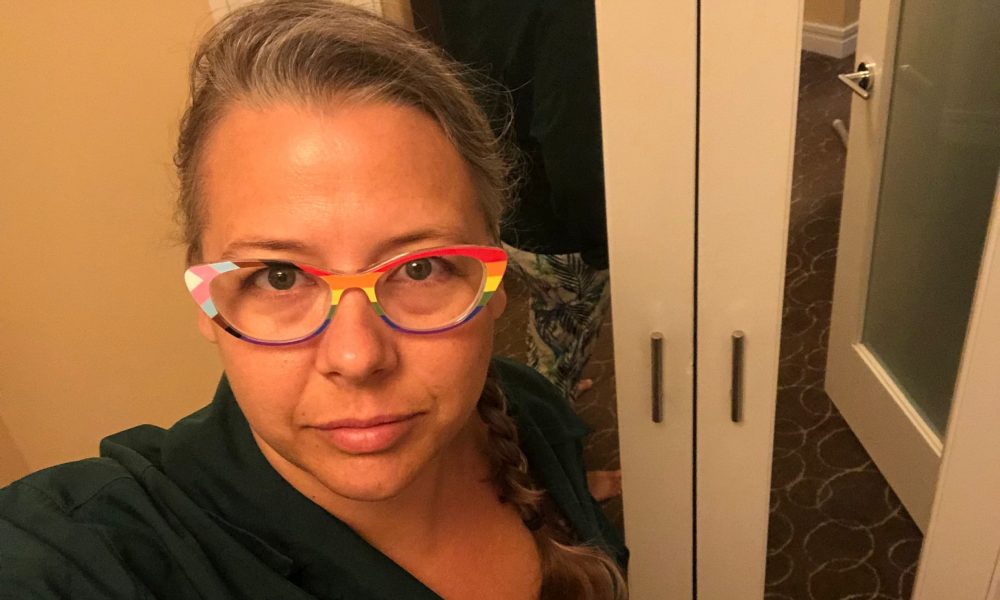
Today we’d like to introduce you to Shannon Kozlovich.
Hi Shannon, can you start by introducing yourself? We’d love to learn more about how you got to where you are today?
In the current iteration of my career, I start every meeting with “Hi, I am Dr. Shannon Kozlovich, she/her/hers pronouns. That is Dr. as in Scientist, I am not a medical Dr.”
Whoooo, I surely didn’t start out that way. I started out adulthood and parenthood nearly simultaneously. I raised my kid on a single income that was low enough to be on food stamps (SNAP benefits) until my kid was in high school. That feels so odd to say now, sitting in my South Bay apartment a block from the ocean.
My path to becoming a scientist began when I was laid off from my job in 2010 when the recession finally hit the medical field where I worked as a recruiter for travel nurses. I placed my box of desk items in my car and drove to the nearest WA state Worksource building where I could start my unemployment claim. The person from Unemployment who was asking me the intake questions told me about a program that would allow me to collect my unemployment while attending college if I was working towards one of the needed vocations in the state. Nursing was on that list.
That is how I walked into my first college class as a 28-year-old single mom of a 3rd grader. I tested into a below college-level math class. I brought my kid to class with me one day and they leaned to me said “Mom, why is your college class teaching the same math as MY class?”… and that kid had more of a stage whisper than a whisper.
My first year at community college is where I fell in love with chemistry. Now, when I tell people that I am a biochemist, they often say “I could never do science because I wasn’t good at math”. My reply is always “I do not Math, I Science” and I stick to that to this day.
I went from a fascination with how little we know about chemical reactions inside our own bodies to a love of organic chemistry where I was learning how to build medication for a disease that impacted fewer than 250 people worldwide (that we know of). This led me to a population genetics lab that was studying tobacco-related cancer. They needed an organic chemist and I needed a summer internship close to home. In this lab, I learned how much devastation the Big Tobacco companies have caused and are causing in the world. I also learned how academia doesn’t provide protections to graduate students from harassment and bullying from faculty [more about that here: https://wsucase.org/ases-are-forming-a-union-to-win-strong-protections-against-academic-bullying/].
So the activist in me was drawn to a career where I could produce enough data that Big Tobacco couldn’t sell their product anywhere and where I could make lasting policy change so that no more generations of science trainees were harassed out of their degree programs or out of academic careers. So, as I was finishing my degree I became the student lobbyist for my student government and learned how to create institutional and legislative policy change that improves how people are treated.
I finished my PhD in 2019, the day after my kid graduated high school. As I was weighing a career in science, creating data, and a career in policy, creating change, the policy career won. I was hired away from a fabulous post-doctoral position at the University of California San Francisco in early 2020 to run a tobacco control program for an LGBTQ+ organization here in Los Angeles. Even through the pandemic, we made great strides in reducing the accessibility of flavored tobacco products that culminated in the passing of Prop 31 in this last election, which ends the sale of (most) flavored tobacco products in the state of California.
Today I work as a freelance Science and Policy consultant at the intersection of science and policy. I help fellow scientists understand where they can refocus some of their perspectives to ensure they are not rendering the LGBTQ+ community invisible in their work. I contract with LGBTQ+ nonprofits to develop programs that aim to being to heal the mistrust in science and medicine among our communities. I have also been a part of some teams working to develop recommendations for international tobacco control.
Would you say it’s been a smooth road, and if not what are some of the biggest challenges you’ve faced along the way?
My path was not a linear one to get here, and I anticipate many curves and adventures yet to come.
I have been many things, the young mom, the one holding up the line with the WIC coupons (when they each had to be specific items rung up in separate transactions for each coupon), the food stamp house, the trailer park kid, the queer, a woman in a male-dominated field, the bisexual woman married to a cisgender man, the activist and so much more. All of these were obstacles and struggles. I was lucky. I was lucky all those years that I was one accident, one disaster away from losing everything… but the disaster never struck. I had a community, I had being first-generation poor, I had white privilege and straight-passing privilege and cisgender privilege on my side. There were YEARS where everything felt like it was 3 steps forward, 2 steps back. Progress that was so painfully slow that giving up felt like a valid option.
I would place single parenting at the top of the list of struggles. Being the sole provider of the food, the comfort, the discipline, the rules, the structure, and everything else that parenting is while also working enough to keep the house and the food on the table… it is A LOT. I operated in ‘survival mode’ for nearly two decades. The lasting impact of this is a generalized discomfort NOT being in survival mode any longer.
For me, I looked at my struggles and survived them by working to make the struggle less for the next person that came along. There was little I could do to change many of the situations I was in, but I could always see ways that I could change something so it wasn’t so hard for the next person.
Can you tell our readers more about what you do and what you think sets you apart from others?
I specialize in highlighting the gaps in information and data that uphold systems of oppression and render whole communities invisible in both the identification of a problem and the funding to develop solutions.
My community partners know me as Dr. Shannon the Badass Queer Scientist. And I am pretty sure earning that monicker is what I am most proud of.
What sort of changes are you expecting over the next 5-10 years?
With all of the anti-transgender and anti-LGBTQ+ legislation coming out of so many states, I see my industry having our work cut out for us.
Contact Info:
- Linkedin: https://www.linkedin.com/in/shannon-kozlovich/
- Twitter: @KozlovichS


 Image Credits
Shannon Kozlovich
Popular
-
Cedar Boschan on Elevating Black Music Rights and Driving Urgent Conversations Around Credit, Equity, and Artist Protection
-

Portraits of the Valley
-

LA’s Most Inspiring Stories
-

Robin Olive on Building an Inclusive Performing Arts Movement and Expanding Opportunities for Every Student
-

Que Johnson on Building Brands That Last: From Visibility to True Market Authority
-
Christina Wren Steps Into the Director’s Chair to Tell Stories That Feel Like Home


