


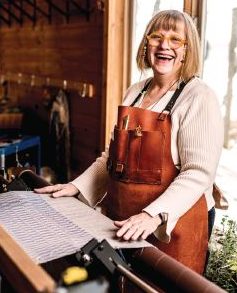
Today we’d like to introduce you to Marian Quanbeck Dahlberg.
Marian, please share your story with us. How did you get to where you are today?
I start my story as a child, with my mother, a demur but elegant woman, who loved to entertain with dinner gatherings, putting out the best china and crystal, silver and candles, and the best tablecloths made of linen, inherited from her mother, who had inherited them from her mother, brought over from Norway more than a century before. I was drawn to these table linens with their tone-on-tone damask designs which only showed those intricately woven designs when caught just right in the light.
When I graduated from the University of Minnesota with a Bachelor of Science degree, I began my career as a certified interior designer in commercial design, eventually establishing my own firm. One of my most favorite parts in the design process was discovering the wonderful and wide array of textiles available to the design community. Rich and beautiful, elegant and suffused with color, these fabrics helped me fall further in love with the tactile world of textiles.
When we were finally able to get our son diagnosed, we found that he had Aspergers Syndrome. This was about 20 years ago, before Aspergers was even recognized in the United States. This diagnosis confirmed our thoughts that he needed full-time supervision and guidance. My husband, an architect with his own firm, took over my firm and I became a stay-at-home mom. While caring for him (6 years old) and my daughter (4 years old), I needed some creative outlet. After exploring several options: pottery, painting, designing for a baby knitwear company; I decided to take a few weaving classes. My teacher was Traudi Bestler, a nationally renowned and widely respected and knowledgeable weaver who studied at the Sievers School of Fiber Arts, The Weaving School, and the Weavers Guild of Minnesota. She provided a classical education in weaving, slowly expanding my weaving knowledge as my skills became more honed.
The day came when I realized I had so much knowledge I would be hard-pressed to make use of it all before I forgot much of what I had learned, so I launched into the world, weaving linen, still not fully feeling I could call myself a ‘Weaver’. But as I would weave for friends and relatives, gifting them with my linen textiles, a phrase became more and more frequent. “You should sell your weavings!” So, I decided to go professional and open my studio. This decision required me to adjust my path quite a bit. I needed to find linen yarn that I could get at an affordable price that would not make my woven textiles cost prohibitive. I wanted it to be local, but was unable to find any sort of production linen yarn in the western hemisphere! I finally located 2 mills who produced and sold smaller quantities of high quality linen yarn located in Belgium and Lithuania. Although I was very disappointed in the mills being so far away, I felt compelled to weave linen and therefore had to find these mills acceptable for linen yarn.
Several months before I moved in to my new studio, I had decided to try getting into some shows, but the only one that I really knew anything about was the American Craft Council Show. I applied separately to each of their 5 shows across the U.S., thinking that the act of applying would be good practice anyway, and forgot about the applications until I began receiving notifications that I had been accepted into the St. Paul show!! Then the next day another notice came letting me know I was juried into the San Francisco Show! A couple days later, the acceptance notices from Atlanta came, and then the 2 Baltimore Shows!! I had barely moved into my new studio, I didn’t have a business card yet, I had no experience showing – ever, and I had no inventory. It was 2010. I could only afford to go to 2 shows, so I chose the St. Paul show and the San Francisco Show. Because I had such a low inventory, I decided to make swatches of the assorted designs I was going to offer in the colors I had available. Thirty separate pieces. No problem. But I was weaving into the wee hours of the night before the first show. I quickly zig-zagged the edges of the samples, thirty 1-foot square samples, packed them up and went home so I could put them into the washer for a gentle wet-finishing.
So far, so good. But when I opened the door to the dryer after they had tumbled to a damp dry, I gasped at what I saw. All the zig-zagging had not held the edges and the samples had frayed into a huge tangled mess. It took me a minute to get over the shock, and to absorb the gravity of what was before me. It was 3 am, the morning of my first show, I was already exhausted, and I had 4 days of grueling work ahead of me. These samples were to be the only real representation of my work, and from these samples people were supposed to be able to order my textiles. If I didn’t have these samples, people wouldn’t be able to place orders and I wouldn’t be able to pay for the cost of the booth rental and all the other expenses I had already accrued for the two shows. It was several thousand dollars. I was so far out on a limb, and the samples were going to be the very instrument that sawed through the branch I was sitting on. Tears burned my eyes. Several expletives escaped my lips. This just couldn’t be happening!! I slumped into a chair and had myself a full-blown pity party!
After about 5 minutes, I realized that if I didn’t do something, things were not going to get any better. So, I took the samples out of the dryer and examined them. I decided that I could repair them by snipping off all the raveled edges and applying a diluted mixture of glue and water to all the edges of all the samples. But all my supplies were at my studio downtown. What now?! What was open at 3 am on a Thursday morning that was located close?? The only ‘store’ within a reasonable drive was Walgreens, a drug store. I jumped into my car and flew the few miles to the 24-hour Walgreens. As I got out of my car, I saw a car in the darker part of the parking lot with someone leaning into the window of the driver’s seat talking to the driver. The way things were going I would have the bad luck of mistakenly getting arrested for soliciting or dealing drugs just for being in the wrong place at the wrong time! I quickened my pace into the store.
Once inside, I noticed that the only people at Walgreens at that time of morning were looking more than a bit buzzed on something or another, so I speed walked through the store to the school supplies and quickly selected Elmer’s Glue, a scissors, and a ruler. There was a line at the register when I got there… at 3:30 in the morning! Are you kidding me?? As I inched forward my impatience sharpened, until I was second in line behind a woman who apparently was wearing her pajamas and had left most of her money behind since she was having the cashier add each of her items separately and then totaling the amount, then hemming and hawing about what to take out of the things that had already been checked out, making the cashier need to make a refund . . . you get the picture. went my foot. I checked my watch for the 14th time wondering if I would get out of Walgreens before the next century. I watched the woman digging in her jacket pockets, finally pulling out a couple of needed coins along with lint, candy wrappers, used tissues, and long strands of hair. Ewwww!
I finally checked out, screamed home, fixed the samples, and even got an hour of sleep before the Big Day! Everything went swimmingly with only a few people asking why the edges of my samples were so rigid, and would their textiles have edges like that? Sigh!
My first real studio was a big open room in the basement of what was once a refrigerated keg facility for the Grain Belt Brewery, now defunct. It had one window up by the ceiling that measured about 15” high x 30” wide. Otherwise the room was painted all white, with water and a mop sink in one corner and exposed everything running across the ceiling, but it was built like a fortress with thick concrete walls and ceiling, quiet as a church. I thought it was heaven on earth!
From this point to the present has been a slow building process, getting my name out in front of people through shows, pop-up shops, features in magazines, social media, and a website (which is still under construction). I started to get to know the movers and shakers within the ‘makers’ community and who was who in the retail community. I started to realize that ‘making’ meant more than making! It meant rubbing elbows with politically correct people, and showing up at the right events, and looking appropriately funky, although not too funky since I am 60+ and living in the Midwest. It meant knowing who is who within the state government, and at the Universities of Minnesota and Wisconsin. And it meant knowing all the various editors of all the local magazines and papers. This also meant that I had no time to weave! Time to hire someone to get this stuff done!
In my search for local linen, I came across someone who would influence me and inspire me to change course. I met Rebecca Burgess online through Fibershed.com. I visualized a shed full of fibers of all kinds, including flax! But Rebecca could not tell me what I wanted to hear. “No.”, she said “I do not know of any linen yarn being produced anywhere in or near the U.S.” But In talking with her I found a kindred spirit! She spoke my language. I have always felt a strong compulsion to work for our earth, but didn’t see any way to help until I talked with Rebecca. I realized that I could continue doing what I love, while offering local weaving services to a strong local market of fiber growers who do not have enough fiber or find it cost prohibitive either financially or ecologically, to send their fiber to the few surviving textile mills in the East or all the way to China. I came to understand that Fibershed was not a shed full of fiber but rather, like ‘watershed’, fibershed is a focused area where fiber can be utilized locally, as well as being a defining moment for both farming techniques and how the textile industry operates. I suddenly realized I could do more than just post on Facebook. I could continue to do what I love, which is weaving, but I could offer to do this as a service to others who have animal fiber they have processed into yarn and want to go to the next step of having it woven into cloth. I could help the small fiber grower make use of the crop of nettle, flax, or hemp once they have gotten it processed into yarn, and I could weave it into fabric for them. This was a FIBERSHED moment! This was when Small Dog Weaving Mill was born!
It was at this point that I opened my doors to all the sheep farmers and fiber growers who populate the farmlands where I live. It is these people upon whose shoulders our country was built, not huge corporations. I want to turn to these people and offer them a means by which they can make a little more income, and maybe make it possible to improve things on their current farm, or even grow their operation. I want to help them be proud of their fiber and put their name behind their product. I want to help grow the textile industry back up on a regional scale, in hopes that small processing and weaving mills will spring up throughout the country, making services available to the small farmer and anyone else needing weaving services. I want to encourage the individuals rather than stockholders!
By offering this local weaving service, the carbon footprint of the textiles from local fiber is substantially reduced, keeping the fabric local, and providing opportunities for local designers and makers to create from local product. This also helps build local community and local economy, much needed in the local farming communities! This is an exciting adventure for me and seems to be something that many fiber growers are excited about! We are already working with fiber ranchers and farmers, weaving their fiber into fabric, which can then be made into blankets, or used for apparel, upholstery, or home décor. The wool processing mills are lining up to have Small Dog Weaving Mill weave for their clients as well. I am even getting referrals from Faribault Woolen Mill for projects that are too small for their operation!
Local fiber farmers who have no resources for getting their fiber from yarn into fabric, can bring their yarn to Small Dog Weaving Mill to be woven. There are many things we discuss before proceeding with each project, and many directions we can take depending on the thickness and tightness of spin of the yarn, and what the fiber owner is seeking in his/her fabric. We can also take the fiber, and have it processed by one of several processing mills with whom we have worked and trust and who have the appropriate expertise and equipment to process the fiber. Because we are stepping onto relatively new ground, we are currently not requiring a minimum yardage when the order is placed. We want to encourage new clients and consider that each new client will have special and specific requests, so we want to keep things flexible and learn as we go. If we design and/or weave the fabric, the labels of Väva! Veve! and/or Small Dog label is included on the finished product.
In the next phase we hope to be able to purchase fiber from the fiber farmer and be able to have it processed by our local mills and provide the client with a one-stop shopping experience. We also hope to be able to purchase fiber, weave and sell it in our own online retail shop.
We do plan on keeping Väva! Veve! operational. We just can’t NOT weave linen! Good news in that area as well. For years I have searched for local linen that is of the quality and quantity that we can use. Until recently there has not been anything at all . . . not in the whole Western Hemisphere, requiring us to ship linen yarn all the way from Europe! The U.S. lost its complete knowledge base for flax cultivation, processing, and weaving linen after cotton become cheaper to process when the Cotton Gin was developed during the Industrial Revolution. Even the flax processing machinery and any people with knowledge to operate them are gone. But a group up in Nova Scotia, Tap Root Fibre Lab is reinventing the proverbial wheel by developing machinery that will process flax into linen yarn! And several local farmers are experimenting with growing flax. I hope we can see this small industry grow quickly and I will be able to use LOCAL linen in my Väva! Veve!
Overall, has it been relatively smooth? If not, what were some of the struggles along the way?
Looking back, the road seems to have been pretty straight, with only a few potholes. Once I found weaving it appears I had found the place I belonged. After that, I discovered the linen fiber and fell in love all over again. This was the fiber my mother, and her mother, and her mother’s mother had loved, treasured and kept so carefully, that shone so beautifully in candlelight, that seemed to drape and shine like liquid precious metals, and felt so wonderful in my hands. My love of weaving and linen gets infused into each textile I create, yet there seemed to be something missing for me. While creating wonderful weavings under the name of Väva! Veve! I did not like the fact that I had to import my linen yarn all the way from the two mills I tracked down in Belgium and Lithuania. I searched for over a year trying to find some sort of local producer of linen yarn. I searched all over the United States. I then went to Canada, then to South America. It seemed that no one in the western hemisphere was producing any linen yarn in a quantity and quality I could use. But in my research, I came across Fibershed.com. I immediately pictured a shed full of fiber and thought that these folks should know. I talked with Rebecca Burgess, the founder of Fibershed, who indicated she knew of no producers of linen on a local, regional or even a national level. Although disappointing, this discussion led to talking about mutual concerns for our earth and how we all need to do our part. The philosophy of Rebecca and the Fibershed community resonated with my own, that of growing local, sourcing local, buying local, and leaving as little carbon footprint or disturbance as possible, but instead building and giving back to the earth and the community. I ended up doing some research for her about how hemp is processed and how hemp might combine with wool in the processing line of a cottage wool processing mill. I traveled around my state, talking to people raising sheep, growing flax (growing hemp had not been legalized at that date), making lots of contacts, learning a great deal, and hopefully contributing some basic knowledge helpful to Fibershed.com.
Even though Rebecca has been focusing on hemp, she indicated that flax also is a wonderful and beautiful fiber. One day she hoped the focus could expand to include flax, but for now hemp won the best Bast crop award for being a ‘miracle’ plant, with 100% of the plant material being utilized in one industry or another, and it being much gentler on the earth by needing no herbicides/pesticides or water other than rainwater to grow, and building the soil rather than depleting it.
Just as I saw the viability of linen years ago, and pursued it, so too others have been researching and developing the budding industry. One can’t keep a good fiber down, and now flax is being supported by local farmers who are experimenting with various types and growing methods, and processing equipment is being developed from scratch . . . all in the North American Continent!
A series of events happened simultaneously that steered me to where I am today. I found out about Fibershed and met Rebecca Burgess, who shared my same philosophy. I found a perfect facility with over 8,500 square feet available for developing a weaving mill, and I found not one, not two, but FIVE used AVL Industrial Dobby looms for a phenomenal price! I pursued the facility and the looms with haste and the big picture in mind, but also with a conservative approach.
Lots of personal money was at stake. I tried all kinds of ways to raise funds for their purchase, and ran into issues such as not being able to qualify for such a huge loan, finding out that a Small Business Loan wouldn’t really do anything to help me qualify or to save me any money, finding out that there is no government support for small businesses looking to provide a ‘value added’ service to farmers who grow fiber, and realizing that banks don’t like to blaze new trails with an unproven industry.
The deal fell through with the property since my offer needed to be so low due to lack of funds. This was a huge disappointment since the property offered such great opportunities. It was an old creamery with enough square footage to offer room for growth for looms and room for a retail business, and even a great space for lodging students, as well as a coffee shop! The building located right on the Mississippi River, in Wisconsin. It was also located in a small town with lots of artists, which encouraged a very progressive and creative environment.
Searching for used Industrial Dobby looms took months for each one I found. I went through 4 different deals for various Industrial Dobby looms located around the country, each deal falling apart for any number of reasons, before finally finding a group who could sell their Industrial Dobby Loom for a price upon which we could all agree, with someone who would install it and instruct me on operation. Each loom I found was such an effort, and each time I had to arrange financing. And each time, the deal fell apart. By that time, I had come to realize that starting up a new industry without any backing would have to have a conservative approach. So, my husband and I decided that our cabin would be a wonderful place to turn into my new studio, dedicated to becoming the new facility for Small Dog Weaving Mill.
Upon ordering the loom, we needed to acquire a large compressor which we easily located and had shipped to the business we thought would be installing it. We had researched who would be appropriate for installing a 1,000 pound air compressor requiring hard wiring and air lines run to the loom. In rural area choices are limited. We first contacted the electrician/plumber who had installed our boiler system. They wanted $5,000 to move the compressor from the truck, over a door threshold of about 2 inches and through the open space cabin to the utility room where it would stay. All told, it required the 2 inch threshold at the entry door, about 50 feet of tile on concrete, two 90 degree turns and the electrical hook-up and the airlines run. That’s it. $5,000? Serious? After we negotiated over the course of 2 months (because they were so difficult to get in touch with, and I mentioned that we have been their loyal customers for over 25 years, they came down $5. NEXT! Then we talked with a few more people and found someone who could install it for $1,000. And they could do it right away that week! That’s better! But after 2 weeks of not being able to get them to answer my calls, I looked again. Contacted a few more people, interviewed some more. Finally, in frustration I mentioned to a friend how difficult it was to get someone to move this big compressor. She mentioned that maybe I should check with some piano movers. DUH! I filled out the online estimator for a well-known area piano mover. They were back to me within a day with the cost: $850.00; and a date: end of that week! They drove 2 hours to get to my location, they moved the compressor in less than an hour, and moved like choreographed dancers! Everyone had a job, and they knew what they were doing. Boom! Lesson learned!!
Now the problem I face is that I already need more room…
Please tell us about Väva! Veve! and Small Dog Weaving Mill.
We have two companies collaborating side by side. One weaves linen. The other provides weaving services to local fiber farmers. As a team, we are fulfilling our dreams and the dreams of others by producing beautiful custom fabric in a very ecofriendly fiber of linen, AND weaving the yarn from local fiber farmers who then are able to increase their income from their own fiber by selling a finished product.
Väva! Veve! hand weaves all their bespoke fabric to be sold by the yard to fashion designers, makers, and customers with their own vision. We weave 100% linen yarn which we import from Belgium, in weave structures designed by Marian Quanbeck Dahlberg, where her subtle elegant Scandinavian aesthetic can be seen.
The designs are inspired by her Norwegian upbringing and the beautiful natural surroundings of the Studio, located by a small spring-fed lake in rural Wisconsin.
Besides yard goods, we also produce kitchen and bath towels as well as table accessories from the linen we hand weave.
Small Dog Weaving Mill was recently opened to address the need for local weaving services that local fiber farmers and growers need and who have no resources available to turn their smaller harvests of fiber from yarn into fabric and more. By providing this simple service, local farmers are able to use fiber they might otherwise have burned or composted because it was cost prohibitive to ship their fiber to the East or all the way to China. By providing this service we are also helping people reduce their carbon emissions cost to the earth by keeping things local, making their fiber healthier. Small Dog Weaving Mill is helping local farmers, thereby helping to build local economies and support local communities. Small Dog Weaving Mill may be small, but we have a BIG attitude, and we welcome going up against the Big Dogs! Bring it!!
If you had to go back in time and start over, would you have done anything differently?
Starting with 5 Industrial Dobby Looms in a large facility without investors would have been certain failure. I could have saved so much time by narrowing my scope, adjusting my vision and starting out small, with minimal investment. I am starting a brand new localized industry. Small is good!
I also would have hired piano movers straight off!
Pricing:
- 24″ x 24″ 100% Linen Hand Towel – $80.00
- 24″ x 36″ 100% Linen Spa Towel – $120.00
- 36″ x 60″ 100% Linen Bath Towel – $240.00
- 42″ x 72″ 100% Linen Throw (Huge Bath Towel, Tablecloth, Wrap, etc.) – $360.00
- 7-24″wide x 24-120″ long Table Runners – $30.00 – $480.00
- 12″ x 12″ 100% Linen Face Cloth – $30.00
Contact Info:
- Address: 335 25 1/4 Avenue
Cumberland, WI 54829 - Website: www.vavaveve.com; www.smalldogweavingmill.com
- Phone: 612-799-3802
- Email: norseweaver@vavaveve.com; norseweaver@smalldogweavingmill.com
- Instagram: https://www.instagram.com/vavavevelinen/; https://www.instagram.com/smalldogweavingmill/
- Facebook: https://www.facebook.com/vavavevelinen/; https://www.facebook.com/smalldogweavingmill/
- Twitter: https://twitter.com/vavaveve; https://twitter.com/smalldogweavingmill

Linens handwoven by VavaVeve – Marian Quanbeck Dahlberg – Minnesota, USA Napkin – Design PINE – Color AGATE WITH PLUM STRIPE (Red)Napkin – Design SNOWFLAKE – Color SUNSHINE WITH PLUM STRIPE – Napkin – Design PINE – Color SLATE WITH DREAMSICLE STRIPE

Linens handwoven by VavaVeve – Marian Quanbeck Dahlberg – Minnesota, USA
Hand towel – design PINE – color SLATE with CORNFLOWER BLUE STRIPE


Summer Studio, Wisconsin – Vavaveve is a premier weaving studio specializing in high quality, eco-friendly, luxurious and beautiful linen textiles for the home and personal use.

Summer Studio, Wisconsin – Vavaveve is a premier weaving studio specializing in high quality, eco-friendly, luxurious and beautiful linen textiles for the home and personal use.
Hand towels


Linens handwoven by VavaVeve – Marian Quanbeck Dahlberg – Minnesota, USA
Hand towel – design PINE – color SLATE with CORNFLOWER BLUE STRIPE
Image Credit:
John Haynes
Anne Laure Camilleri
Getting in touch: VoyageLA is built on recommendations from the community; it’s how we uncover hidden gems, so if you know someone who deserves recognition please let us know here.
Popular
-

Portraits of the Valley
-

LA’s Most Inspiring Stories
-
Robin Olive on Building an Inclusive Performing Arts Movement and Expanding Opportunities for Every Student
-

Que Johnson on Building Brands That Last: From Visibility to True Market Authority
-

Christina Wren Steps Into the Director’s Chair to Tell Stories That Feel Like Home
-

JordanL on ‘Breathe,’ Belief, and Building a Movement Beyond the Music