



Today we’d like to introduce you to Andrew Petterson.
Hi Andrew, we’d love for you to start by introducing yourself.
I’m originally from Idaho. My parents were both art educators. My Mom taught high school art history, drawing, and painting. My stepdad taught ceramics, photography, and drawing, and he was also a car guy who built custom cars in the garage at home. My formative years were spent with access to many forms of art. Any artistic medium I had an interest in was fully supported and fostered. I was surrounded by tons of books about art and art history and would be regaled with stories and information about any art form or artists I showed an interest in, so art and art history were a super important part of my life from the beginning. I did also felt pressured to pursue the arts by my parents, and so I got quiet with it and even developed a complex about showing my art to people. Simultaneously, in my early teens, I found my first passion in life – snowboarding. Through my teenage years, it was my world and the thing I wanted to do as a career. Snowboarding taught me so much about life. Literally, if you fall down, dust yourself off and try again. It took me on so many amazing adventures, and I met wonderful friends I still have to this day. As I started to progress and take it more seriously, I saw a few of the people in my social group becoming professionals, and I realized that I did not have the extra something they had. I had to figure out what the next chapter in my life would be. I was still drawing and painting regularly, but it was a secret passion that I was not ready to share. I thought back to working with my stepdad building custom cars and how much fun helping him was, and that could be a new direction to go.
My stepdad was a childhood friend of Boyd Coddington’s (of the American Hot Rod TV show), and I had the opportunity to connect with Boyd and work for him in 2003. A new chapter began at his shop in La Habra where I met Charlie Hutton. He became a great mentor and someone who really built my career as a car guy in Southern California. He was the first person to take me under his wing and show me how to make great work. He showed me what hard work looks like and what dedication and passion for your craft is. At that point, I had really fallen in love with cars. Building cars, the creative process, the problem-solving, and the attention to detail all were things that brought me a lot of joy. I was learning metal fabrication as well as surfacing and painting. In 2005, I followed Charlie to work for Chip Foose (Overhaulin, Rides TV show) in Huntington Beach. We built a car called the Impression which won the Ridler award, the most prestigious award amongst hot rod builders, and was one of the greatest accomplishments that I’ve had in my life as a car guy.
Around 2008, I shifted over to working on the prototype and development side of the automotive industry, working for a company called 5 Axis Design under Troy Sumitomo. This is where I spent the majority of my years in the automotive industry, and it’s been one of the greatest jobs that I think I’ve ever had. I have immense gratitude for it and the experiences I had there, the people I got to work with. Troy himself is just an amazing guy. We were building prototypes and concepts for Toyota and Honda. This is really where I started to grow and diversify my skill set, learning mold making, vacuum forming, milling, machining, composites/carbon fiber, and woodworking. It was a place where everyone was a specialist in specific skill sets, and we were all open and supportive of each other teaching and learning everything we could and sharing as much of our skills with each other as possible. We all turned into these prototype monsters, all working together. There was no gatekeeping or competition, and it’s a work environment unlike any that I’ve experienced since.
The automotive industry is a wild place to work. There are razor-thin budgets and insane deadlines. There are so many moving parts, things that just have to be built and timed perfectly. I had spent from 2002 up until 2011 working 60 hours, 80 hours, and sometimes 100 hours a week to make deadlines, often staying up for multiple days to get it done. On top of these crazy hours, I was also surfing and making art, starting to sell art, and thinking that was all sustainable and possible on only a few hours of sleep a night. Then in 2011, that all came crashing down. I got really sick. I had terrible back pain and just no energy. It felt like I had a hangover every day; it took a while for me and doctors to figure it out. I was diagnosed with adrenal burnout, which essentially means you’ve exhausted your body, organs are failing, and you are starting to die. Once I found that out I had a long road of recovery ahead of me, I had some really difficult times and decisions to make. I had to change my life. I had to start sleeping. I had to make time and space for my art and for a balanced life. I realized that I couldn’t sustain working as much as I was, so I shifted to working part-time three days a week and spending the rest of my time focusing on my art and making it my career.
The first and most difficult part of leaning in on my art career was making my art visible and sharing it with people. In hindsight, it seemed so fun and exciting, but at the time it was so terrifying. I began by sketching at coffee shops and getting comfortable with that. Then sharing my work more with friends and newer friends. Then sharing that I was an artist when speaking about myself. I had gotten a great head start around 2008 when I developed a great relationship with Oakley through some mutual friends that work there. I kept painting sunglasses for them for fun, and Jamin Jannard, the head of alternative marketing at the time, kept seeing them and asked to meet me. One thing led to another, and I had an artist series with Oakley. I hand-painted fifty sunglasses in a limited artist series. That launched me into the public eye at a time when I wasn’t really prepared for it, and it was an amazing opportunity for me. It made me believe that people love my work and want to see more of my art. It became a springboard for me to look at being an artist as a sustainable career and grew something in me that made me feel like my art was bigger than I am and something I need to share.
I started drawing in museums, going to live art model sessions, and taking art workshops, where I found my people. I was finally in the supportive art community that I had been looking for. Seeing that my art was as good as others in these classes, how supportive they were, and how comforting it was for me to be around other artists, I learned that there is no magic trick, there is no God-given ability. Just like what I was learning in the years I worked for Boyd, I saw that art is hard work, dedication, the hours you put in building your skill, talent, and ability. It became a numbers game. As cliché as it is, 10,000 hours is a true story. No one has gotten good at what they do without putting in the work, so I just made time and looked at it as an investment in myself. I was able to work part-time and make ends meet. Things were tight, but I was able to make it work. I was still recovering from adrenal burnout and had low energy. It was about three to five years of recovery before I started to feel like myself again. I had to change so many things about my life – my diet, my sleep habits, and my relationship with stress. I was a stress addict, and now I had to learn how to get motivated, how to work, and how to get things done without using stress as a motivator. Learning to make interest, excitement, love, and passion a motivator has been one of the greatest gifts from that experience. I had to sleep 8 hours a day, and that changed my life so much. It was something that I hadn’t done for over a decade.
I made the decision that art was a priority in my life and something I needed for spiritual survival, and that it was a critical part of who I am. I got more and more comfortable with people seeing my art. I used social media as a platform to really put myself out there, and I got placed in a few group shows. I started going to the Rome Workshops, which is an American workshop taught in Rome, Italy and run by the amazing and knowledgeable sculptor David Simon. There I studied with Sean Cheetham, who’s a legend as a painter and a person, I am so grateful to now have him as a friend. Traveling to Rome really galvanized why I make art. I understood the legacy and the centuries of art that have come before me, where I fit in the lineage of art history, and that it is this never-ending organism. It motivates me to make the best contribution to art that I can while I’m here.
At the same time, 5 Axis was changing its direction as a business, and I was looking for some new opportunities with all the skills that I had built in a decade working with Troy. I was super interested in prototypes, small startups, and helping in product development There was demand for the experience that I had gained so this was sort of where I started to grow more as an engineer and designer beyond being a fabricator and builder. This was another huge place of growth. I started to find myself, feel at home in my position, and use my creative artistic mind to find efficient ways to build prototypes, make new manufacturing processes, and also help at any step of building the product. Making practical things look beautiful; this “art to part” idea is something that I think is missing from a lot of startups and even larger companies. Finding someone who can transcend all three of those facets of a project, communicate productively with everyone, make sure that you’re streamlining and that every process is supporting the process behind – all these steps were something that had been missing for most of the time I spent in this industry.
Often we didn’t know what the engineers were making, and the engineers didn’t know how they could be making it easier for us fabricators. I saw this new position that I was in, and that became what I wanted the future of my relationship with the prototyping and product development industry to be. Being this person that is consulting and helping communicate and create more efficient, streamlined processes for these extremely expensive and detailed builds. At this point, I started my own business as a design/engineer/fabricator, and I worked for multiple small startups. I did some fun work with Honda, Rivian, and Sygnal Automotive. My work schedule changed as well, and I started working more in batches. I’d work intensely for a few weeks or months straight and then shift and focus on art, going back and forth sort of as needed per project. That has been interesting and new at this stage, but I am feeling pulled stronger and stronger to grow my art. No one’s going to tell me to leave work early and go home and work on becoming a fine artist. I was making some big decisions becoming my own best advocate and deciding that I needed to fight for myself to become a fine artist.
It was around this time that a person showed up to tell me to leave work early and go home to make time for myself and work on becoming a fine artist. That person was Kara Duffy, who is currently my agent-boss-business coach-supervisor-project manager…I could go on. She is hands down the most critical part of my business as a fine artist, and the whole reason why I’m having this interview and the exhibition in October is all thanks to her. I think I’ve learned so much from her, but in a fundamental way, the biggest thing I’ve learned is that you’re not going to be able to do this (success) alone. It takes a team, it takes help, it takes you asking for help, it takes finding the people that love you and care about you and want to see your vision come to life and make an investment in you. Make sure that you have access to the things that you need to be successful. Realizing that I’m an artist, I love to draw, paint, and make art; my obsession and passion with art is endless, but that does not make me good at the business of art, that does not make me good at selling my art or even talking about myself and my art. That is something that I needed help with, and Kara has been a critical part of that realization. Having people to help you with those things that you don’t know can be completely transformative in your career and your business.
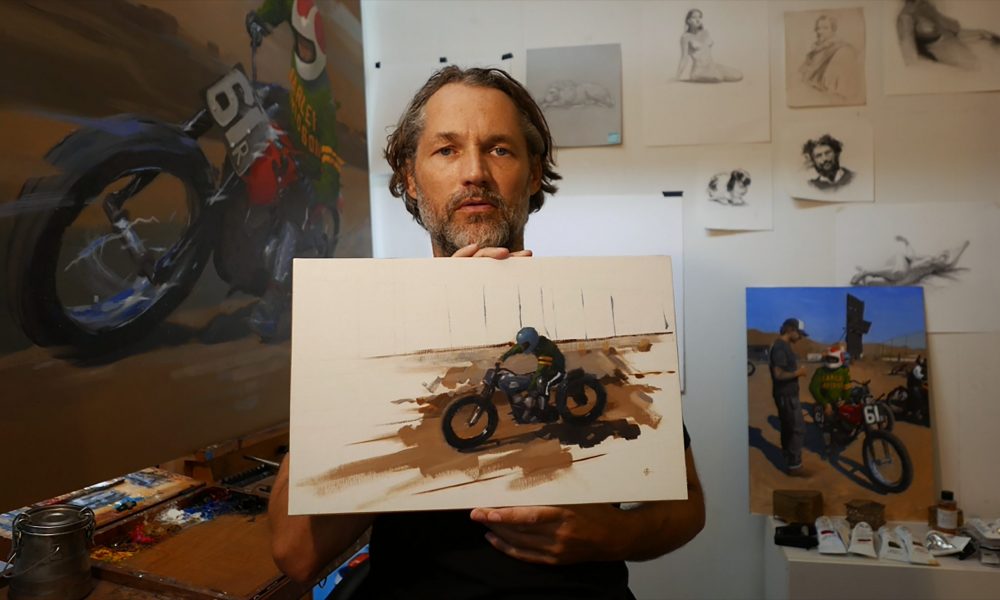
That brings us to the present day, creating the show for the Hot Shoe Chronicles. Some old friends of mine and mentors from my hot rod days that I looked up to and had a great friendship with, but had just slowly grown distant as life happened, had recently started racing vintage tank shift motorcycles. I saw these images of them, and I thought, “These are paintings, these look like genre paintings, and a story I would love to tell.” I hit them up, and they were really excited and so supportive of it. I just said, “Hey, I’d love to come take some pictures of you guys I’d like to do some paintings of what you are doing.” Grant Peterson was so gracious and would always give me access to the pits and the track. I could be everywhere I wanted to be to capture some amazing content for paintings. I followed along for a season and went all over California from mid-Cal to San Diego and captured as much as I could and then went into the process of editing and trying to find the paintings. Once I did that, it was time to paint.
I was struggling to make more time for myself to make art, and that was tough. I think that’s something I’m still actively working really hard on making time for myself, making time for my artistic career. I can easily dedicate my time to someone else or another company or another business. Learning a lot about myself, my personal deficiencies and finding things I need to improve upon came at the right time when I met Kara. She’s been able to support that growth, foster it, and expedite this phase. I’ve made more progress in the last year than I’ve ever made in my career. I have spreadsheets for my art now, I have deadline tracking and commission processes in place now which is wild, and I like them, I actually kind of love them. I learned so much about my art and my process in building them out, and it’s been so cool to track and see changes in growth and sales.
We started seriously working on the show about six months ago. I started some of the paintings a few years prior just sporadically working on them in between projects. These are big paintings for me, 24 X 36 inches on average. We put some flags on the horizon and said, “Okay this is when we should try to do the show” and as we started to push and develop it into what it is now. Once we started to take action, amazing people and opportunities started showing up. Dutch and Vicki at the Bike Shed Moto have been amazing and so excited and supportive for this show. Discovering amazing sponsors like Fess Parker Winery has really been a blessing, to find people that are so aligned with what we’re doing and have been passionate about something for a long time feels great. I’m really excited for it to happen. It’s been one of those projects where all our obstacles have turned into opportunities. There’s been so many moments of overlap where someone we are working with knows a person in the painting or people that I was working with knew the riders. There are so many dots that are connecting and supporting this show going forward that it really is a rare moment when it feels like the universe is just yelling and screaming for you to do this and that it’s exactly what you should be doing.
We all face challenges, but looking back would you describe it as a relatively smooth road?
I think most of my life, I’ve struggled with a lot of the things that artists have notoriously struggled with: believing in myself and believing in my art. The vulnerability of sharing my art or any creation. It is unique as an artist to share something that comes from a place so deep inside you that putting it out in the world is so terrifying. There is a feeling that can happen that no one understands you or likes you in the core of who you are. There’s a hurt that comes from that and feels unmatched. It is heartbreaking, and in my life as an artist, I would be absolutely crushed by this. Putting myself out there not being seen, not getting into an art competition, not being selected for a show, or not selling my work.
The sooner I realize that it has nothing to do with me that my job as the artist is to be inspired and create, and that success is not going to happen on your first try. I didn’t realize soon enough that my career as an artist has so much in common with the time I spent snowboarding. I would never expect to land a trick the first time I tried it. It will take a lot of tries before I am successful, and that is the great lesson that I’m so glad I learned as a young man. You have to try a lot and learn from it before it starts to work and is successful, and sometimes it’s going to hurt, but this is what makes the moment that it starts to work feel so good and something that you’re able to celebrate in a way that you wouldn’t be able to celebrate if it was easier. The great gift and curse of the artist is that even when you want to quit, you can’t. Creativity has a hold of you, and you can’t get away. You will be like this for the rest of your life, and you can hate it and be miserable with the curse, or you can embrace the gift and know that you have infinite ideas and opportunities to create.
Specifically, my adrenal burnout was the hardest time in my life. The pain, the depression, just feeling so sick and hurt. Not knowing if I would ever feel healthy again. It takes a long time to do that to your body, and it took me a long time and a lot of hard work to recover from it. I’m able to look back now without regret and with gratitude. It formed the healthy foundation of my life now, built with balance and boundaries, priorities for myself, and what I decide is important. I want to live a life rich in experience. I am open to all it has to offer me: pain, loss, regret are all a part of being human, and I will always be willing to feel those emotions. I think you need a little salt to taste the sweet, and that happiness and joy feel exponentially better after experiencing their opposites.
Thanks – so what else should our readers know about your work and what you’re currently focused on?
I love that art was a part of my life at such a young age and that it’s something that has always been a part of me and who I am. This shift to becoming a known and seen artist is the only thing that’s new in my artistic career.
Art history to me is almost as important a part of my creativity as painting is. I think looking at Leonardo da Vinci, who was such a great engineer and artist is someone that I draw a ton of inspiration from. I love to think about what he and Michelangelo or Caravaggio and even Anthony Van Dyke would think about what my world looks like now. What they would feel was worth documenting, the stories that they would like to tell.
For me, that’s a perspective that’s perpetually running and playing in the back of my mind. How would the great masters tell the story of what’s happening in my life now? I think that is the place I like to be creating from. I always want to tip my hat to the masters and the great artists who inspired me. I feel a close and deep connection to them, and that is why I paint with oil and draw with charcoal. They are some of the oldest forms of visual, and I feel like they’re lost in our world. We are visually bombarded with TV, ads, social media, and things have to be moving faster and faster and be more eye-catching and stimulating. If I can create something that makes a person slow down, give them a respite, a gentle and comfortable space, I can give that person an experience that is now pretty unique. I believe there’s always a space for art and for the type of art I’m making, and I will always hope people will find the time and a way to make the space for it. The idea I can start a movement that returns us to slow and gentle visual imagery is really exciting.
The things I’m proud of would be being a part of the team that built Foose Designs Impression, the Oakley artist series; I’ll always be proud to see how sought-after and passionate collectors are for the originals. It is something that always makes me smile, and I have immense gratitude for. There are two paintings of sisters Aubrey and Megan that I made, and I look at as the moment I arrived as an artist operating at the level I wanted to be at. I studied and practiced and practiced until I got to a place where I felt like I could tell stories with paint the way I wanted to. These portraits are what gave me the confirmation that I had arrived, and those friends and paintings will always have a special place in my heart.
Where we are in life is often partly because of others. Who/what else deserves credit for how your story turned out?
I would like to thank Kara Duffy, first and foremost for creating what is happening this year for me and taking the time to understand who I am and what my dream is, for supporting me and being there for all my ups and downs as I move into this new phase in my artistic career. She has held the space for me when I needed time and has been there with a jetpack when I was ready to go. She always has kept my vision and identity as an artist intact and has really made the space for me to be more myself than I ever have before. I really don’t know what this path I am on now would look like without her.
My friend and art mentor Sean Cheetham, your skills as a painter will always be an inspiration. I am still learning so much from you and am so grateful for our friendship; you are the only person I can talk art/art history and metal fabrication/forging with.
Killer Mike, you are a great friend and inspiration. Your appreciation for the art I have made and the cars I have built is unique only to you. Your new Album is an inspiring dive into vulnerability, and I hope one day to be able to share that much of myself with the world. I hope you win more Grammys than you can fit in your pockets. Thanks for always being in my corner and rooting for me.
Pamela Knoll for being the best art friend I could ever dream of. Your support and believability in me has been such an important part of where I have gotten and am going. Painting with you always gives me an immeasurable depth of peace and
inspiration.
Vince Kamp, you’re an inspiration as a painter, family man, and creative your ability to tell a story with paint is incredible and you have helped me so much expand the narrative of my art. When I am feeling my best or worst, you are always there with something relatable and cheering me on thank you so much geeza.
Contact Info:
- Website: https://andrewpettersonfineart.com/
- Instagram: https://www.instagram.com/taterman/
- Facebook: https://www.facebook.com/tatesmade
- Twitter: https://twitter.com/Tatertweetsart
- Youtube: https://www.youtube.com/channel/UCEN4pNV5khpx56XEzwRf_Tw
- Other: https://www.tiktok.com/@tatermanart?lang=en


Popular
-
JordanL on ‘Breathe,’ Belief, and Building a Movement Beyond the Music
-

Megan Birney Rudert on How Access to Light Is Powering a More Sustainable and Equitable Future
-
Linda Kneidinger on Building Lasting Change Through Small Steps and Self-Compassion
-

Jolana Nika on Redefining Modern Connection Through Intentional, Real-Life Experiences
-
What did suffering teach you that success never could?
-
Who saw you clearly before you could see yourself?


