




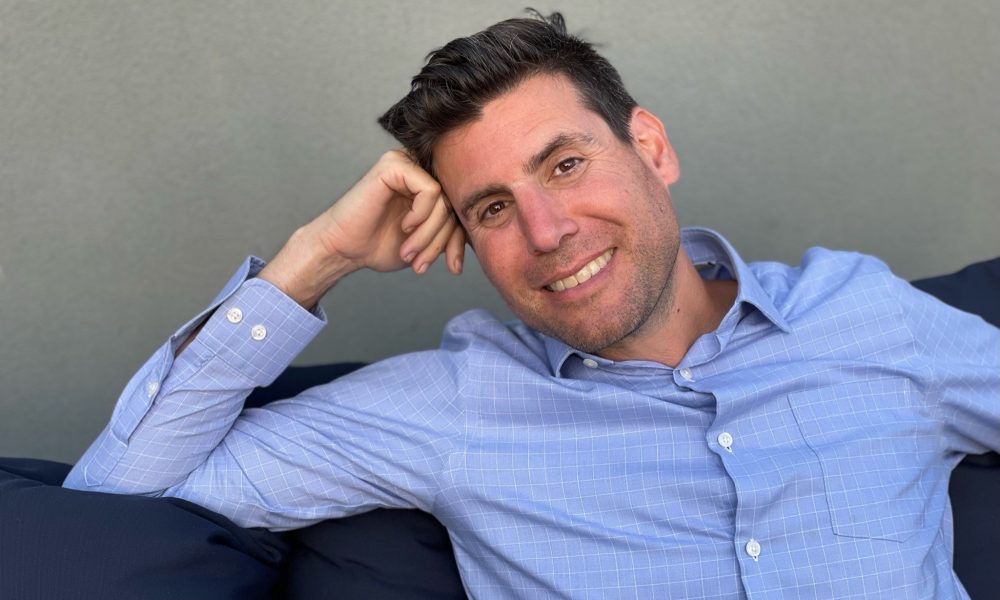
Today we’d like to introduce you to Alex Douglas.
Alex, we appreciate you taking the time to share your story with us today. Where does your story begin?
I am a psychotherapist who specializes in working with teen & adult males, creatives & public figures, and addictive behaviors. I am trained in EMDR, and my modality uses parts of Depth Psychology, CBT, Existential Therapy and Attachment-based Therapy.
I previously spent over a decade as a TV writer. Though I had some success, I began to realize that I spent so much of my daily life living with anxiety, stress, and fear rather than the joy of storytelling as I used to. Anxiety of whether I would receive positive feedback that day — an email, a meeting, etc. — which would send my spirits flying high but send them crashing if I didn’t. Stress of desperately chasing what I thought “the industry” wanted rather than following my own voice. Fear of being worthless and unlovable if I wasn’t “valued as an artist” because that was how I had defined my identity since I was a child.
Things came to a head during the pandemic when society’s shutdown removed the distractions I could use to avoid my distress. I felt like the walls were closing in: I had put all of my eggs — of my financial success, my identity, my chance at happiness — into this one basket, and it wasn’t going to pan out. I was having panic attacks, constantly overwhelmed, and terrified. I had been sober for about 20 years but began using again. Frankly, my wife saved my life: she helped me take a real look in the mirror and process the traumas which I had done everything I could to ignore for the past 30 years.
During my time as a writer, I had begun volunteering: as a counselor on the National Suicide Prevention Lifeline, a hospice companion, a Court-Appointed Special Advocate (CASA) for an adolescent in the LA County foster system, washing dishes at a home shelter… I thought I was doing this to feel more connected to my fellow man, since the entertainment industry can be quite a bubble and – frankly – to forage for story ideas. But I slowly realized that volunteering wasn’t a means to further my passion of writing, as I had thought, but the reverse: Writing had brought me to my true passion of connecting with others.
With a lot of introspection, I realized that what had attracted me to storytelling was the exploration of human psychology: Hamlet’s inability to process his grief over his father’s death takes him over; how Othello’s experience as an outsider creates a feeling of being “less than” which Iago preys on. How our traumas influence our decisions and dreams. How they can trap us in an invisible prison, we have the key to all along.
I wandered in the weeds for a long time, but when I hit upon becoming a psychotherapist, it instantly felt authentic. Since graduating with my master’s, I have worked at adolescent and adult treatment centers and am currently seeing clients in person in private practices in Marina del Rey and Hermosa Beach, as well as virtually throughout the state.
We all face challenges, but looking back would you describe it as a relatively smooth road?
My road here has been very rough. One major struggle on my journey was with substance abuse. Another was learning to listen to – and validate – my authentic self rather than chasing the “Alex” I thought others wanted.
Growing up, I was painfully shy, bullied; an outcast. I latched on to writing both because it offered a protective mask of “other characters” through whom I could express myself and because it was the one thing which brought me praise rather than bullying.
In college, I vowed to break out of my shell. I latched onto a group of “cool kids” and followed them down the rabbit hole of drug use. Initially, it was a blast, but combined with the anger I felt at the world and my self-loathing at “allowing myself” to be ostracized when I was younger, my heavy partying soon pulled me in a dark direction. As I escalated from “party drugs” to harder ones, my use stopped being about having fun and became a means to avoid my pain. I funded my habit through lying, cheating, and stealing – from loved ones and strangers – which meant that now I not only hated myself for having been bullied but also for becoming a degenerate addict. I got sober after about five years, motivated by seeing a very close friend suffer a life-altering injury while high.
Flash-forward to the pandemic. I finally realized that I had misunderstood this external validation for internal validation: it wasn’t the writing itself that brought me meaning; it was the recognition of its value by others. I learned (and am still learning) to begin to forgive myself for my incredibly harsh self-judgment, to allow myself to recognize my feelings as valid, and to redefine myself by what I want to be rather than what I think others will want.
As you know, we’re big fans of you and your work. For our readers who might not be as familiar what can you tell them about what you do?
I provide psychotherapy to individuals, couples and families in treating depression, anxiety, suicidality and self-harm, grief, gender and sexual identity concerns, childhood trauma, psychosis, existential crises, and coping with life transitions such as loss or end-of-life.
Working with men, I specialize in helping individuals struggling with challenges such as stress, anger, sex and intimacy, emotional awareness and regulation, and career issues. As a married, new father, I offer a particularly personal, empathetic space for dads struggling with challenges such as parenthood preparation, self-care, conflict management, navigating gender roles, and career and relationship concerns.
Working with creatives and public figures, I specialize in helping individuals struggling with challenges such as perfectionism, burnout, professional vs personal identities, self-acceptance, and isolation and loneliness.
Working with addiction, I specialize in helping individuals who struggle with all types of addictive behaviors, such as substance use, porn, workaholism, social media, exercise, shopping, and perfectionism.
What sort of changes are you expecting over the next 5-10 years?
Our society has a long history of stigmatizing mental health issues, of pathologizing anyone less than “perfect” as someone “broken” who should be hidden away lest they infect the rest of us. The reality, of course, is that there is no “perfect.” We all have about 80-90 years on this rock spinning in space, and we’re just doing the best we can to make it through the day.
A large and wonderful change I see is the normalization of both acknowledging and addressing mental health concerns. It is more and more becoming the logical decision when someone is feeling less than great, the same way you wouldn’t question going to an MD for a broken bone.
In addition, psychotherapists have historically been the blank slate who sit behind the sofa, taking notes and nodding, showing no emotion or reaction. Current psychotherapy, though – what’s described as postmodern – is evolving into something much more experiential, recognizing the value of the client’s experience in the room, and much more relational, recognizing the value of the relationship between therapist and client as a lens through which to examine all other relationships in a client’s life, whether that be with other people, objects, behaviors, or the one the client has with themselves. To that end, I bring as much of myself and my life experience into the room as is appropriate: my struggle with addiction; with the isolation, hyper-competitiveness, and creative block, as a writer; with the invalidation of my own emotions, as a man.
Contact Info:
- Website: alexdouglastherapy.com
Alexander (Alex) Smith Douglas, Registered Associate Clinical Social Worker, ASW 106791, is employed and supervised by Kryss Castle, LMFT 95114 in Hermosa Beach, and Deanna Olivas, Psy.D. PSY24435 in Marina del Rey.


Popular
-

Que Johnson on Building Brands That Last: From Visibility to True Market Authority
-

Christina Wren Steps Into the Director’s Chair to Tell Stories That Feel Like Home
-

Portraits of the Valley
-

LA’s Most Inspiring Stories
-

JordanL on ‘Breathe,’ Belief, and Building a Movement Beyond the Music
-

Megan Birney Rudert on How Access to Light Is Powering a More Sustainable and Equitable Future


