



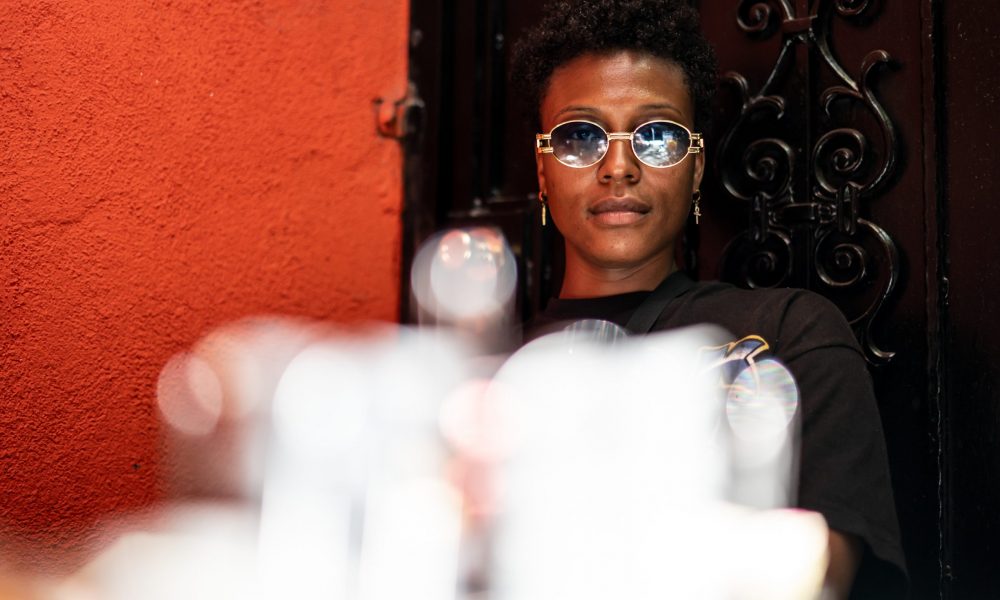
Today we’d like to introduce you to Briana Monet.
Briana, we appreciate you taking the time to share your story with us today. Where does your story begin?
I’m a D.C. native who recently moved to Los Angeles, CA in the midst of the Covid 19 pandemic in 2020. My interest in filmmaking started as a kid. I’d observe the art of photography. Paintings spoke to me more than words. I was considered the weird kid in my family, community, and amongst my peers. This is where I learned the art of visual expression in order to connect with the world around me.
In my family, the matriarchs are artistically gifted. My grandma was a chef, model, and fashion designer. My mother is a hair stylist, mixed-media artist, chef, and interior designer. My grandmother received an offer to move to Europe to pursue her fashion career, however, she declined and stayed in D.C. to raise my mother. The cycle repeated as years later, my mom did the same for my brother and I. I grew up watching my mother turning someone’s garbage into wonderful works of art and turning folks’ homes into elaborate show spaces. Although my mother had great clients, it wasn’t enough to keep us out of poverty. Much like my grandmother’s decision to stay in D.C. limited my mother’s artistic growth. I watched my family go into depression while fighting for their artistic dreams. I told myself that I would go wherever my art takes me and never limit myself.
I joined the photography club at my high school and spent days taking photos of my peers, family, and community. I learned so much about humanity from still images, however, I still felt that there was something missing from each image. The before, after, and the why. This gave me the idea to create a series of photos that properly told the stories that reflected the true imagery of my community. At that moment, I realized I wanted to capture the world and reveal the beauty in my everyday reality. My photography teacher suggested I study movies such as “Do the Right Thing“ and “Belly” for ideas. Although I wasn’t sure what to call it, my love for filmmaking was born. The idea of showing the world’s landscapes and portraits through psychology enticed me. Playing with colors, shadow, and camera movement in order to express emotion attracted me to the art form even more.
When I attended college in Miami, I explored my love for filmmaking further. I apprenticed under Gil Green and Dayo Haywood under their company called 305 films. There I worked as an intern, Camera P.A., and Assistant Camera/Film Loader for music videos and commercials. I had a natural affinity for business, so my internship seemed to be pushing me towards directing and producing. When it came time to apply for our thesis positions. All of my professors, except for my cinematography professor, tried to coerce me into pitching for the producer position. I knew then that being a woman, let alone a black woman cinematographer was rare, but I stood my ground and fought for the cinematographer position anyways. At that moment, I had doubts for the first time. When my thesis film didn’t win the award for Best Cinematography, my passion for film grew even more. My cinematography professor walked up to me in tears and said, “I voted for you. I heard you and understood what you were saying with every image you painted.” I also burst into tears.
Despite the loss and going back home to D.C. I knew I had it in me to be the best. Post-college, I worked as a camera operator in the live broadcasting industry for ten years. Shortly after that, I started a business called Freelance Camera Ops. The business focused on training inner-city youth and entrepreneurs on camera operating and provided job opportunities for local contractors. I grew my business from a gross revenue of one hundred thousand dollars the first year to one million in the second.
Even though I achieved a lot in D.C., I often found myself feeling unaccomplished. After seeing accomplishments from industry titans like Bradford Young, Chase Irvin, and Kira Kelly; I became extremely motivated. I fought my imposter syndrome and moved to L.A., knowing that filmmaking has always been my language. My way of creating, expressing, and connecting without being too loud. I had to position myself closer to my passion, my heart. Which was and will always be visual storytelling.
Since moving to Los Angeles, I have had opportunities to work with some of my idols, produce a few shorts, and be a camera operator and cinematographer for clients such as: Spotify, Revolt, Complex, Hoorae, Westbrook, E network, Hartbeat Studios, Nickelodeon, Disney, Marvel, Essence, and many more.
I now confidently promote myself as a Cinematographer, Editor, Photographer, Director, and Producer.
Would you say it’s been a smooth road, and if not what are some of the biggest challenges you’ve faced along the way?
My journey in moving to Los Angeles hasn’t been the easiest. I had no choice but to couch surf when I first moved here and ended up being homeless a couple of times due to some unfortunate situations. I also found little to no work in my first six months in L.A. As a result, I had to travel between D.C. and California as work opportunities came.
I maximized my downtime by networking on social media with other filmmakers and cinematographers. I volunteered to work as an intern on other people’s sets in L.A. while taking paid jobs in D.C. After some time, I finally saved up enough money to make my move final and get my apartment. Even with a roommate, I was proud to finally have that L.A. address. Work slowly started to pick up, and I eventually found an apartment of my own. I continued to make connections like my friend Keitumetse Mokhonwana, who took me under her wing, put money in my pocket, and taught me updated camera skills. It was the support from other black women in the industry like Keitumetse, Sade Ndya, and Malakai who continuously shared my name and kept me working in L.A. A huge thank you to all of you!
Last year I injured my ACL and needed surgery. Shortly after that, I was diagnosed with two auto-immune diseases. I had to use my savings to pay for surgery, health, and dental insurance as a result. I also had to abandon camera operating work for almost a year. Ironically, this opened up doors for more opportunities in cinematography, editing, and directing.
Thanks for sharing that. So, maybe next you can tell us a bit more about your work?
My work exhibits hyper color, high contrast, and experimental images. Dogma style and color choices are a true reflection of my roots in experimental films, music videos, and documentary filmmaking. I believe in telling stories that reflect black people in spaces outside of trauma. Spaces that show love, joy, fantasy, and our people as Gods in our ancestral power. I am a huge fan of Octavia Butler, Sci-Fi films, and afro-futurism. I believe magic happens in the real world, so my art is the bridge between documenting that reality and mirroring the esoteric realm. I am most known for my work in documentary spaces since I have been working in documentaries since high school. I have directed, executive produced, photographed, and worked as a cinematographer in documentaries. Although my artistic expression began in documentaries, my career started in music videos and commercials. Currently, I am most proud of my growth as a cinematographer and my confidence in producing personal projects.
What were you like growing up?
I was an enigma. Awkward, but still accepted by the cool kids. Issa Rae’s “Awkward Black Girl” was a true biopic of my life. I was an athlete who played basketball, but I was also a musician and artist. I am the oldest of four kids and grew up in inner-city D.C., so someone was always in the house. Whether it was cousins, dogs, or friends, there was never a dull moment. I think all of this influenced my outgoing personality and desire to connect.
Contact Info:
- Website: https://www.brianamonet.com/
- Instagram: https://www.instagram.com/iambrimonet/?hl=en


 Image Credits
Dee Dwyer Alexis Hunley Dante Bailey
Popular
-
JordanL on ‘Breathe,’ Belief, and Building a Movement Beyond the Music
-
Megan Birney Rudert on How Access to Light Is Powering a More Sustainable and Equitable Future
-
Linda Kneidinger on Building Lasting Change Through Small Steps and Self-Compassion
-
Jolana Nika on Redefining Modern Connection Through Intentional, Real-Life Experiences
-
What did suffering teach you that success never could?
-
Who saw you clearly before you could see yourself?


