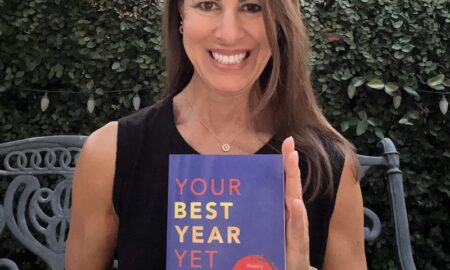



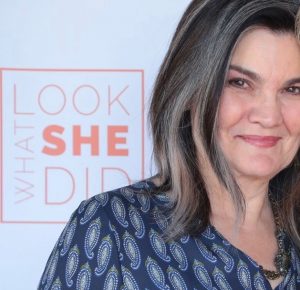
Today we’d like to introduce you to Julie Hébert.
Hi Julie, it’s an honor to have you on the platform. Thanks for taking the time to share your story with us – to start maybe you can share some of your backstory with our readers?
I’m originally from south Louisiana, right on the Gulf. Came out to California after college for a gap year in theater and never went home. After working as a theater director and playwright for a good while I was hired to write a film that went to Sundance, which got me started in film and television where I’ve had a good run as a writer/director. A few years ago, my brother passed away, then my parents and I realized there were a few things I wanted to do before I followed them. Our nonprofit, Look What SHE Did! was born out of that desire to do something meaningful.
Around that time, I went to Jury Duty in Downtown LA in a building named after a woman I’d never heard of, Clara Shortridge Foltz. My friend Jill Klein had also been to Jury Duty there and we researched this woman only to discover Clara Shortridge Foltz, single mother of five, with no resources or help, had become the first female lawyer in California. She had to sue to be allowed to attend law school, but when she won she no longer had the money to pay for it — so Clara simply took the bar exam and passed. As an attorney witnessing the unfairness of the legal system, Clara originated the concept of a Public Defender Program, which she lobbied for in all 50 states while also advocating for women’s suffrage. Clara later was the first woman to run for Governor of California. Jill and I thought “How have we not heard of this woman? And how many other women have done astonishing things we’ve not heard about?”
The problem of women being left out of history seemed vast, but we decided to do what we knew how to do — make a short film telling Clara’s story. Our friend Courtney Graham borrowed a camera, I interviewed Jill talking about Clara, our friend Farrel Levy edited it — and we put it on YouTube. We’d had so much fun we decided to do it again by inviting a few friends to the backyard to tell more stories of wildly inspiring but unheralded women. Honestly, the reason we kept doing it was we had such great times at the shoots — finding out about remarkable women, from remarkable women.
Look What SHE Did! has always had a life of its own. We were all volunteers with full-time jobs, but our little films found a growing audience and eventually, we became a nonprofit. To date, we have 120 finished four-minute films that have been viewed over a million times across different platforms and exciting plans for more shoots and strategic alliances on the horizon.
Can you talk to us a bit about the challenges and lessons you’ve learned along the way. Looking back would you say it’s been easy or smooth in retrospect?
Oh sure, there have been lots of struggles along the way. We started as a group of volunteer professional filmmakers so our films look amazing — they’ve been shot and archived properly since the beginning, all broadcast ready, hi-def, beautifully framed, lit, edited, etc… but none of us were business people or nonprofit arts leaders so we didn’t have experience in marketing, distribution, fundraising, grant-writing, you-name-it. We created our nonprofit from a handbook online because we couldn’t afford a lawyer. A few years ago, we were incredibly fortunate to find a young woman who’d just graduated with an MFA in Nonprofit Arts Management who was looking for part-time work because she had a new baby. Our godsend, Sylvia Hathaway Chavez, has upgraded our game tremendously, and our Board of Directors recently hired her as our new Executive Director. I will move to the position of Artistic Producing Director, which is where I’ve belonged all along!
Can you tell our readers more about what you do and what you think sets you apart from others?
Our films are different. We do a few things that set us apart from typical documentaries.
We’re way casual. We always shoot outside, preferably in a garden. We love mistakes, we shrug off continuity, We like asymmetrical framing. No script, no reading, no memorizing — just a chat.
We film passion. We never tell anyone who to talk about, we let the storyteller decide whose story to tell, who she thinks the world needs to know about. Who really blows her mind? When a woman talks about another woman she loves and reveres, she’s telling us about herself — what she values, what she holds most dear. That intimacy, that openness makes the viewer remember the story.
Our storytellers are as remarkable as their subjects.
Where we are in life is often partly because of others. Who/what else deserves credit for how your story turned out?
Oh my yes — this has been a team effort from the beginning!
Founders — Courtney Graham, Jill Klein, Farrel Levy. Brilliant women who continue to work tirelessly for no pay.
Cinematographers, Editors, Directors, Crew — our lead Cinematographer Sevdije Kastrati has been a true partner artistically. I can’t imagine doing this without her.
Board Directors, Advisory Circle — women and men who offer resources and insight. Our first Board Chair, Melinda White, truly made a difference, inspiring all of us to believe this was possible.
Administrative Staff — hoo boy, have we relied on them. Shout out again to Sylvia!
Donors — I’m humbled and grateful every year that friends, family and folks we don’t even know give donations, big and small, in support of the vision of telling stories of amazing women.
Contact Info:
- Email: info@lookwhatshedid.com
- Website: https://lookwhatshedid.com/
- Instagram: https://www.instagram.com/lookwhat_shedid/
- Facebook: https://www.facebook.com/lookwhatshedid/
- Twitter: https://twitter.com/LookWhatSheDid
- Youtube: https://www.youtube.com/channel/UCx2n08UiHqDjJHMSxwnOvyA


Popular
-

Portraits of the Valley
-

LA’s Most Inspiring Stories
-

Robin Olive on Building an Inclusive Performing Arts Movement and Expanding Opportunities for Every Student
-

Que Johnson on Building Brands That Last: From Visibility to True Market Authority
-

Christina Wren Steps Into the Director’s Chair to Tell Stories That Feel Like Home
-
JordanL on ‘Breathe,’ Belief, and Building a Movement Beyond the Music