


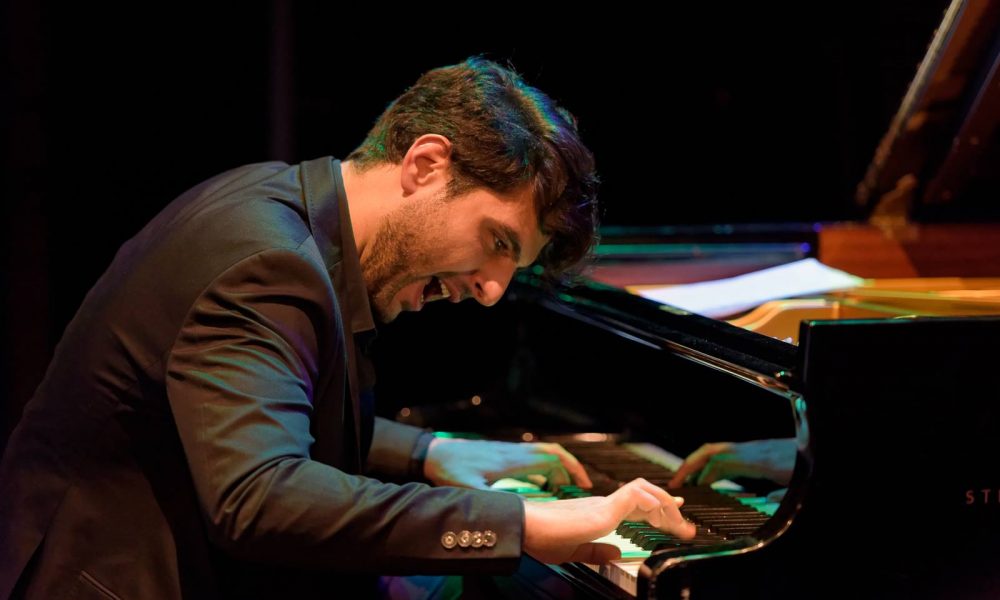
Today we’d like to introduce you to Marco Apicella.
Thanks for sharing your story with us Marco. So, let’s start at the beginning and we can move on from there.
I was born in Rome and raised in a very small town 1 hour north of Rome called Santa Marinella. I’m the last of three brothers but neither my parents nor my siblings were exposed to a lot of music or had a formal training. My father was always in love with movies and in particular with classic Italian cinema and spaghetti western movies so he used to listen to composers like Ennio Morricone and Nino Rota, as well as some classical music and opera occasionally. People say that he used to be a good singer when he was young but I don’t have many memories of him singing. He could and still can whistle very well.
A cousin of mine from my mother side used to study classical piano in Rome’s Conservatory “Santa Cecilia” and he used to play those amazing pieces from Chopin, Rachmaninov, Liszt and more. We would have lunch at my uncle’s house and after the meal he would sit at the piano and play for us. That was always my favorite moment of the day and I couldn’t wait till the next time we’d get invited over for lunch to hear him play. From the very first time I heard him play, I was incredibly fascinated by it and I knew I needed to learn as well so around my tenth year of age, I started bugging my mother to find a music school and take me there.
For the first year or two, I really only studied technique, solfege and theory. It was tough and not very fun but I never lost motivation. Things changed when I got in middle school and met my best friend of a lifetime, Simone Cesarini. His father was a drummer and taught him how to play a little but of guitar. He loved music as much as I did and soon, we started getting together to try and play some little songs. He showed me you could play without using music sheet, that you could play chords and kinda make it up on the spot. I was amazed.
So we kept on practicing and playing. We got better and the first little school performances arrived. Then the first band, together with his father and some family friends. Then the first gigs in town. I discovered electric keyboards, organs, synthesizers, rock and prog music. A whole new world of possibilities besides classical piano slowly unfolded before my eyes, and I liked it a lot. By the time we were 16 we had 3 or 4 different bands and played in towns around our area. But we knew we wanted to learn more and play with better musicians so we both enrolled in this modern music school in Rome called “Saint Louis College of Music”. I started with pop and rock keyboards and slowly transitioned to jazz piano in the next few years. In the meantime, I kept on studying classical piano and still took lessons with my old teacher.
By the time I finished high school I had to decide whether to go to the university for something like medicine or engineering (I liked medicine but knew it was a lot, and my father was pushing for engineering because then I could have worked in his company), but I knew that really what I wanted to do was to be a musician. So I decided to keep studying jazz piano at the “Saint Louis” school and at the same time, I auditioned for Rome’s conservatory to study classical piano. I eventually got it and started my bachelor. My new teacher was a very tough woman. She demanded nothing less that excellence from all of her students. I wasn’t ready for that and honestly, I wasn’t that committed to classical piano to lock myself in a practice room for 8 hours a day. So after a couple of years, I finally had a talk with her and decided to quit classical and dedicate myself to jazz.
I finished the program at the jazz school in 2011 but now there was a problem: I had the knowledge and the skills but no degree. So together with my friend Simone we started searching for good jazz schools. It turned out that Holland had amazing schools and teachers and their program was in English so we decided to give it a try. The first time we auditioned we both got rejected. Our level wasn’t there yet. I decided to take a year off and just practice and play. So I did. The next year we had a much better plan of attack and we auditioned for four different music schools in Holland. We got accepted in 3 out of the 4 schools this time and we could decide where to go. We ended up in Rotterdam where they have one of the most amazing arts schools in Europe. Here a new chapter of our adventure started.
I lived in Rotterdam for the next four years and had the most amazing time of my life. The school was great, I got to study with some of the most talented pianist of the nation. The music scene in the city was vibrant and diverse. There were concerts every night: jazz, hip-hop, RnB, classical, electronic music, you name it. There were jam sessions 3 or 4 times a week and the musicians were incredible. I was constantly pushed to get better and study more. After a year or two, we started getting called by some of those musicians and we entered the scene. I started playing jazz trio gigs, as well as funk and RnB concerts with different bands. In the summer, the North Sea Jazz Festival would happen right in the city and musicians from all over the world would come perform in Rotterdam for a few days. In the nights after the festival there was this huge after party jam session/concert with many musicians from the festival playing. It was an occasion for all of us to share the stage, even if for just a song or less, with the pros. It was an amazing moment of growth, even though it was scary as hell.
One of the most exciting projects I was involved with during my time in Rotterdam was definitely the “Dutch Music Community” or “DMC”. It was a collective with some of the best musicians in the country and the whole concept was instant composing. We would all have headphones and we could talk to each other. Every section had a talkback mic with which to communicate with the other sections, and we just made music on the spot. It was challenging and thrilling to just go on stage and have no idea of what was going to happen. With that band, we recorded our first album in a three days session. The name of the record is “DMC One” and all the music just happened during the recording session, no preparation or rehearsal whatsoever.
In The Netherlands, people started talking about us and we got to play good venues. One of them was actually the after party of the North Sea Jazz Festival. As the resident band we got to play with artists such as Marcus Miller, Ed Motta, Snarky Puppy, Jason Lindner and more. I cherish that time and I’m grateful for the opportunity. At the end of the four years bachelor program, I had to decide whether I wanted to get a master’s degree or just keep working as a musician in Holland or somewhere else in Europe. But in a way, I knew that if I really wanted to go deeper into jazz music, I had to go to the place where it actually started. So I decided to look into music schools in the US to try and get a Master’s degree. I was interested in Juilliard, New England Conservatory, Manhattan School of Music and The New School, among others.
Then one day, I stumbled upon the USC Thornton School of Music website. A quick look to the campus and the facility and I was already in love. Then I check the faculty and I see Russell Ferrante’s name. If you like jazz and fusion chances are that you listened to the band Yellowjackets at some point. Russell is the pianist and main composer in that band and they made the history of the genre in the ’70s and ’80s. He was and still is a personal hero of mine. His piano playing inspired me since I was a teenager and I dreamt about listening him playing live but never had a chance. Now I had a possibility to actually study with him. My mind was blown. I knew that was the school I wanted to go to and so I applied for it. I got called back for a live audition in LA and decided to go. There I met him and Alan Pasqua (the other part of the piano faculty at USC) and played for them. I guess something in my playing or the fact that I had come all the way from Europe to audition got their attention and they actually accepted me in the school.
So in August 2017, I moved to LA to start my Master of Music in Jazz Studies at USC Thornton School Of Music. There I found a very welcoming environment full of inspiring people. Having to confront myself with some of the best young musicians of the nation really opened my eyes and gave me the push, I needed to keep working hard for what I love. I was fortunate enough to learn directly from some of the masters of this music. I studied arranging with Bob Mintzer, Composition with Vince Mendoza, Piano with Russell Ferrante and Alan Pasqua, and got a chance to play with legendary drummer Peter Erskine and record some of my compositions with him in his home studio in Santa Monica.
Apart from having an amazing faculty and just being a great Jazz program, the biggest perk of USC is the fact that it’s in LA. The music scene here is not comparable to anything I’ve ever experienced. Literally, every night there’s one or more concert that would blow your mind. Musicians from all over the planet coming and going. It was great to confront myself with this reality and even if two years in this incredible city aren’t much, I’m pretty happy with what I accomplished so far by sharing the stage with some of the best-emerging musicians on the scene (I’m thinking of drummer Anthony Fung, saxophonist Alex Hahn, trombonist Ivan Malespin and Ido Meshulam) and playing some famous and historic venues in the city such as the Blue Whale, Vibrato, Vitello’s and The Lighthouse.
In the near future, I look forward to keep working as a sideman with renowned artists, but also to start working as a bandleader and being the artist myself. My goal for 2020 is to release my first record as a composer. It will be a mix of Jazz, world and cinematic music, infused with influences from classical music, and possibly a touch of Italian folk songs (for those who can find it in the mix). Besides playing and composing in LA, I keep working as a producer both in town and remotely with artists from Europe. Some of the most interesting projects I’m working on are a funk/jazz/electronic record from bassist Dario Giacovelli (Rome), and electronic dance music with Dutch/Caribbean DJ Tera Kòrá. I also plan on releasing my own mixtape of beats and electronic music possibly by the end of 2020 or beginning of 2021.
Overall, has it been relatively smooth? If not, what were some of the struggles along the way?
Sometimes the biggest challenge and artist has to face is himself. That’s at least true for me. I tend to overthink and to be extremely self-criticizing when really there is no need for it. There is so much great music out there that it’s easy to get discouraged and think you’re not good enough. But something I came to understand lately is the fact that music is not about who writes it. Music is something we put out there for other people to listen, enjoy and hopefully be inspired by. I can’t possibly know what feelings a piece of music I composed will raise in the listener because it will be different for each and every person that listens to the record. As artists, our main concern should only be trying to convey our feelings and emotions into our songs as purely and honestly as we can, and not worry about the outcome because that is not for us to decide.
Can you give our readers some background on your music?
I think what really sets me apart from many musicians of my generation in LA is my background. Coming from Italy, I carry a completely different cultural heritage, and I think this shows often in my music. Growing up studying almost exclusively classical music infused in my playing and my composing a certain structural balance and form awareness. On the other hand, growing up listening to Italian pop and folk music taught me a kind of lyricism that is simply different than that of musicians I confront myself with, and in music and art in general being different is often a good quality.
Moreover, my years in Holland exposed me to many different cultures, lifestyles and ways of making music. Collaborations with musicians from Iran, Turkey, Finland, Peru, Cuba and more, opened my ears and especially my mind. In addition to that, being in Holland and immersed in a very strong electronic music scene allowed me to keep an eye on the present and to keep experimenting with unconventional instruments and sound design. My music is a reflection of all the experiences I had (and will have) in life, and I’m proud to show this because I think it makes me a unique artist.
If you had to go back in time and start over, would you have done anything differently?
This will sound like a total cliche but I’ll say practice more. Practice every day. And I don’t necessarily mean the technique. Don’t get me wrong, that’s very important too, but practice the language, transcribe the masters, the way they play in a group, the way they solo, the way they accompany the other members of the band. If you’re a classical musician, don’t stop to the mere execution of a piece. Try to understand how and why the composer came up with that, what was he thinking and what did he study/practice to then being able to come up with something like that.
Also, listen, listen, listen. Find as much music as possible and as diverse as possible. Soak it up, make it yours. Music is a language and there is no better way to learn a language than to completely immerse yourself in it and being surrounded by it at all times. Finally, be more open-minded. There is no right or wrong in music, there is just you and what you feel in the moment. Don’t be afraid to try and especially don’t be afraid to be judged.
Contact Info:
- Phone: 2132469673
- Email: marco.apicellakeys@gmail.com
- Instagram: https://www.instagram.com/marcoapicellakeys/
- Facebook: https://www.facebook.com/marcoapicellakeys/


 Image Credit:
Roelof Mulder, Kaya Blaze Kelley
Suggest a story: VoyageLA is built on recommendations from the community; it’s how we uncover hidden gems, so if you or someone you know deserves recognition please let us know here.
Popular
-
Christina Wren Steps Into the Director’s Chair to Tell Stories That Feel Like Home
-

Portraits of the Valley
-
LA’s Most Inspiring Stories
-
JordanL on ‘Breathe,’ Belief, and Building a Movement Beyond the Music
-
Megan Birney Rudert on How Access to Light Is Powering a More Sustainable and Equitable Future
-
Linda Kneidinger on Building Lasting Change Through Small Steps and Self-Compassion