


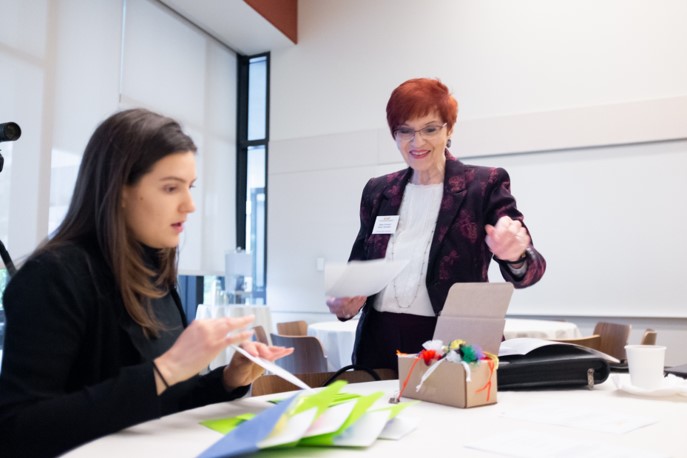
Today we’d like to introduce you to Maria Simpson.
Maria, can you briefly walk us through your story – how you started and how you got to where you are today.
I’m an executive coach and consultant on conflict resolution to organizations, but I’ve actually had two careers, one in New York as a senior manager in a variety of nonprofits and a second here in LA.
In NY, my first job was as the administrative assistant to a university Dean who put me in charge of the typewriter inventory and watering his African violets. But I also had a master’s degree from NYU in film history and criticism, so I was promoted quickly to managing the film library, then all of the college’s print and publications services, and then the TV studios and the learning lab.
To stay in higher education administration, I needed a Ph.D., so I got that at NYU in a wonderful, eclectic program called Media Ecology, the study of complex communications environments, and got a new job as Academic Director of the graduate program in Media Studies at the New School while teaching part-time at other universities.
When NY went bankrupt, my work in higher education ended, and I worked instead in other educational nonprofits as a conference designer for The Conference Board, the folks who give you the Consumer Confidence Index, and as Director of the International Conference Program for the NY Academy of Sciences.
The jobs themselves were interesting because I was always learning something new through the conference topics, but the most fascinating part of those jobs was the people I met. At TCB, I met C-Suite executives from the largest businesses in the country, and at the Academy, I worked with advisory committees that included Nobel laureates and internationally recognized scientists. I didn’t know it then, but this work prepared me for my current career as an organizational coach by giving me experience in how different organizations work and how executives think.
I loved living in NY, but eventually, I took a friend up on a very generous offer to move to LA — to become a baker. That didn’t work, so I got a job at another nonprofit as director of a program that introduced students to business issues by looking at the Bill of Rights and wrote business curriculum for high school students.
One day I saw a flyer for mediation training, and although I had no clear idea of what mediation was, I knew I had to take that training. For me, learning mediation skills was transformative, and being a mediator has driven everything I have done since.
Mediation training taught me that I had a Ph.D. in communications but few practical communications skills, especially in any kind of conflict. I froze when someone disagreed with me and was lost if an argument arose. I didn’t know how to ask for what I wanted or express an opinion. Becoming a mediator changed all that.
Mediators are highly trained, neutral facilitators who help others sort out their disagreements. I finally understood how not having these skills had hampered my own relationships and career, and I thought that if I could take just a few basic mediation skills into the workplace, work would be much improved, so I switched focus and began consulting on conflict resolution in organizations.
Now I work one-on-one with C-Suite executives and leadership teams to improve their communications and decision-making processes and to address difficult situations like division-wide disputes. The work and the people are fascinating. And I continued to teach in the management program at Antioch University and in the conflict resolution program at CSU Dominguez Hills. My graduate students in business got large doses of conflict management and communications training, no matter what the title of the course.
To be sure that I could pass on what I learned about organizational conflict and conflict resolution, I began a column in 2003 called “Two Minute Training” (www.mariasimpson.net), collected about 50 columns into a book called “Leading Unstoppable Teams!” (www.mariasimpson.com), and began to speak often for organizations and professional society conferences.
I also became a member of the Southern CA Mediation Association, joined the Board of Directors, and was asked to chair the board of its Education Foundation, which had been inactive for a few years, to rebuild it. After six years on the board, five as president, I cycled off the board knowing that the organization, now called Kids Managing Conflict, had a clear focus on training middle and high schools students in mediation so they had conflict resolution and negotiation skills they could take into all areas of their lives. I still serve on several boards, both corporate and nonprofit. During this time, I was also a volunteer mediator for the LA County Superior Court, an experience that was immensely rewarding as I helped people get through the debt collection phase of the economic downturn.
All of these experiences strengthened my commitment to teaching as many people as possible, the skills and approaches of mediation. I saw the value of these skills in my own life and wanted others to be able to use them, too.
Has it been a smooth road?
None of this was easy. Women weren’t welcomed in the workplace when I started working, especially in higher education or finance, but my education gave me resources and opened doors. I’m very persistent, so when I encountered an obstacle, especially at work, I found a way to get around it, which I admit sometimes got me into trouble with my managers. And even though having many different jobs could be seen as a liability, I always used that variety of experience to bring extra knowledge to each new position and turned that potential liability into an advantage.
The biggest challenge, though, was going from paid employment to being an independent contractor. I was now constantly looking for a new job, a task I really don’t like, in part because I’m an introvert. (My website www.mariasimpson.com includes an article on job-seeking skills for introverts.) But I decided too many people controlled my life without taking my goals into account, so even though this route is harder for me than it is for many others, it is much more satisfying. I get to meet a much larger group of people, work on a larger variety of projects, and learn something new with every project.
So let’s switch gears a bit and go into your story. Tell us more about your work.
What I do:
As an executive coach to large nonprofits or government agencies, I’m called in to work with senior executives or leadership groups where something is going wrong and needs an atypical approach to address it, like working with a city manager who didn’t understand why his sexist jokes were not well-received by the women on the city council or surveying 100+ people about the leaders in their agency and the changes that might have to be made.
I absolutely love this work because I help people in really substantive ways like saving their jobs, for the variety of people and challenges, for what I learn, and for how I have been able to improve working conditions and performance.
What sets me apart:
The services I provide are unique because I draw on several different fields to create a holistic approach to coaching. I read widely in communications and sociology for my doctorate and had to learn whole new areas of expertise for the graduate courses I created. Working in different kinds of organizations gave me a broad understanding of what makes different organizations succeed, and what people need to succeed in them.
I bring all these perspectives, and my own experiences in organizations, some of them difficult, to my work, giving me a depth of perception and understanding that others in this field might not have if they focus on just one area of expertise or coaching.
And I’m a mediator, trained to see many sides of a disagreement, so I understand problems at many different levels and want to sort out the issues, not just end the fight.
What I’m most proud of:
First, the effects of my work on my students and clients. It is wonderfully rewarding to watch my former graduate students take leadership positions in the field of conflict resolution and mediation and become as passionate as I am about carrying on this work. And watching clients reclaim their standing in their organizations based on the work we have done together is exciting. It is gratifying to know that I can develop a level of trust with others that enable people to talk to me openly so we can figure out what to do.
Second, I’m a programmer at heart, so I am especially proud of the lasting programs I created for several organizations as a volunteer, all focusing on teaching mediation to others. I created a program for middle, and high school students called the “Peer Mediation Invitational,” now in its 17th year, and another called the “Institutes,” for a professional society. And for the Education Foundation which I chaired, now called Kids Managing Conflict, I created a program called “The Symposium on Kids Managing Conflict,” an annual conference for coordinators of school Peer Mediation Programs, where students are the mediators, now going into its third year. Rebuilding KMC is among my most satisfying accomplishments because I see the effect of mediation training for middle and high school students and hear directly from them about how it has changed lives.
Third, I am very proud of having been given three awards for my work in mediation: two President’s Awards from the SCMA for my contributions to the organization and for my work in rebuilding the Foundation, and the Conversity Award for Leadership in Education from the Asian Pacific American Dispute Resolution Center. I am deeply grateful for this recognition.
Last, my life was changed when I learned about mediation, and I have used those skills over many years to repair personal relationships and bring people back together. I’m not sure proud is the right word – may be grateful or relieved is more accurate — that I finally had the skills to make this happen, but repairing these relationships, and knowing I can help others do the same thing in their lives, is one of the most important things I have done.
How do you think the industry will change over the next decade?
As companies increasingly see the value of coaching, they create coaching cultures and get away from disciplinary cultures to deal with problems. There is already a trend toward using mediation to resolve disputes between staff members, and then with clients as well. In addition, learning the really important communication skills will improve the quality of the work environment, and everyone wants to do that, so the focus will shift from a managerial perspective to a problem-solving perspective, especially for broad conflicts that involve large groups, all of which, means mediation skills, which apply everywhere, will be in demand.
As one of the high school mediators put it, “Mediation isn’t just a process, It’s a way of being,” and that way of being will be of value in the workplace.
Contact Info:
- Website: www.mariasimpson.com; www.mariasimpson.net for samples of my articles
- Phone: 310-826-7440
- Email: msimpson.coach@gmail.com or mariasimpsonphd@gmail.com


Getting in touch: VoyageLA is built on recommendations from the community; it’s how we uncover hidden gems, so if you know someone who deserves recognition, please let us know here.
Popular
-

Portraits of the Valley
-

LA’s Most Inspiring Stories
-

JordanL on ‘Breathe,’ Belief, and Building a Movement Beyond the Music
-

Megan Birney Rudert on How Access to Light Is Powering a More Sustainable and Equitable Future
-

Linda Kneidinger on Building Lasting Change Through Small Steps and Self-Compassion
-

Jolana Nika on Redefining Modern Connection Through Intentional, Real-Life Experiences