





Today we’d like to introduce you to Dominik Krzanowski.
Dominik, we appreciate you taking the time to share your story with us today. Where does your story begin?
I’ve spent most of my life working somewhere between entertainment, engineering and problem-solving.
I became interested in magic at 5 years old and became a junior member of the Magic Castle at 17. I eventually spent about twelve years working there as a stage manager, and over the years I moved further into the technical side of entertainment — designing and building illusions, lighting, stage technology and unusual things that often didn’t have an off-the-shelf solution.
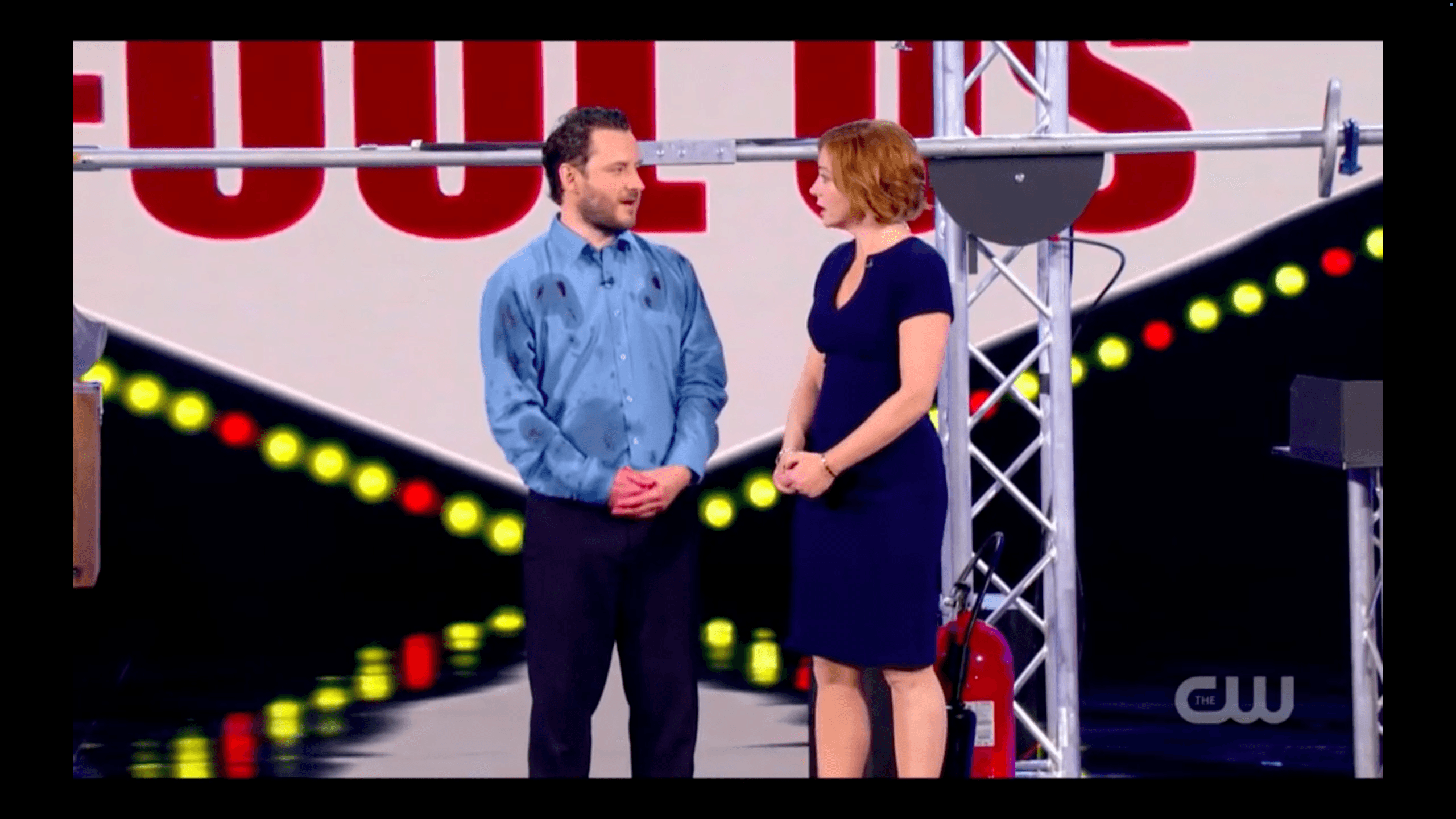
That led to work in television, live shows and production, including projects connected with The Carbonaro Effect, Dynamo, Masters of Illusion and Penn & Teller: Fool Us.
The strange thing about doing that kind of work for decades is that you accumulate an enormous digital history.
Photos. Videos. CAD drawings. Contracts. invoices. reference images. client files. old show footage. backups of computers that no longer exist. And then more backups of those backups.
Eventually I had hard drives everywhere.
The problem wasn’t that I had lost the files. I knew they were there. The problem was finding them.
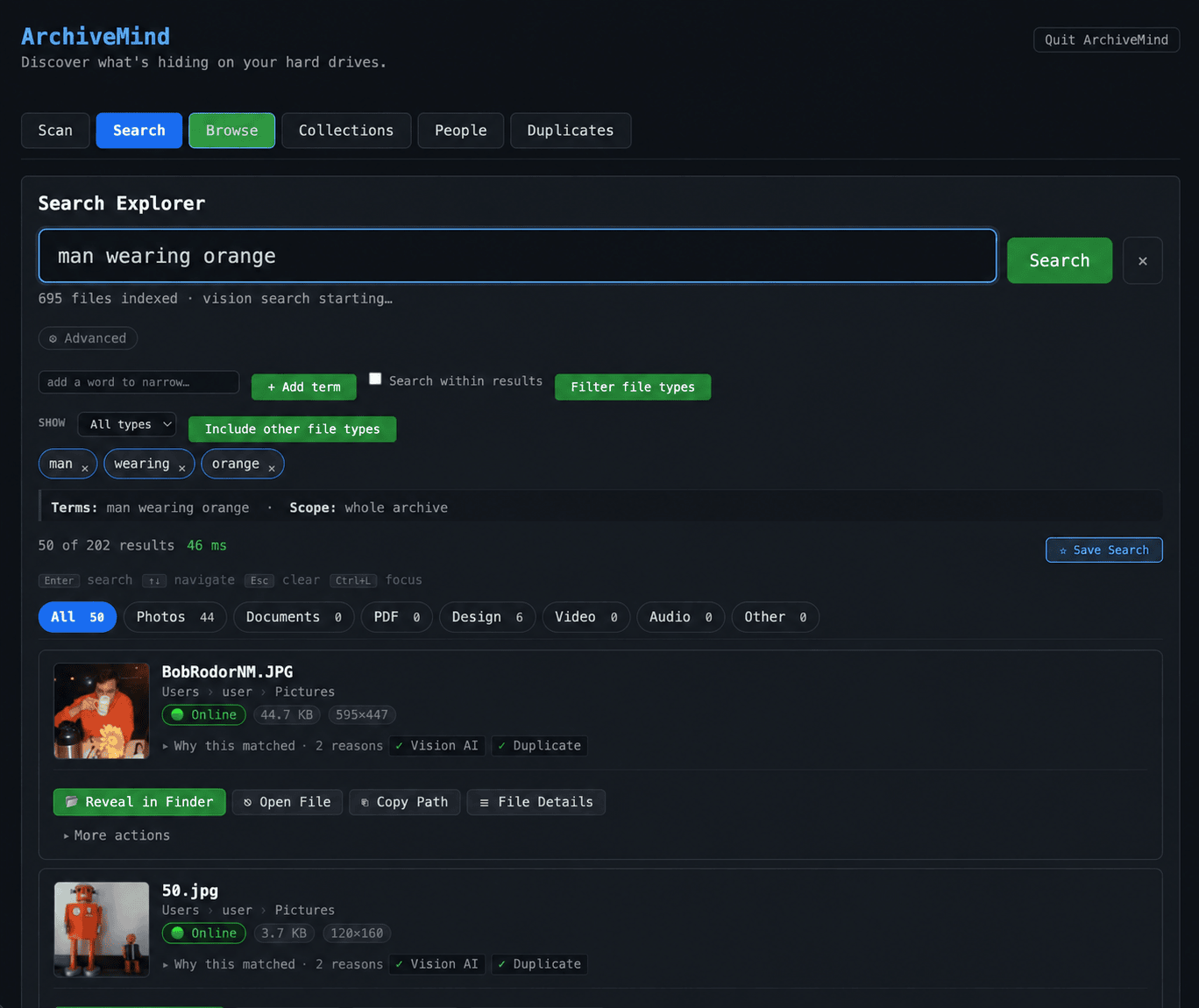
I could remember what a photograph looked like, or what a drawing showed, or a phrase inside an old document — but I couldn’t necessarily remember what I had called the file or which drive I had put it on ten years earlier.
I started looking for software that would let me catalog everything and search across all of it, including drives that weren’t currently plugged in. I couldn’t find anything that worked the way I wanted. A lot of modern software also assumes you’re willing to upload your information somewhere or keep paying a subscription forever.
Neither appealed to me.
So I started building what I needed.
That became ArchiveMind.
At one point I turned it loose on my own archive and it cataloged 587,016 files. That was when the project stopped feeling like an experiment and started feeling like something other people might need too.
ArchiveMind launched in September 2026 for Mac and Windows. It lets you catalog your drives, unplug them, put them back in a drawer, and still search what was on them later.
In a strange way, it feels very connected to the work I’ve always done. Magic and illusion design are really exercises in looking at a problem and thinking, “There has to be another way to do this.”
ArchiveMind came from exactly the same impulse.
We all face challenges, but looking back would you describe it as a relatively smooth road?
Definitely not.
One of the biggest lessons came almost immediately after launch.
I had tested ArchiveMind extensively while I was developing it, but I discovered there is a huge difference between testing software as the person who built it and experiencing it as someone who has just downloaded it onto a clean computer.
On launch weekend I found problems that hadn’t appeared in my development environment. Some components behaved differently when the application was launched normally from Finder rather than from a development environment.
I stopped purchases while I fixed it.
That wasn’t a fun decision on launch day, but it was an easy one. If I wasn’t confident someone would get the experience I had promised, I didn’t want them paying for it.
That changed the way I release software.
Now every release candidate is installed and tested like a customer would install it, on several very different machines — including Apple silicon, an older Intel Mac and a Windows pc — before I publish it.
That process has already caught obscure problems I would probably never have found otherwise, including one that appeared intermittently on the Intel Mac.
The other challenge is simply being a solo founder.
One minute I’m working on search quality or debugging a shutdown issue. The next I’m designing an installer, answering support questions, making a marketing video, dealing with licensing, writing documentation or figuring out taxes.
Coming from live entertainment probably prepared me for that better than I realized. Backstage, if something doesn’t work five minutes before the curtain goes up, there usually isn’t another department coming to rescue you.
You figure it out.
Appreciate you sharing that. What should we know about ArchiveMind?
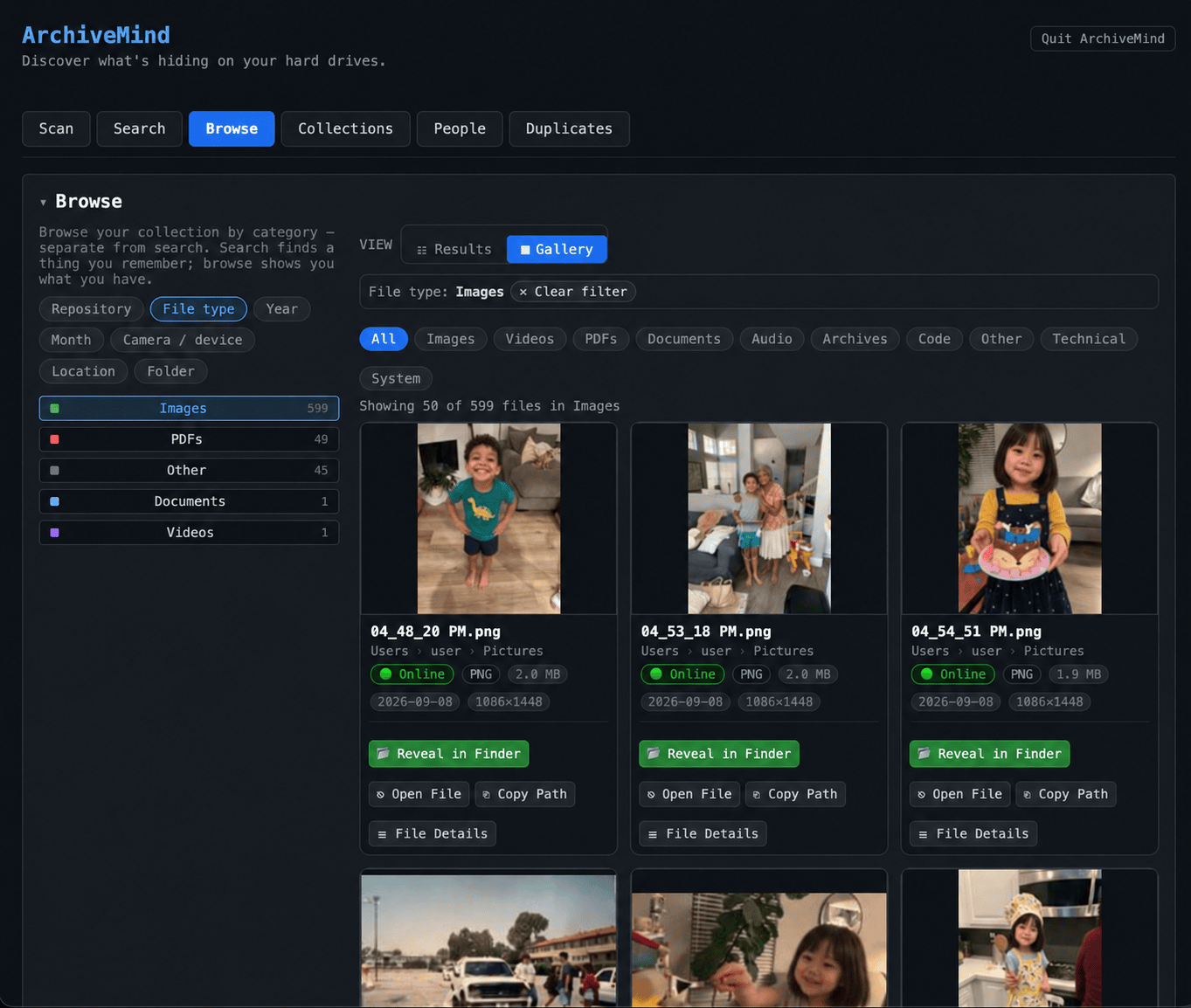
ArchiveMind is a local-first desktop application designed for people who have accumulated years — sometimes decades — of files across computers and hard drives.
The idea is simple:
You shouldn’t have to remember where something is in order to find it.
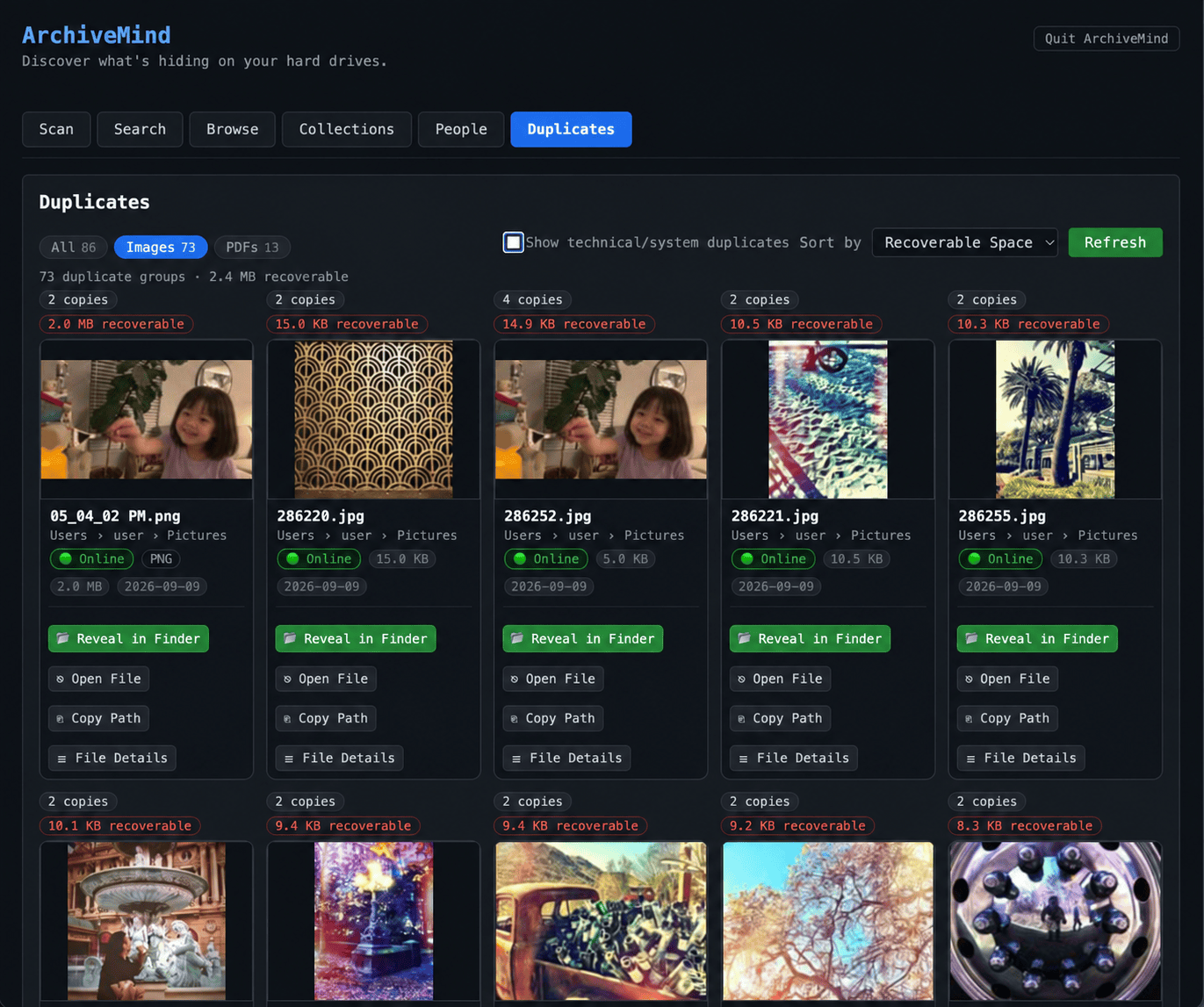
Once ArchiveMind catalogs a drive, you can disconnect that drive and still search its contents later. You can search filenames, documents, metadata and even visual content. ArchiveMind can then tell you which drive contains the thing you’re looking for.
That offline-drive feature is probably the part I’m most excited about because it solves the exact problem that started all of this.
The other major difference is privacy.
ArchiveMind is designed to work locally. Your archive doesn’t need to be uploaded somewhere just so you can search it. The catalog, visual analysis and search information stay on your computer.
I also made a very deliberate decision not to turn it into another subscription.
The first 10,000 files are free, with the features available to try properly. After that, ArchiveMind is a one-time $49 license.
I wanted the business model to be as simple as the product:
Buy the software. Keep the software. Keep your files.
And ArchiveMind never reorganizes or changes the original files. It catalogs what is already there rather than deciding it knows better than you where everything should go.
I’m probably most proud that ArchiveMind came from a real problem in my own life rather than an exercise in trying to invent a market.
I needed it.
Then I discovered that an awful lot of other people have a drawer full of hard drives too.
Do you have any advice for those just starting out?
Solve a problem you genuinely understand.
If you are building something because you need it yourself, you have at least one extremely demanding customer from day one.
Also decide early what you will not do.
With ArchiveMind I made two decisions very early:
I didn’t want people to have to upload their archive to use it.
And I didn’t want another subscription.
Those constraints actually made later decisions easier because I knew what kind of product I was trying to build.
Constraints can be surprisingly useful.
And refine, refine, refine. As an artist I’m never really done.
Pricing:
- $49
Contact Info:
- Website: https://archivemind.app
- Instagram: archivemindapp
- LinkedIn: https://www.linkedin.com/in/dominik-krzanowski-425117207

Popular
-

Portraits of the Valley
-

LA’s Most Inspiring Stories
-

Greg Hex Is Turning the Everyday Kitchen Knife Into a Modern Design Object
-

Rick Norris Learned That Building a Successful Business Means Building a Life You Actually Want to Live
-

How Olivia Rush Turned Survival Into a Mission to Help Others Keep Going
-

How Bibi Goldstein Is Helping Entrepreneurs Reclaim Their Time by Embracing the Power of Delegation


