




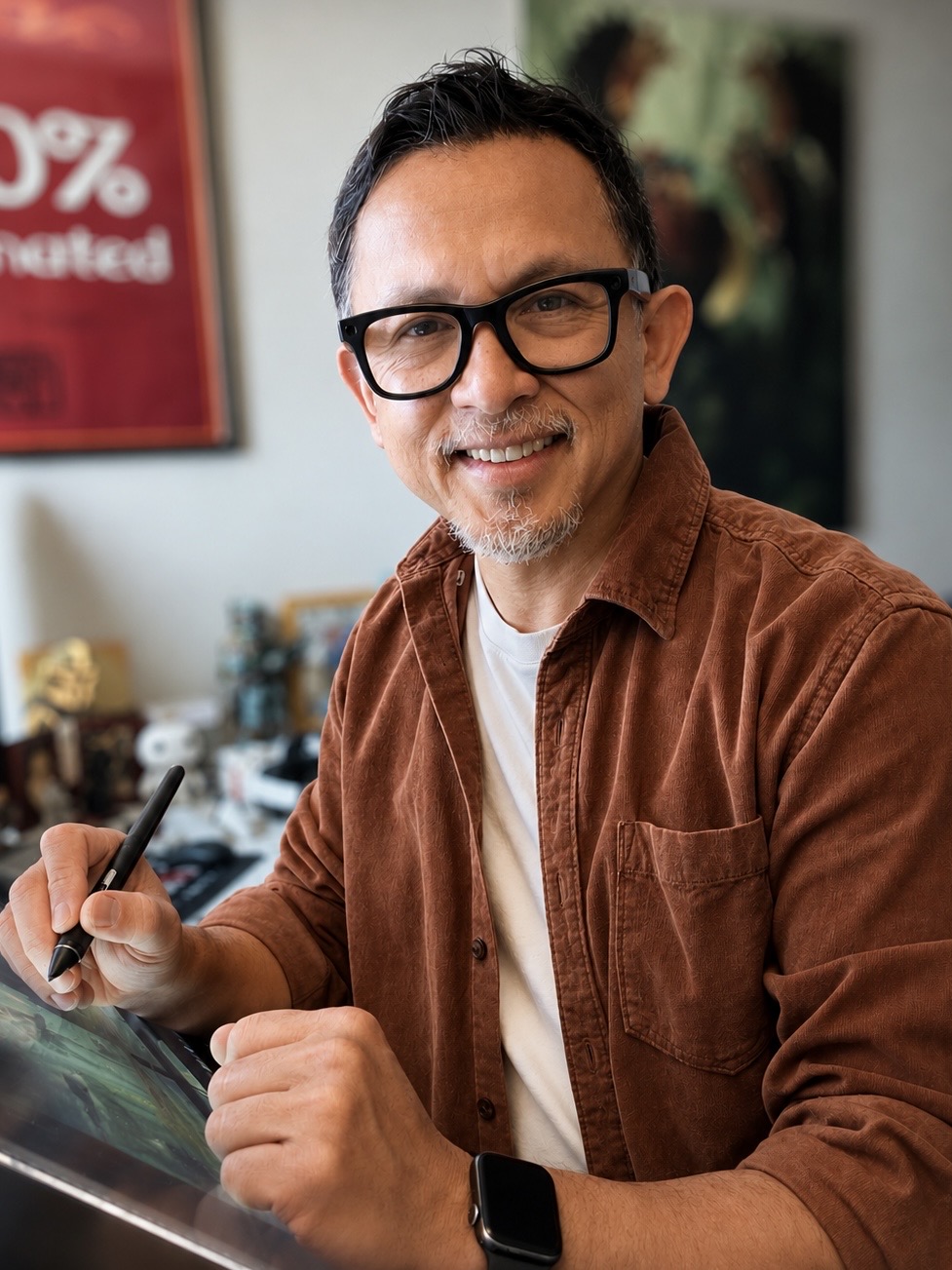
Today we’d like to introduce you to Armand Serrano.
Hi Armand, we’d love for you to start by introducing yourself.
My path into animation was not a straight one. I was born and raised in Manila, Philippines, and although I loved drawing from an early age, I never imagined it would become my profession. I studied Civil Engineering at the University of Santo Tomas and briefly worked in construction and design after graduating.
In 1990, I was given an opportunity to join Fil Cartoons, a Hanna Barbera studio in Manila. I began as an assistant animator, but within a year I realized that my real passion was not character animation. I was drawn to designing the environments, staging, and visual worlds surrounding the characters. That discovery led me into layout and became the foundation of my career.
I later joined Philippine Animation Studio, where I supervised layout for Marvel television productions such as X Men and Fantastic Four. In 1996, my family and I moved to the United States. After taking a layout visualization and background design course in Los Angeles, I was hired by Walt Disney Animation Studios in Florida to work on Mulan. I went on to contribute to Tarzan, Lilo & Stitch, and Brother Bear.
When Disney closed its Florida studio, our family returned to California, and I joined the newly formed Sony Pictures Animation. Over the next nine years, I worked on projects including Surf’s Up, Cloudy with a Chance of Meatballs, Arthur Christmas, and Hotel Transylvania. I later returned to Disney and contributed to films such as Big Hero 6, Zootopia, Raya and the Last Dragon, and Encanto. My journey has since included work with Marvel Studios, The Bible Project, Blizzard Entertainment, Sunrise Animation, and other studios.
Today, I serve as a production designer at Skydance Animation, while continuing to teach, mentor artists, and lead workshops internationally. I also co own Redeemer Studios with my son Luke, where we help create meaningful stories and design grounded in strong values.
Looking back, I see my career as a series of unexpected doors that God graciously opened. Civil engineering taught me structure and problem solving, animation taught me storytelling, and every transition taught me to remain humble, adaptable, and willing to keep learning. More than three decades later, I still approach each project with the same curiosity and excitement I had when I first entered the studio in Manila.
Can you talk to us a bit about the challenges and lessons you’ve learned along the way. Looking back would you say it’s been easy or smooth in retrospect?
It has certainly not been a smooth road. Moving my family from the Philippines to the United States meant starting over in a highly competitive industry while adjusting to a new culture. Later, the closing of Disney’s Florida studio forced another major transition and reminded me how quickly circumstances can change in animation.
There were seasons of uncertainty, and the constant challenge of growing creatively while keeping pace with emerging technology. What carried me through was my faith in God, the support of my family, and a willingness to remain teachable.
As you know, we’re big fans of you and your work. For our readers who might not be as familiar what can you tell them about what you do?
I am a production designer, art director, and visual development artist specializing in environment design for animated films and games. I am currently a Production Designer at Skydance Animation, where I lead the art department in building believable worlds that support the story, characters, mood, and cinematic experience.
What sets me apart is a strong foundation in traditional layout, composition, and visual storytelling, combined with my background in engineering and my commitment to keeping pace with emerging technology. I incorporate tools such as VR, 3D, and real time rendering into my creative process, but the story always comes first.
I am proud to have contributed to films such as Mulan, Lilo & Stitch, Zootopia, Big Hero 6, What If…? and David. Beyond the projects themselves, I am especially proud of mentoring younger artists and building Redeemer Studios with my son Luke, where we create meaningful stories and designs with lasting value.
Any advice for finding a mentor or networking in general?
The best mentorships and professional relationships begin with genuine connection, humility, and consistency. Look for someone whose character and work you respect, then approach them with a specific question rather than simply asking, “Will you mentor me?” Show that you value their time by applying their advice and sharing how it helped you grow.
Networking has worked best for me when I focus on building friendships rather than collecting contacts. Attend workshops, industry events, and creative communities, but also look for ways to encourage and support others. Be curious, dependable, and generous. People may first notice your work, but lasting opportunities usually come because they trust your character and enjoy working with you.
Contact Info:
- Website: https://www.armandserrano.com/
- Instagram: https://www.instagram.com/armand_serrano
- Facebook: https://www.facebook.com/armand_serrano
- LinkedIn: https://www.linkedin.com/in/armandserrano
- Other: https://www.redeemerstudios.com/
Popular
-

Portraits of the Valley
-

LA’s Most Inspiring Stories
-

Greg Hex Is Turning the Everyday Kitchen Knife Into a Modern Design Object
-

Rick Norris Learned That Building a Successful Business Means Building a Life You Actually Want to Live
-
How Olivia Rush Turned Survival Into a Mission to Help Others Keep Going
-

How Bibi Goldstein Is Helping Entrepreneurs Reclaim Their Time by Embracing the Power of Delegation


