




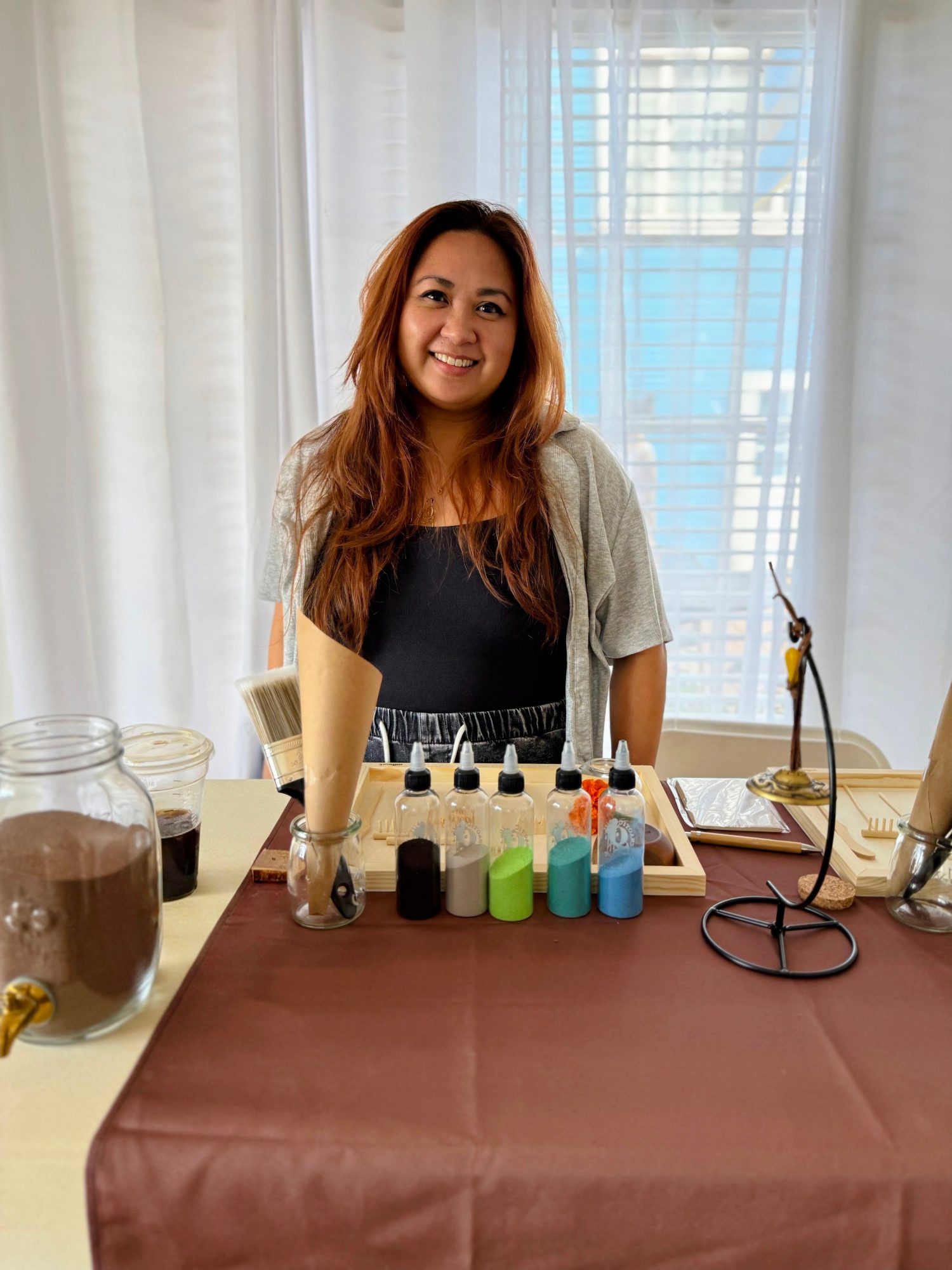
Today we’d like to introduce you to Fatima De Leon Koolmees.
Hi Fatima, so excited to have you on the platform. So before we get into questions about your work-life, maybe you can bring our readers up to speed on your story and how you got to where you are today?
In 2025, my life looked great on paper. In reality, I was putting in somewhere around 140 hours of work a week across my day job, school, and side projects (yes, I did the math). I was about to turn 39, with a question I couldn’t shake: was the life I’d built actually mine, or what everyone else wanted me to be? I’d also leaned on AI so much that year just to get through all my work that I knew I needed to protect the parts of my life that were meant to be made by hand. So I went looking for ways to quiet my mind. I started reading Meditations, learning about monastic traditions and philosophies, and making original art and writing again.
Around the same time, I got really into hiking, and it taught me how to be present in my body and in my mind. There’s a trail called Torrey Pines Beach Trail that ends at steps leading down to the beach at low tide. I used to sit there an extra hour or so, drawing in the sand, listening to music, and letting thoughts come and go. As the tide came in, it would reach my drawing and start to erase it. In those moments, it felt like a metaphor for the lesson I keep returning to in life. I’m just this dot of sand. What we create, our choices, our relationships, our feelings, literally yesterday, all come and go and change shape. Holding on and trying to preserve them isn’t possible. Being grateful for the moments worth preserving, and then watching them transform, is the headspace I try to live in.
I can’t get to a beach or climb a mountain every day with the day job I have (believe me, I’ve considered it), so I started exploring ephemeral art as a way to reach that same place at home. The more I did it, the more I realized that if I need this, surely someone else does too. Someone who just needs a little time every day to be brought back to center.
That became The Grounding Co. After finishing my certification in Therapeutic Arts, I started hosting therapeutic sand art workshops across Los Angeles and Orange County, and I asked one of my favorite humans, Maritza Rivera, LMFT, to co-facilitate with me. It isn’t an art class, but it IS art. (You just don’t get to keep it. That’s kind of the point.) Every workshop is different, depending on who’s in the room and whether the group leans introspective or playful.
But the heart of it was always the private practice I started at home: headphones on, totally vibing, feeling whatever I’m feeling, sad, angry, or peaceful, and letting it move through me into the sand so I can let it go. I wanted people to be able to do that on their own. That’s why I made stillwork., a tactile at-home sand art kit from The Grounding Co. that’s launching in November 2026.
Can you talk to us a bit about the challenges and lessons you’ve learned along the way. Looking back would you say it’s been easy or smooth in retrospect?
Not exactly. The first challenge was figuring out how to even explain it. My whole career has lived in boardrooms and leadership presentations, where everything runs on logic, numbers, and strategy. That’s logos, and I’m fluent in it. Explaining a tactile, hands-on practice like a therapeutic sand art workshop takes pathos, and that was a part of myself I’d kept compartmentalized for a long time. How do you tell someone it isn’t an art class, but they’ll make art? That it’s an exercise in openness and receptivity, in emptiness and acceptance?
The bigger struggle has been resisting the pressure to turn it into something it isn’t. People could easily compare it to something clinical like sand play, and more than one marketing consultant has told me it won’t work unless I use clinical language and have licensed professionals back it, or it’ll come off too woo-woo. I get it. People want evidence-backed things, and they want one clear line. I’m grateful to have a licensed therapist alongside me in the workshops, but I don’t want the practice itself to depend on clinical language to be worth trying. I’m still a student of this practice, and at its core, it’s about presence and play.
So I kept it simple, which is somehow harder. In the workshops and in stillwork., there’s a flow but very few instructions. There’s just enough structure that people who make decisions all day have somewhere to start, and nothing that forces you to use the tools in some hyper-organized way. You can go as deep as you want, or you can just stay in the colors and the moment. What you get out of it is entirely yours, not something I’m trying to manufacture for you. Anything that might alienate someone who’s simply curious isn’t something I want in it.
How do you sell just being present? Honestly, if that’s hard to understand, it’s probably the clearest sign of why we need it. The idea of adults playing just to be present feels so foreign that we think we need clinical logic to justify it. But think about kids’ toys. Do we have to justify Play-Doh?
Great, so let’s talk business. Can you tell our readers more about what you do and what you think sets you apart from others?
The Grounding Co. creates therapeutic, tactile, meditative art experiences and the tools to practice them at home. We host therapeutic sand art workshops across Los Angeles and Orange County, and our flagship product, the stillwork. Therapeutic Sand Art Kit, brings that same practice of openness, receptivity, and play into your daily life, from the comfort and safety of your own home.
The kit comes with guidance on breathwork and tactile meditation, a sand tray, sand, and all the tools you need to start your own sand art practice, plus two small bowls, one for dirt and one for water, so you can literally ground yourself before you begin. It also includes an hour of original music at 432 Hz to accompany your practice, with a version for regular speakers and a binaural version for when you’re wearing headphones (which, if you ask me, is the best way to do it).
What I’m most proud of is how differently the practice lands for each person. Anyone can do it, but no two people experience it the same way, and I love that for me and for everyone who tries it. During workshops, I like to walk around while everyone is working in the sand and ask how they’re feeling. At one workshop, a guest was half-heartedly pushing the sand around and told me it was an interesting experience. I asked if she was being honest, and whether maybe she didn’t know what she was supposed to be doing or what it was for. Her face changed. I told her I get it. When you’ve spent so long being the organized one, the prepared one, the one anticipating everything, it’s hard to do something just to play or explore, with nothing asking anything of you. She started crying, and I asked if I could hug her. That’s the whole point, as simple and as hard as it is for all of us to accept, me included.
What sets us apart is that we don’t tell you what you should get out of it. There’s a flow to follow, but no right way to do it. What you find is entirely yours.
You can find The Grounding Co. and stillwork. at thegroundingco.com and on Instagram at @thegroundingco.us.
Is there a quality that you most attribute to your success?
I think people are gradients, not binary, and I’m definitely one of them. My mind craves being logical and analytical, but it wants to get there in a creative, lateral way. On any given day, I’m curating the practice itself and thinking through how the immersion has the best chance of landing for someone, and then I’m switching over to R&D, building my own website, and stumbling my way through how to reach the right audience. (Stumbling being the operative word.) Most people assume you have to pick a lane, the business person or the artist. I’ve never been able to.
The other half of it is grit. I don’t get deterred easily, and I know the value of hard work. Doing everything yourself means making a lot of mistakes, and I treat every one of them as a learning experience, not a failure. The art needs the strategy to reach anyone, the strategy needs the art to have something worth sharing, and it takes a little grit to keep holding both.
Contact Info:
- Website: https://www.thegroundingco.com/
- Instagram: https://www.instagram.com/thegroundingco.us/
- Facebook: https://www.facebook.com/profile.php?id=61592602271173
- LinkedIn: https://www.linkedin.com/in/fatimadeleonkoolmees
- Other: https://www.linkedin.com/company/thegroundingco
Image Credits
Monica Lara, Jolene Ung
Popular
-

Portraits of the Valley
-

LA’s Most Inspiring Stories
-

Greg Hex Is Turning the Everyday Kitchen Knife Into a Modern Design Object
-

Rick Norris Learned That Building a Successful Business Means Building a Life You Actually Want to Live
-
How Olivia Rush Turned Survival Into a Mission to Help Others Keep Going
-

How Bibi Goldstein Is Helping Entrepreneurs Reclaim Their Time by Embracing the Power of Delegation


